Showing posts with label history. Show all posts

Wednesday, June 5, 2019

Galactic Anglo Saxons?

Seahorse -- from the "Stafforshire Hoard"
I decided I am a little tired of the underestimation of the abilities of humankind. (Gosh-darnit.)

I'm not sure when the trend of considering the involvement of aliens in ancient Earth started, but it sure was in full swing when I was a kid, in the seventies and eighties. There were tons of documentaries on TV and in the theaters about aliens helping with, say, the pyramids, whether they were the ones in Egypt of Peru. Each of these shows asked the question: how could humans have done this with their limited technology?

It's a cool idea, and all, that aliens might have visited and hooked us up with knowledge and technology and then left. (Makes for fun movies, like Stargate.) But it really is an insult to our own DNA to always think that our past generations were oafish, dirt-digging grunts with square fingers and closets full of mystical baubles.

I get it: we know a lot of stuff. We have come a long way. But it is not because we are smarter than our forbears; it's because we have stood on the shoulders of our forebears. We added what we can do and what we know to what they could do and what they knew. In some cases, we have forgotten the things that they knew, by the way. Let's not forget that. I think Les Stroud, in his short-lived show, Beyond Survival, proves well that cultures with inferior technology to ours are able to survive in situations that would kill an MIT physicist, a computer programmer or a virtuoso violinist within days.

I started thinking about his a few days ago while listening to The British History Podcast  in my car.  Some of the details about the lives of the Anglo Saxons that I learned really drove this home. For instance, it turns out that Anglo Saxon healers actually had the skill to fix harelip. Yes, you heard me right: Anglo Saxons (you know, those guys who drank mead and chopped each other up with swords so that they could get gold rings from a warlord...) actually did plastic surgery. (Or, you know, it could have been the aliens...)

The Sutton Hoo helmet. 
But it was also from this podcast that I learned (ten years late, by the way) about the Staffordshire Hoard -- an archaeological find of Anglo Saxon treasure that rivals the Sutton Hoo find. The most famous piece in this hoard (their version of the Sutton Hoo helmet) is the "Seahorse."

"The Seahorse" is an incredible example of gold-working and filigree. It's an impressive piece to look at (see the picture at the beginning of this post) on the surface. Beautiful work; wonderfully stylized; impressive detail. Sure, that's all really nifty. But it becomes nigh on impossible when you learn that the piece is only one-and-half inches long by three quarters of an inch wide. On grain of rice is longer than three of those little filigree loops.

Someone did this -- spun gold threads thinner than human hair and scrolled them into minute little loops -- without the use of modern tools; without artificial light sources; without magnifying glasses; without a microscope. he (or she, but, probably "he" back then) did it in a "barbaric" and non-scientific age. None of our insufferably up-to-date, modernly-equipped scholars really know how.

Was it the aliens?

No, it was little-old us. Just us fur-clad, sword-swinging barbarians. How'd we do it? By being inexhaustibly and overwhelmingly cool. That's how.

Just like with the daily news and in every online feed, all of the attention goes to the wars and atrocities and mistakes of the past. But in the real world of the past, there were farmers figuring out unrecorded ways to keep foxes away form the chickens; there were healers picking just the right roots to quell menstrual cramps; there were bards who could remember more poetry than the modern person can even stay awake through.

And there was a craftsman, bent over a bench in the all-too-rare British sunlight, who was so smart (smarter than us, so far) and so deft, that he makes us think about galactic travelers in spaceships.

Friday, April 3, 2015

The LAUREL SPRINGS NATIONAL BANK: My Hero

When I am gone, I want to be like an old bank building.

In my area, there are a few old bank buildings, and, true the financial scenario, they have had many different names: TD Bank, Citizen's Bank, Wachovia, Susquehanna, Bill's Bank, Fred's Bank, The First Bank of Louise...you name it.
...etched in stone. 

Each of these banks has had a parade of plastic, internally-lighted signs. Each of them has been emblazoned on the face with a hundred logos and slogans. It seems as if their names change every week as the phony, surreal financial tides of the world and of the country shift.

But a mile or two away from me, there is a bank in a "downtown" area that hearkens back to earlier days. There is a pizza place that looks like it might have been a general store; a building that was obviously once a saloon or hotel is now a hairdresser's. A railroad track that runs through the heart of the downtown area passes a small train station building (which no longer operates, since the trains that come through now are only freight) that Walt Whitman once used to get from Camden, NJ to his summer digs, a short walk away from the station.

Monday, December 16, 2013

A Message to Future Historians

One thing that makes it fun to be a historian or an archaeologist is the lack of information left behind from past generations. Right? It's the searching that is the fun part; the following of trails of clues...

An archaeologist uncovers an object with a pointy end and another end that appears to have been wrapped in long-decayed-away leather, apparently for grip comfort, and he concludes: "Ah! A Weapon. A jabbing weapon, too..."


A historian finds some pictures from the dawn of photography, all taken in New York City, and he draws conclusions about the manners of the day: men tended to walk on one particular side of the street; women held their parasols in the left hand; hansom cab drivers didn't just touch their hat brims, they lifted their bowlers completely off of their heads when greeting a lady... Or, he reads newspaper articles from the highly opinionated writers of the late nineteenth century about, say, the World's Fair in Chicago and compares the author's opinions to the letters of the fair's primary organizer, Burnham, in order to get closer to the truth...

Monday, July 29, 2013

Tricorns, Flaming Tractor Trailers and Voyages in Muddy Puddles

We just returned from trip to Colonial Williamsburg, in Virginia. For those of you outside of the US, the place consists of a "triangle" of historically significant sites, including Williamsburg itself, which was an instrumental city during the American Revolution; Yorktown, which is the location of the battlefield on which Cornwallis surrendered to Washington (or, rather, sent an underling to surrender to Washington, in order to make a point of honor) and Jamestown, the location of the first permanent British settlement and stomping grounds of John Smith and Pocahontas. (She never married him, by the way; she married John Rolfe.)

An evening at the Raleigh Tavern
Anyway, as I was there -- and not writing -- my mind was full of I-should-blog-about-thats. And now you shall pay the price.

It took us five hours to get there, headed south on many southerly roads, but, having left at three am to avoid the ridiculous (nay, offensively busy traffic) in the Washington, DC area, we arrived in Williamsburg by nine am. We were tired, but excited to be there.

Since we could not check-in to our hotel until four in the afternoon, we had a good deal of time to walk around Williamsburg, among the costumed re-creators and the visitors. The foot traffic was light and the town really is a lovely time machine (except that, since the last time I visited, some fifteen years ago, they black-topped the main road, Duke of Gloucester Street. It was a shame to see and it was a shame not to hear gravel anymore under people's feet. And it is ugly and jarring, as you can see in the picture.

Friday, September 21, 2012

Scattered Backward

The very lighthouse...
During a recent morning drive, I glanced over and caught just a quick glimpse of a set steps -- only two of them -- set into the edge of a green lawn, facing the road. They were concrete and they were older; deeply gray and weathered. There was a trace of a stone path leading up onto the lawn, but it was mostly covered over with grass. There had been a house there, once, long ago -- full of living people trying to make the best of their lives, but now it was just a well-kept lawn.

That kind of thing give me a physical feeling of loss, like a little hole in my chest.

Years ago, while in Dover, England, I remember placing my hand up against the outer wall of a Roman lighthouse, the Pharos. I imagined the hands of the builders and I saw images of legionnaires leaning again the outside, making crude jokes or dreaming of heading home over the channel's waters. 

That same feeling -- "loss" is the best I can do.

Wednesday, November 30, 2011

The Mead Mystery

Speaking of history . . .

Back when the Internet was something really new to us, my wife, Karen, and I discovered eBay. This meant, also, that we discovered the giddy joy of bidding on items we absolutely did not need. We won a few things, too, among them a leather-wrapped telescope (which, later, met its demise as a pirate prop for two little boys); a signed copy of Peter S. Beagle's The Folk of the Air; a first edition of Ray Bradbury's only mystery novel (which, though I love Bradbury's work, I couldn't finish reading); a few baubles to decorate the tops of shelves; a reproduction of a Roman sword (which looked swell in the picture but, in person, is just silly); a real, live copy of Harper's Weekly from the post Civil War era and (drum roll, please) my favorite find, ever: a 1764 copy of The London Magazine.

The oldest thing I own:
The London Magazine from May of 1764

But the story of this aquisition is a complex one, after all. I was prompted to bid on it not only because I love historical objects, but because the table of contents boasts a recipe for mead. And, as a lover of the idea of shaking hands with the past, I could think of no better way of doing so than by drinking a drink cherished by my predecessors.

Monday, June 20, 2011

If Fate's Cannon Misfires . . .

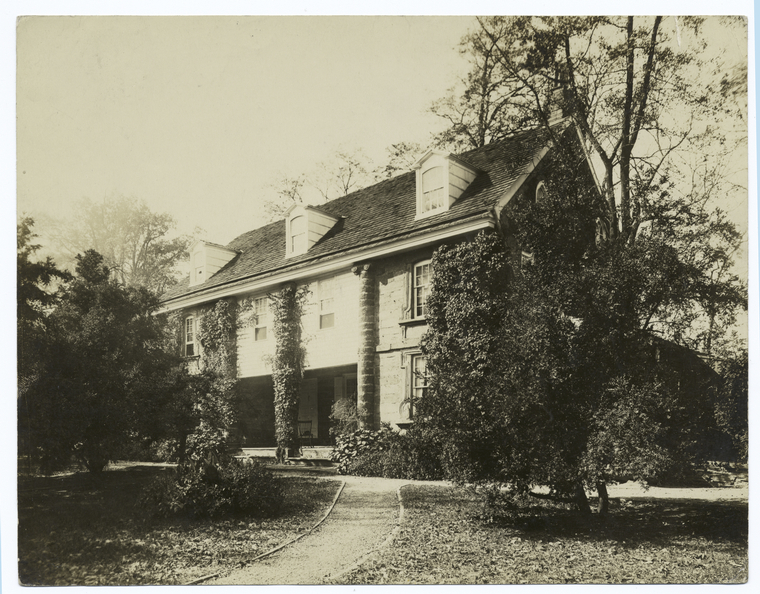
Bartram's house.
This weekend, I attended a loved one's wedding at a historical site in Philadelphia: Bartram's Gardens. John Bartram, sometimes called "The Father of American Botany," was a man who built his home, botanical garden and research site (all by himself), around 1770, a short walk above the banks of the Schuylkill River. The place is a small cluster of stone buildings nestled in among trees and the austere natural surroundings that are so characteristic of the northeastern part of the United States; surroundings that always feel so much like a warm blanket to me.

Friday, November 19, 2010

Power-Washing the Lord

Click pic for source
One morning, I drove my usual route down an ugly business-lined road, dodging fools like I was in a video game -- fools popping out of driveways. Fools cutting across lanes. Fools standing on the double-line in the middle of a fifty mile-per-hour road. Then, as always, I made a slight right onto a rural road and slowed down to take in the rising morning sun over the trees and fields on both sides of the car.

On my way in to town, I passed a church. A sparkling cloud hung there as if someone inside a glycerine-water-filled snow globe had hit a drum covered with gold dust. I slowed down, watching, expecting the cloud to fall, but it remained, changing shape and drifting into nothing at the edges, rolling like cream does when it is poured into coffee.

Then, I saw the source of the golden, miraculous cloud.

Monday, October 25, 2010

Climbing through the Window

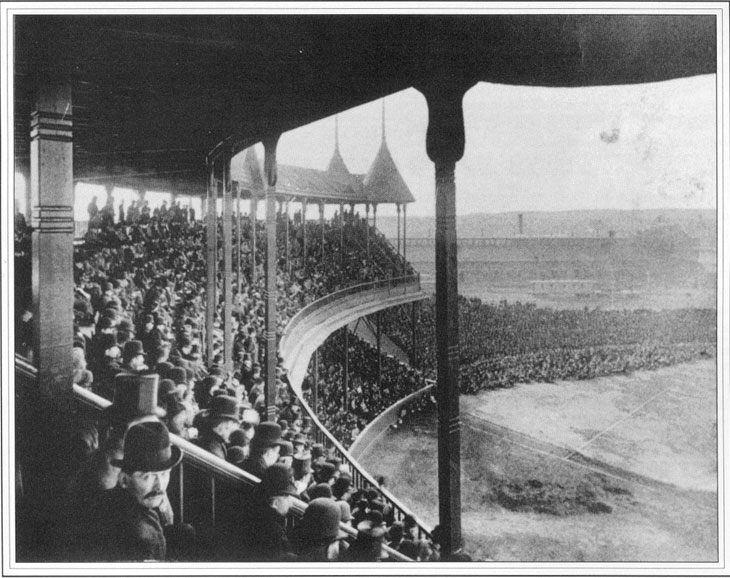
History can be dates and numbers. It can be stories of adventure or explanation of the most banal actions and it can be a record of business deals and governmental edicts. But real history is a 5, 500 year-old shoe found in an Armenian cave. Real history is a man in the black and white foreground, wearing a narrow-brimmed cap, glancing sideways at a photographer (at you) as a picture is clicked of a gigantic crowd at an 1894 Boston Beaneaters baseball game (source). Real history is the worn velvet of a couch in Dove Cottage where Coleridge used to sit talking to Wordsworth on cold Grasmere nights. It is the connecting of "now" to "then" in a way that chills us to the core and makes us realize that people in 1732 used to get toe-itches with their shoes on; that women in 550 AD and in 1943 sometimes had "bad hair days." History is the floor of the old Globe Theater that was made out of packed dirt and hazelnut shells carelessly dropped and trampled underfoot to the hardness of cement by the snacking groundlings, over time. Real history is a boy lying on his bed, lightly tossing a ball up and down on a lonely summer day in 1910. And it is the American quarter I once tossed into the Thames river, off of the tower bridge, just to leave an imprint of my presence in London.

Real history is the unedited film below, taken from the front of a streetcar in San Francisco, probably a week before the great earthquake of 1906 and the devastating fire it caused. Here, you can see images of long-dead people: boys riding the bumpers of cars; a man stealing a ride on the back of a cart being looked back at by the annoyed driver; people hamming it up for the new-fangled motion picture camera; women in bustles and floral hats dodging the streetcars; men who walk with the same gait as guys in jeans and T-shirts today, only in dark suits with hats; drivers of automobiles cutting in and out between horse-drawn carriages; children on the way home from school, books in tow; professional men crossing Market Street discussing upcoming meetings.

This video is history in its most staggering sense. Here you'll see people with heartbeats who are gone, but who were alive at the moment the camera crossed their paths and etched them into history's living rock forever, whether they died in flames and collapse in the 'quake or in their sleep, decades later. People like us, looking through the window of time directly at us.

(Stick with this -- there is a lot of rolling and flutter in the beginning, but it stays clear for most of the time afterward. Although it is dated 1905 in the title, historians believe this was shot perhaps a week before the earthquake.)


HAT TIP: Gina Matarazzo Stewart