12 Days in Africa: Part 3
Days 9 and 10
After our stay in in the monkey-beseiged tents at Chisomo Lodge, we drove back to Johannesburg for another night in the completely unashamed Southern Sun Rosebank hotel, towering in its yuppy arrogance above the streets of the city, but we’d leave immediately the next morning to catch a flight to Victoria Falls, in Zimbabwe, for the final leg of the trip.
We had known from the beginning that Braison, our guide, would be handing us off to another guide in Zimbabwe. We had a nice farewell dinner at the hotel and many hugs were given, but Braison would be going with us to the airport in the morning and Calvin would be driving us for the last time.
Unfortunately, at the airport the next day, we got a bit of a jarring surprise.
We hadn’t gotten notification, but our flight had been moved up in time. We arrived just before boarding closed, instead of what we thought was the obligatory two-hours early. If it had not been for David (the most experienced traveler among us) having the instinct to look into things—“just in case”—we’d have sat tight waiting for our eleven o’ clock flight to pop up on the board.
When David reported that we needed to board right away, it was a rush to get checked in. To complicate things, Braison had gone off with Debbie to pick up her recently repaired suitcase. (She’d left it to be fixed after our previous flight into Joburg when the baggage handlers destroyed the wheels.)
We texted them to hurry back and scrambled to the line for security, in a low-key state of panic, forgetting that Braison could not enter with us. We’d neither given him a final goodbye nor his gratuity (an very important part of a guide’s income) but that problem would be solved later: Braison lived in Zimbabwe and he texted that could meet us at our next hotel for a final goodbye.
We were greeted at the airport by our new guide, Princess, and our new driver, Smart. (They were as colorful as their names, these two.) We’d miss Braison, but our new leaders were their own brand of cool.
On ride to the new lodge, Princess informed us that we would need to bow to her whenever we saw her because she was from a royal family…hence her name. Soon after, she’d tell us she was just kidding and that “Princess” was the nickname her parents gave her, and it just stuck. She was a sharp cookie, an incredible worker and very available to us to help us plan our time in Victoria Falls where we’d have a ton of flexibility. Smart had an affable, welcoming face, and he radiated the warm sincerity we’d seen during all of our time in Africa.
Karen and I expected Victoria Falls to be very touristy—like a Niagara Falls sort of place, with shops and…well…paved roads and concrete walkways. Not quite. Except for the Mutare road (sort of a dusty highway), everything up to the entry of our new lodge, Explorer’s Village, was a gritty, reddish sand or packed dirt lanes that were ramdomely pimpled with jutting grey stones.
As we drove slowly through the town, Princess served up facts and history tidbits. She explained that there is an 80% unemployment rate in Zimbabwe. When she told us not to wander the streets after dark, it led to assumptions, but she then explained this is not because of crime. Crime in Vic Falls is “near 0%.” The danger was animals. Elephants and various other beasts would wander the streets at night and the occasional…unfortunate incident involving elephant tramplings and ingestion by other animals might occur. (Elephant are cute, but one shouldn’t surprise them in the dark and one does not want to approach one that is in musth, as many of us learned from Orwell’s “Shooting an Elephant.”)
Here, more than anywhere we’d been, you’d notice animals living among humans in a mundane sense. At an outdoor lunch, a sounder of warthogs sauntered onto the premises, falling to their elbows in the grass and shoveling with their lower jaws for food. Off the Mutare road, you’d see the occasional elephant or giraffe peering mythically out from the bush. Monkeys and baboons perched in trees and on fences, waiting for opportunities for their next heist. (“Crrrrrriminals. Very naughty.)”
The people of Victoria Falls were used to this, I’m sure, but, to my warm and fuzzy delight, when I asked a young and soft-spoken cab driver if she ever got tired of seeing the animals, she smiled into the rearview and gently said, “Oh, no. They are wonderful.”
After we checked in, we had some spare time. We’d be dining that evening at the home of a Victoria Falls resident, Ms. Flatter. But the ladies wanted to check out the “shops.”
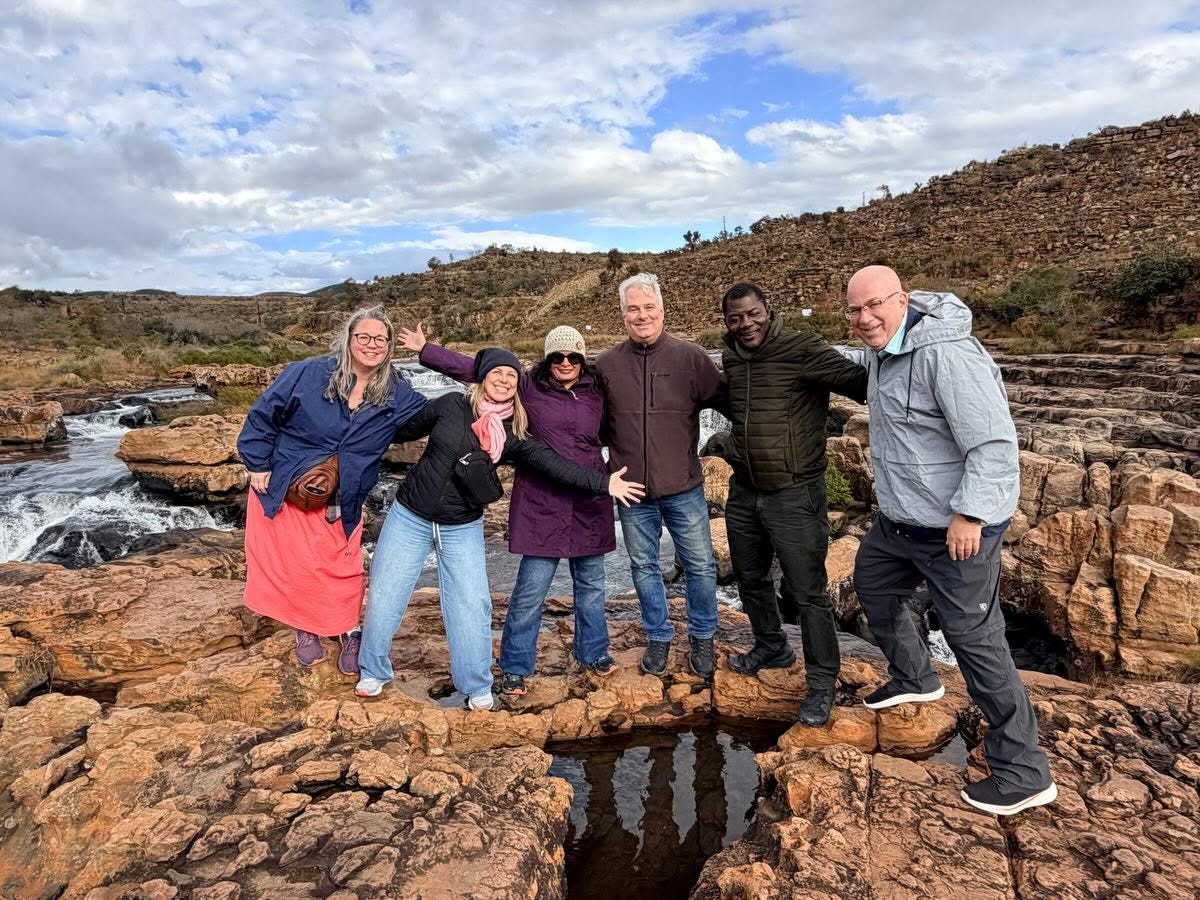
Since the trips offered by our guides were kind of modular, we had said goodbye to Jim, Charlotte, Johnny, Aimee, Ellen, Emily, Julia and Jordan in Johannesburg—they were headed on to other adventures and home, respectively. Our core group was now Debbie and Carol (yes, the adorable impromptu girl band had not yet split up!), Paul and Michelle (one more birthday cake to come!), David and Karen and me.
David had elected to walk to the falls while we shopped.
I couldn’t shake that statistic: an 80% unemployment rate as we stepped into the “Men’s Marketplace.” (It was separate from the “Women’s Marketplace.” More on these divisions later.) It was a crudely-built but sprawling structure in which artisans had set up squared-off stalls with their wares arranged carefully on the dirt floors. The marketplace was low-ceilinged, built of rough timber. It was stuffy and dim under under the thatched roof.
Each stall had its own proprietor waiting for us to walk by, spider-in-the-web-like. It could have easily felt like becoming lost in a Dante-esque maze. The place was just a bit intimidating. There was no easy way out. You had to walk past the same guys you had denied on the way in, and they would all try again to get you to make a purchase, some saying, “You said you’d come back…look again…”
“Take your time. Check my shop. Looking is free. More over here. Look at this. Let me show you something. Fine craftsmanship, made by my grandmother…I’ll give you a good price… The best prices here.”
But what was unique compared to similar experiences I’d had in other places, was that these men were not the least bit aggressive. They were persistent, sure. But it was a persistence of need. (One guy walked a full quarter mile with us, later, trying to get us to buy two wooden bowls.) The craftsmen in the market were soft-voiced and they’d look you directly in the eye. There was an undertone of: “Please, help me out, man…I really need money” to their expressions and inflections that was a little heart-cracking.
If I were rich, I’d have given every one them money, to be honest, but their “thing” was haggling. They expected us to quibble over prices, so they would come in high on, say, a carved giraffe (“Forty American…”) and they would expect you to knock the offer down. But they did not have the luxury of driving a hard bargain. These dudes simply couldn’t afford it. If you turned away after a final offer, they’d change their mind and take call you back.
After a few deals (the giraffe for twenty American, for instance) Karen and I sort of just started giving them what they asked from the start. We’re not the DuPonts, by any stretch, but…were we going to talk these earnest and skilled artisans down to five dollars when we could just pay them the ten or fifteen they asked for? It didn’t feel ethical to me, no matter how much it was expected. These were not people at home at mall kiosks with iPhones and expensive jewelry, dressed in expensive shoes and clothes. These guys were probably wearing one of the handful of shirts they owned.
One old-timer had on a weathered second- (third?) hand tweed jacket over his T-shirt. As we waked away form the market, not having bought from him, he said, “You said you will be back? I’ll see you tomorrow, maybe?) and he shook my hand. “Tomorrow…” I heard him saying as we walked away.
And, by the way, their work was exceptional. Some of it sits on the bookshelf across the room as I write. Some of them even worked in stone and their sculptures were staggeringly exquisite. In the indoor shops, in a kind of mall-ish area, there was even more top-quality art, some of which looked like it belonged in a metropolitain museum rather than in a street market.
Later, we’d be driving through the marketplace at night and, sure enough, all the pieces were still out in plain view, not a human in sight, from the thousand-dollar statues to the five dollar, carved warthogs—no locked doors, not even a covering of tarps. No security. That near zero percent crime rate must be accurate.
Maybe everyone knew that, if nothing else, the elephants were on patrol somewhere behind the trees waiting to stomp thieves to gravy.
After we came back from shopping, Braison was waiting at our hotel and we had the honor of meeting his beautiful wife, Grace, and his two nieces, who were the sweetest young girls one could imagine—they even did slight curtsies as they shook our hands. It was great to meet them and get a more complete picture of Braison’s world—a world, it comes as no surprise, that was clearly one based on deep familial love.
As they walked back to the car, after a group picture and hugs all around, the last image I saw of them was Michelle walking arm-in-arm with one of Braison’s nieces as they went out to their car. I found that quite beautiful.
(It was also a relief to pay that fine man what he was owed.)
That evening was our “Zimbabwean Dinner.” The seven of us climbed into Smart’s van and we stopped at an open-air market to buy some groceries for our hostess, Ms. Flatter. We hadn’t met her yet, but, as it is in most places around the world, it was good not to arrive empty-handed. Princess walked us around the tiny, open-air market, educating us further on Zimbabwean culture and daily life as we stood over various offerings, from fruit and veg to peanuts and popcorn to bags of cubed earth that are typically consumed by pregnant women for iron.
And, of course, there were bags packed full of dried mopane worms, a dietary staple in Zimbabwe. (More on those later.)
Fortunately, Princess was kind enough to pick our gifts for Flatter. When we arrived, it was already dark. We knocked on the gate and were shown into a dim courtyard. The modest, one-story house was completely bordered by a high fence, and an outdoor table had been prepared near an avocado tree that bore fruit the size of American footballs. (I have never seen avocados so large. I mean…large enough that, in competition with the other wonders of this tour, I am spending words to empasize it. Big freaking avocados. Like…way big.)
Flatter welcomed us with a tray of small metal cups with handles. In them was a traditional fermented corn drink called maheu. It was not alcoholic and it had a mild flavor with a pretty thick consistency, maybe a step more liquid than creamed corn. Not delicious, but not as awful as it might sound. I was pretty neutral on it.
Flatter had a dark and angular face with flint-sharp cheek bones, and her hair was short cropped and not greying, as far as I could see, despite her being, I would have guess, in her late forties or early fifties. She was squarely and sturdily built. Everything about her spoke of wisdom and self-possession. Yet, when Carol complimented her, remarking how pretty her dress was, Flatter, for moment, became a shy little girl, looking down at her feet and offering a sing-songy and enchanting, “Thank you.” A beautiful paradoxical moment in which this woman of such obvious dignity radiated un-pretentiously girlish energy.
After a demonstration of the process of mashing the corn with the duri neMutswi—a thick, staff-like stick (the mutswi) and giant pestle (the duri) made from a hollowed log—some of the ladies gave it a go, including Karen and Carol. After this, Flatter called the men forward to wash our hands for dinner. In Zimbabwean culture, the men go first. She knelt and poured warm water over our hands. (She did the same for the ladies, but they came second, as the culture dictates.)
Flatter explained that men were so favored that at dinners, the chairs are meant only for them. Women are to sit on the floor.
Men eat first, so we were sent to the buffet of foods she had prepared…a little uncomfortable for American and Canadian dudes who were taught the complete opposite, but to do otherwise would have been insulting to this culture of which we were not a part and had no real right to question.
Fortunately, though, we all got chairs, including Princess and Flatter, which was a relief. One got the impression that Princess was definitely not a sit-on-the-floor kind of gal, being of from a younger and more modern generation. This was discussed later.
We enjoyed a very tasty homemade meal—yes, we tried the mopane worms which were, actually, caterpillars—that Flatter had prepared, along with some other more familiar things like chicken and beef. For me, the worms were just sort of crunchy. They were roasted until crispy. I didn’t think they had much of a taste. Karen thought they were mildly “fishy.”
During dinner we talked mostly about the gender traditions of Zimbabwe. Flatter had told David he didn’t have to wait to eat for the ladies and he had said, “Manners are manners.” She simply responded: “When in Rome…” What is reflexively wrong to one person can be a way of life to another. In short, can we ever really say “manners are manners”?
As an older woman, Flatter seemed reconciled to (but neither a victim to nor overly fond of) the Zimbabwean traditions Western people see as sexist. If any woman was able to, for example, kneel with complete dignity, it was her.
As we ate, Princess explained that she and her husband had a more modern type of marriage. He would do things the other husbands would not, like handling laundry or cooking dinner. Still, at times, they would play along with tradition.
If guests knocked while Princess’s husband was cooking, she’d leave the couch and go into the kitchen and he’d move to the couch. When Princess’s more traditional in-laws visited, she’d assume more of a traditional role, out of respect for them, swapping jeans for more traditional clothing and playing the subservient wife.
I found it touching—she was doing these things not only out of obligation, but out of respect. The world of the young was transforming, but they did not spit on the old ways…they just were easing their way out of the past. And, you know, how different are we? I don’t mind that the cards of fate have brought us to a point where Karen makes more money than I do. I don’t pin my masculinity on it. But…I guess if I am being honest, I’m also not exactly chomping at the bit to advertise the fact. I can relate to Princess’s husband in that sense. Tradition has deep roots, but fair is fair. We men have to “get over ourselves” as they say.
Yet again, we see the paradoxes of Africa. Things are changing, but there is an attempt to preserve tradition to whatever degree possible. In a country in which the people are quite well educated, the people still have to deal a marked lack of opportunity. Many people with master’s degrees will wait on tables for the rest of their lives, Princess pointed out to us.
Women like Princess are fortunate enough to work and to have husbands who work as well and who are willing to help around the house, but those women still must straddle the fault points of culture. Again, we see it: the birthing pains of a newly emerging world. One thing Princess mentioned was the impact of social media on the young women in Zimbabwe. There is much for them to envy in the outside world and much to make them wish for change. (And I hope much to make them value their own world, as well.)
When it comes to her husband and Princess, I see hope for evolution tied to tradition. They don’t want the world to leave them behind, but neither do they want to leave their world in the dust.
Princess explained that it is still not really accepted for women to spend time in bars, so if they meet their future husband in one, women will usually say them met him “in church.” At that moment, Debbie asked Princess where she met her husband. Princess immediately started to chuckle and said, “In church.” We all burst into laughter. But she insisted that in her case it was true. (I, of course, had to rib her a bit: “Suuuuure, you did, Princess…”)
As we further discussed marriage, Flatter explained an interesting issue that’s possible in polygamous marriages in their culture - one which I found satisfyingly ironic for a system that is so outwardly male-centric. (Only about one fifth of marriages in Zimbabwe are polygamous and this is mostly in rural areas.) It was fairly jaw-dropping when Flatter explained that if a man fails to get his two or three or four wives pregnant—presumably when he is what we Americans call “shooting blanks”—it is his brother’s place to discretely, uh… “get the job done.” This is something that is never talked about openly, Flatter emphasized, but it is always a possibility. Of course, the kid would share genetics with the husband through the brother, so…there’d be no clear visual proof of who the real father is. Pretty diabolically ingenious, in the end.
Did Flatter’s face, in the low light, betray a bit of satisfaction in sharing this?—a little pleasure in a low key metaphoric emasculation?
As dinner wound down, I glanced into the open door of the house. Flatter’s family were enjoying a soccer game on an HD TV. Outside the fence, I could see a bonfire surrounded by animated figures across the street, shadowed goats passing between us, bending to forage. The men around the fire laughed and talked loudly, sometimes playfully pushing each other and laughing some more.
Flatter laughed at our jokes, and she spoke with comfortable wisdom. Cultural biases or not, this was someone to respect.
Back at the lodge, we had a last drink at the bar—Amarula was the unofficial drink of the trip—and then went straight to bed. The next day would be packed with activity, including a safari at Chobe National Park, followed by dinner and a show.
Day 11
We were up early again to travel to Chobe National Park in Botswana. Fortunately, we had bought a KAZA UniVisa that allows travel between Zimbabwe, Zambia and Botswana. Despite Internet claims of complications and warnings presented by various writers encouraging us to apply for the visa ahead of time, it was not a factor. (Our tour compamny had told me on the phone not to worryu about it until the airport, and they were right.) In fact, David, Michelle and Paul had filled out a questionnaire ahead of time—to get ahead of things, but Karen and I walked up to the visa counter in Zimbabwe and simply said: “We’d like to apply for the KAZA UniVisa, please.” The lady stamped and stickered our passports and said, “110 US dollars,” and that was, quite simply, that. She made us fill out nothing and had posed not a single question—not even the standard, “Where are you staying?” (Insert shoulder shrug here.)
Chobe was another experience—sort of a hybrid of Karongwe, which felt remote and intimate, and Kruger, which felt a little like the Disney of safari parks. There were no personal vehicles there, but there were a lot of trucks jockeying for position all over the savannah.
Our driver, Tiki, was introduced to us by Princess as a fellow with whom she’d trust her own life, so we felt in good hands. Tiki got us through the border checks as Princess stayed behind in Zimbabwe. We had to walk across a big and deserted-looking compound to enter the border to Botswana, passing through a temperature check (“You’re a little cool,” said the official. I almost said, “A little? Dude, I’m, like totally cool,” but some of the officers had guns, so….) and being made to step with our shoes into a shallow pan of liquid, for disinfection.
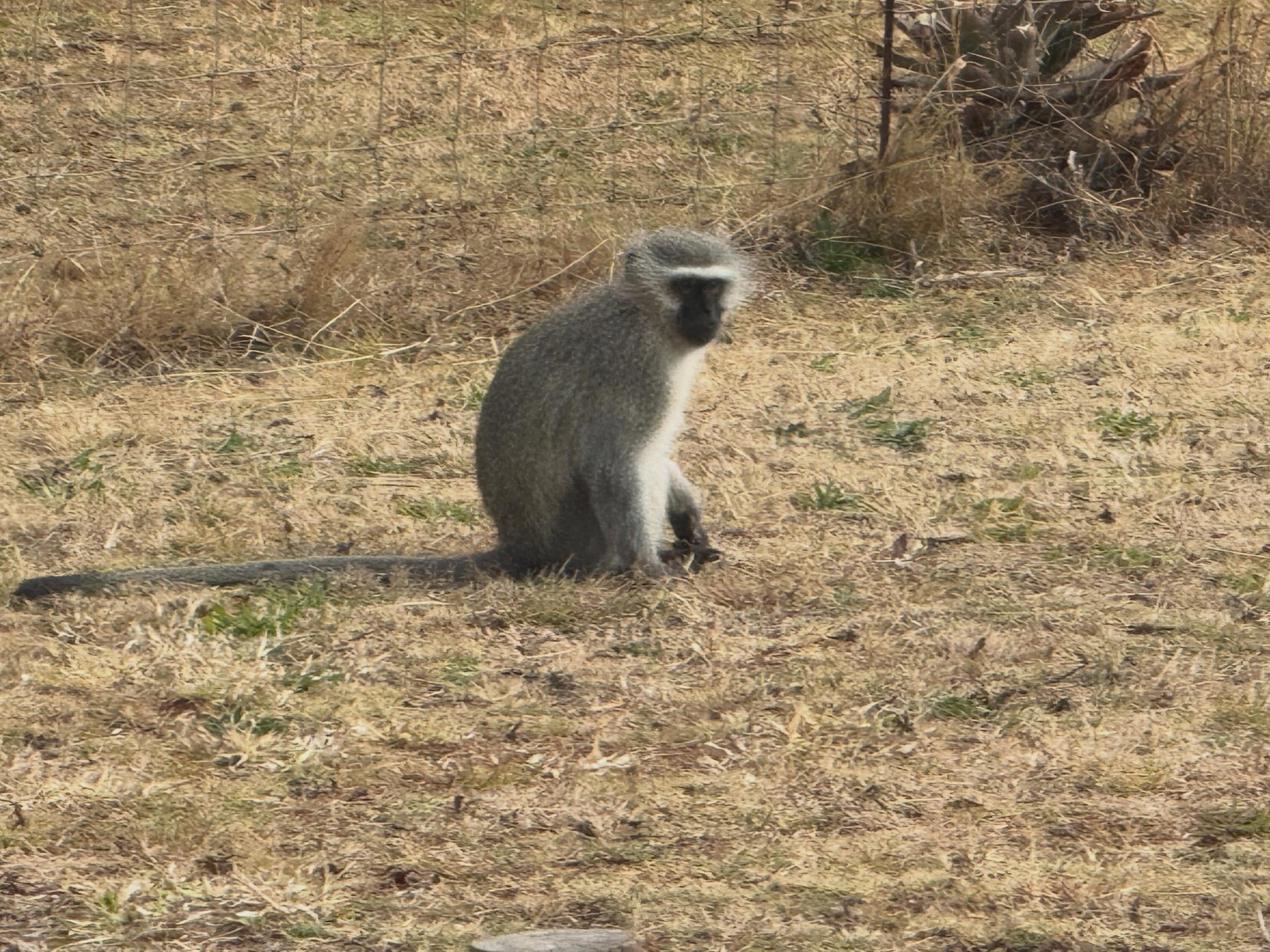
It was a basic operation, to say the least. Scattered, supercilious vervet monkeys leered at us, leaning on lamp posts with feigned disinterest as we passed, some of them repeatedly flipping quarters up and catching them, others spinning pocket watches around on the ends of golden chains as they chewed cigar stubs.
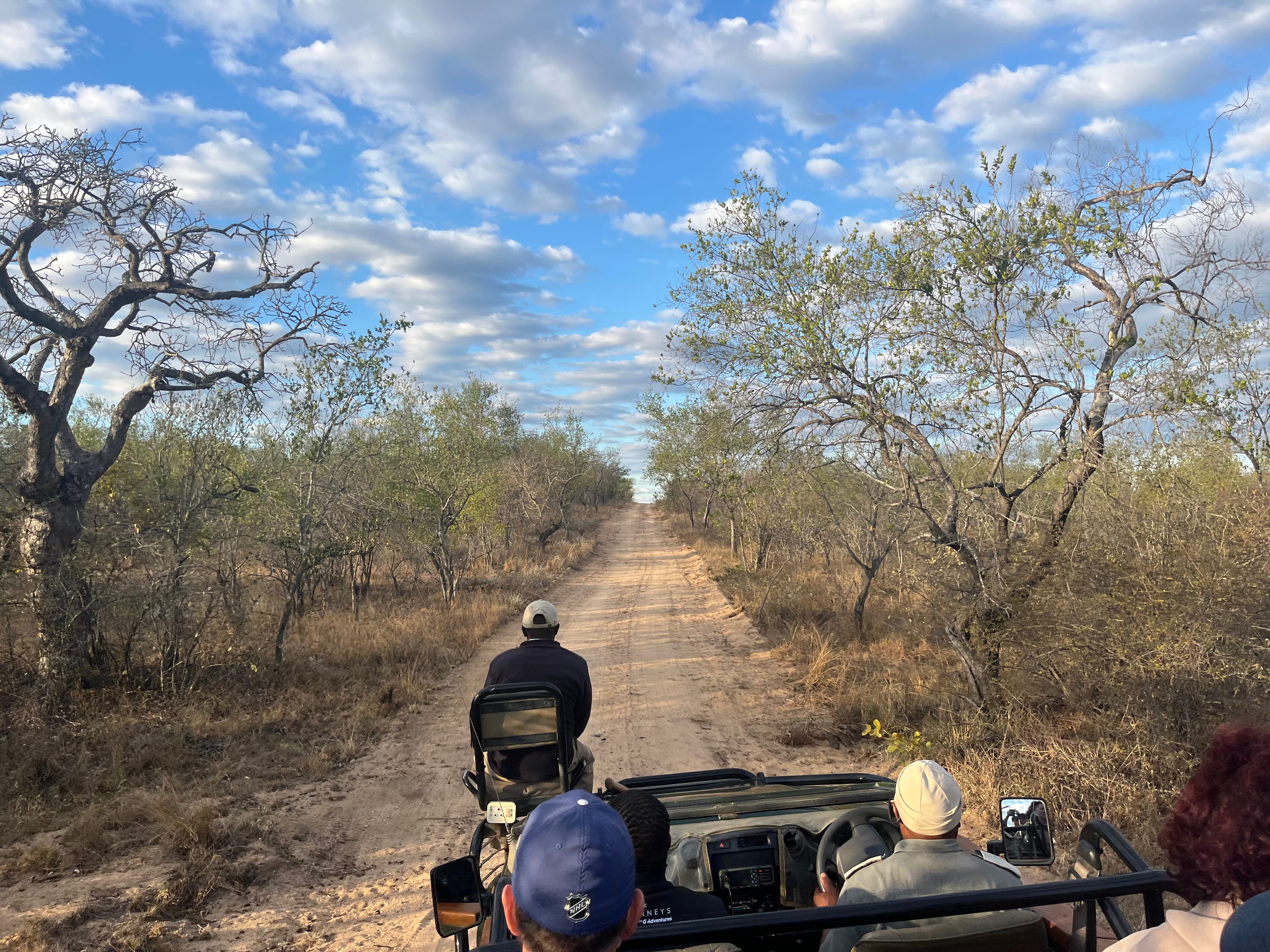
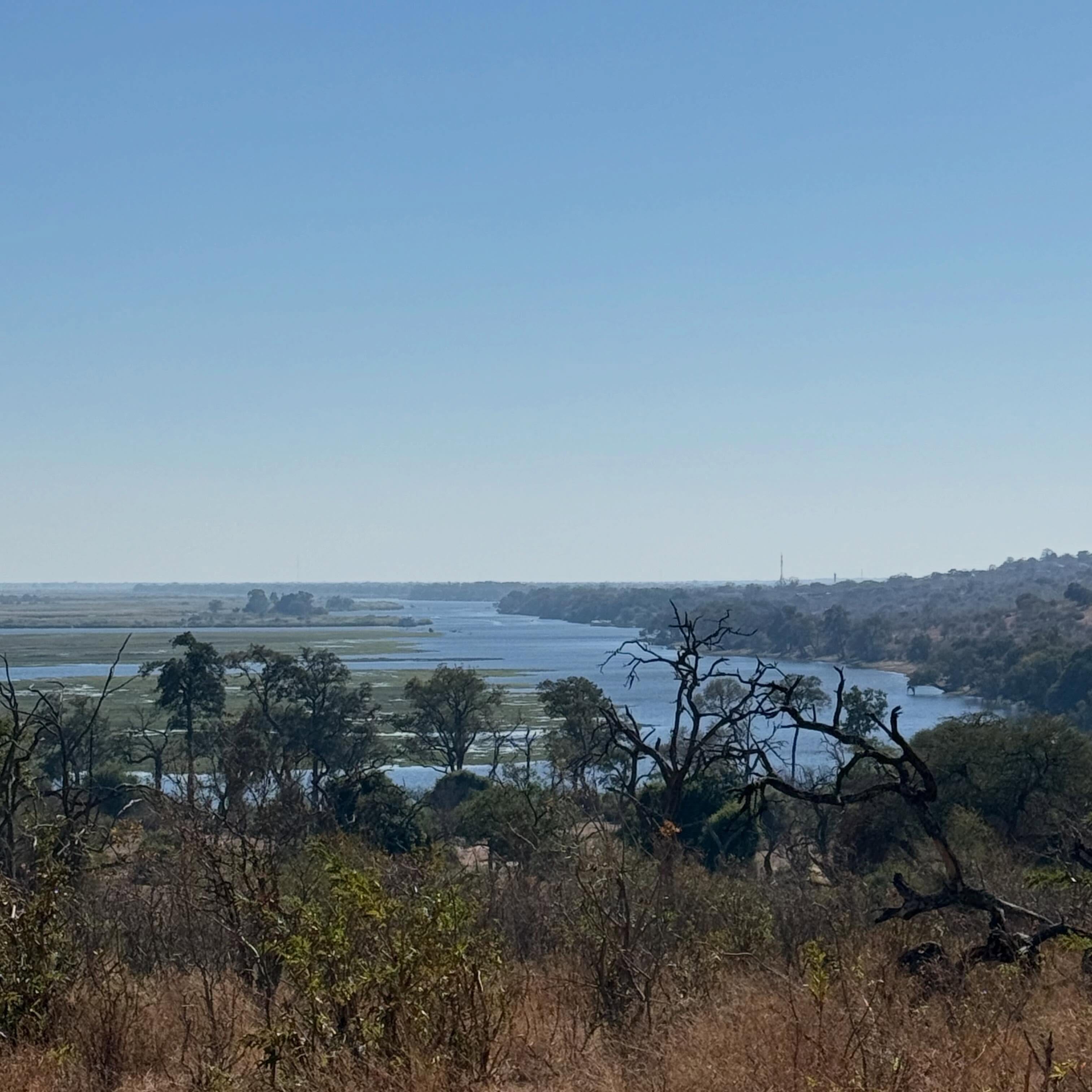
Tiki was a good-natured chap and, like all of our safari guides, he knew full well how to get us to where the animals were, working with the other drivers and using his own instinct to find them. We bounced and slid across large stretches of the wide-open savannah, catching sparkling glimpses of the Chobe river as we went. It was cool, but the sun was arrogantly bright.
Before long, we literally found ourselves between a lioness and her prey.
She crossed in front of us on the dirt road and stopped to peer into the bush. After a quick barrel roll in the grey dust, she’d padded off, her fur dulled to a ghostly shade, as if she’d ment to make herself even more invisible in the bush. She melted into the brush like mist. But she hadn’t fooled Tiki. He got us back to where she’d gone, and we were essentially between her and a kudu she’d chosen from the savannah lunch menu: close enought to almost feel her breath, but far enough to the side that she could see her lunch.
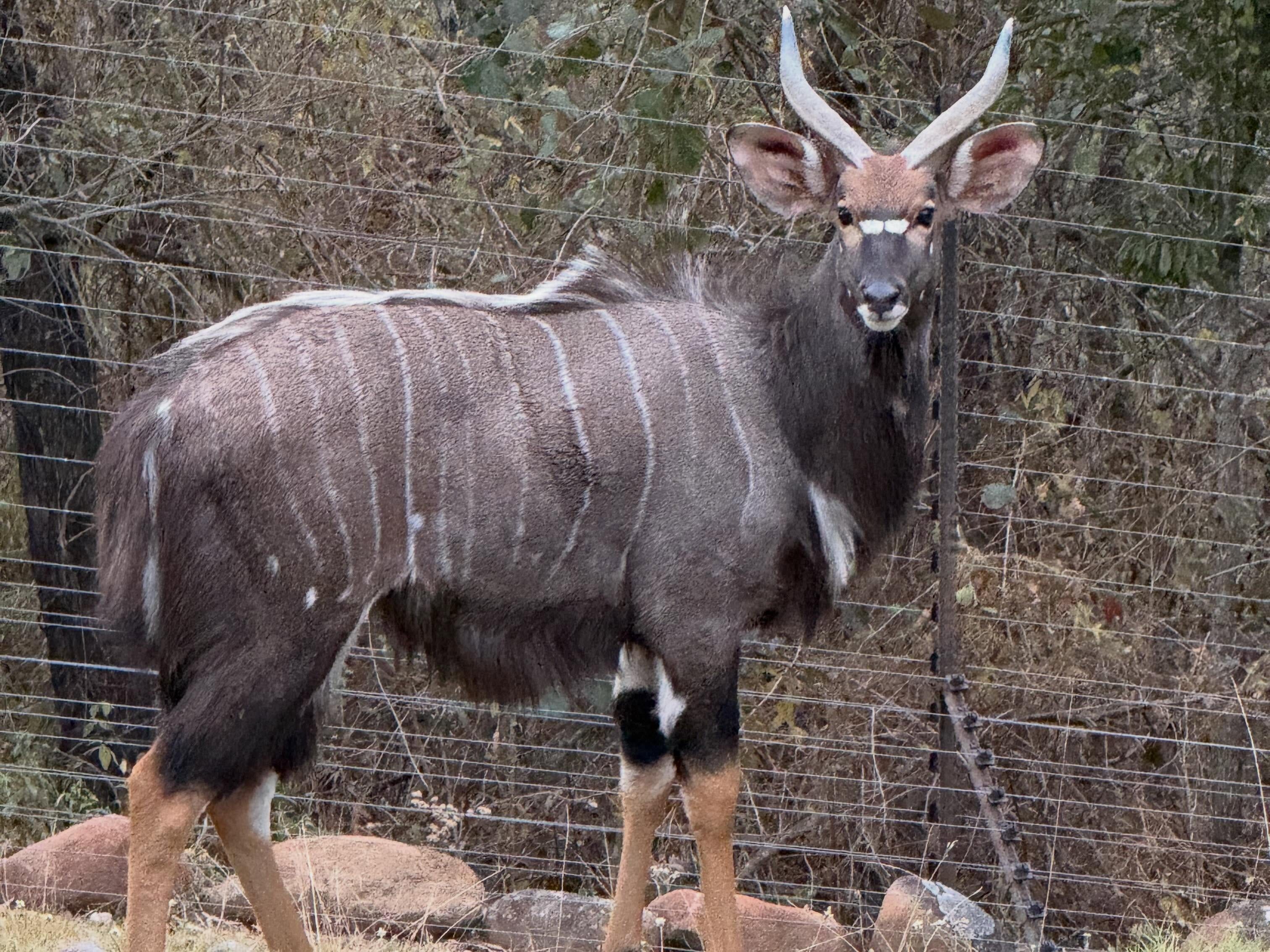
The kudu was about one-hundred yards distant, nearly invisible among the trees, even with binoculars. But the lady didn’t need binoculars. She had babies to feed, and she had locked razor sharp eyes on her prey, walking slowly forward and licking her chops. She stalked forward with the ancient patience of the great hunters of Africa’s memory.
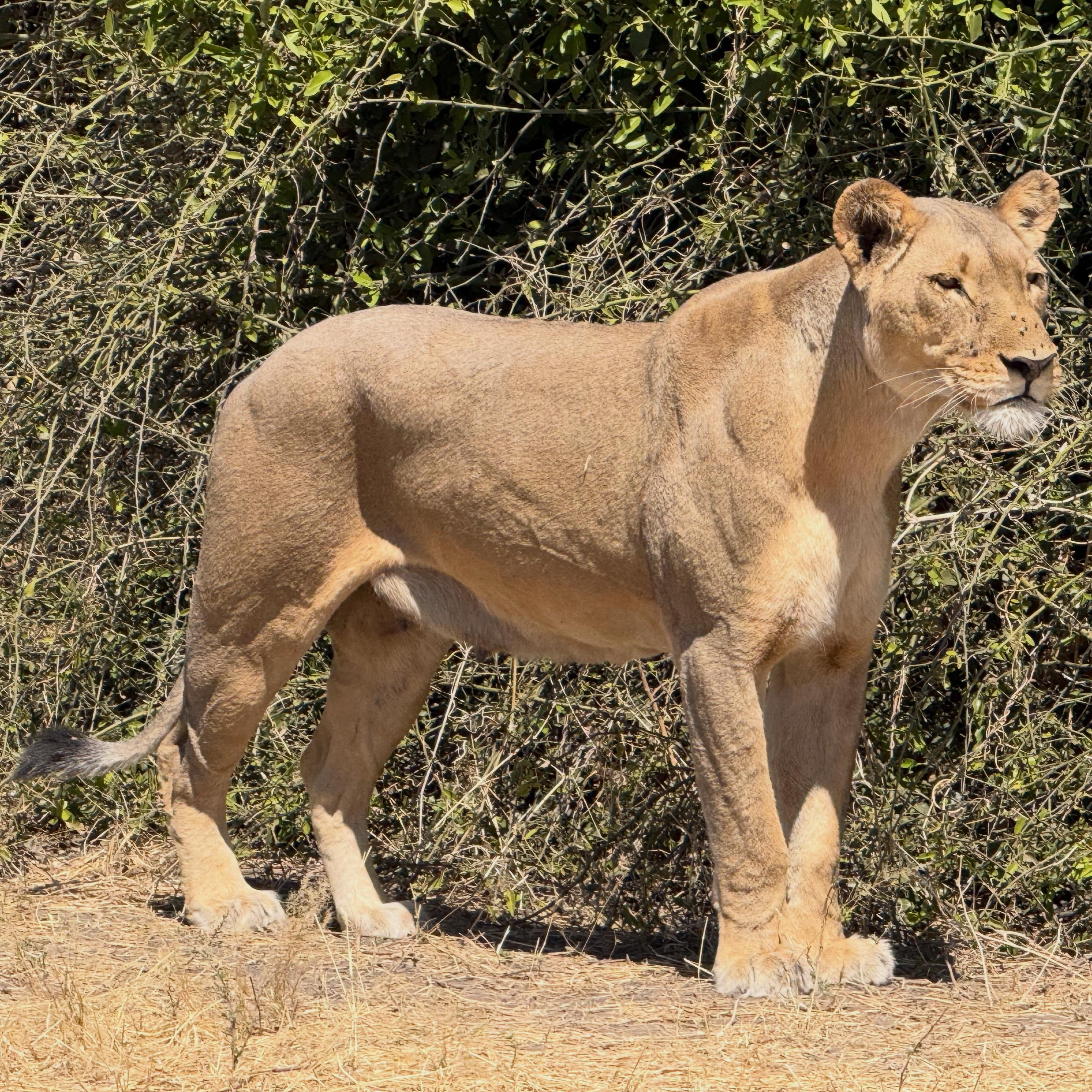
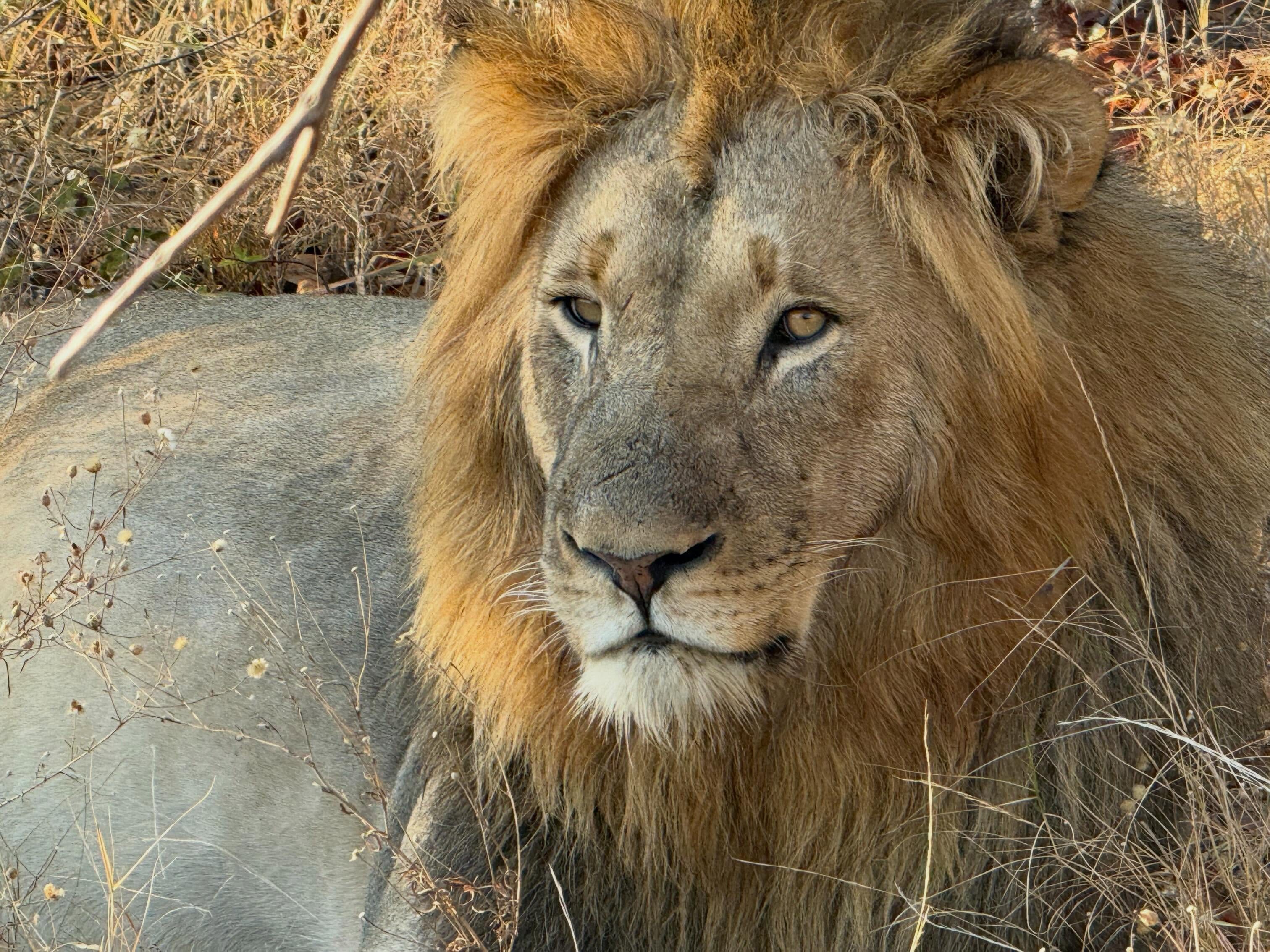
We watched her, silent, for about ten minutes until Tiki suggested, in a whisper, that we move on and let her go about her business. So, yes, we’ve been between a lion and her prey, but she was hyper focused…never even gave us a glance. What a profound thing to have witnessed. I know what you are thinking…yeah, I agree: I wish we had been able to see her strike. (I think.)
Along the Chobe River, we found another lioness and cubs. They’d walk along the riverside and they’d flop down, occasionally, into the sand. Mom would playfully collapse, and her babies would pile on, joyfully nipping at her ears and feet. She bore this with motherly patience and gentleness, licking them now and again, then she got up and soundlessly commanded them to follow, which they did at various and varying distances. You could see which of the little scamps felt more independent and which ones clung more to mommy. From the road, we shadowed them as long as we could, then they trotted off into the distant glare.
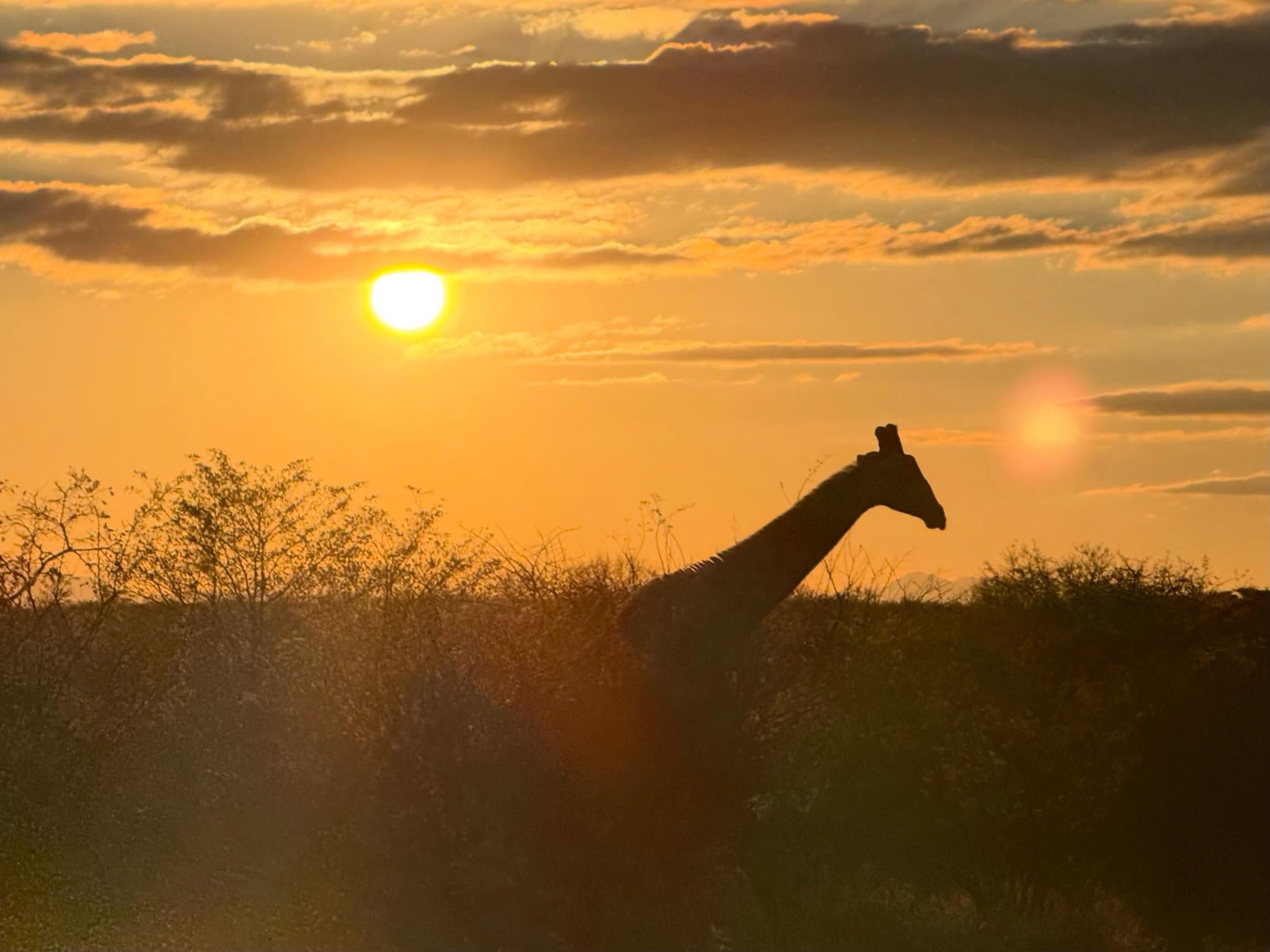
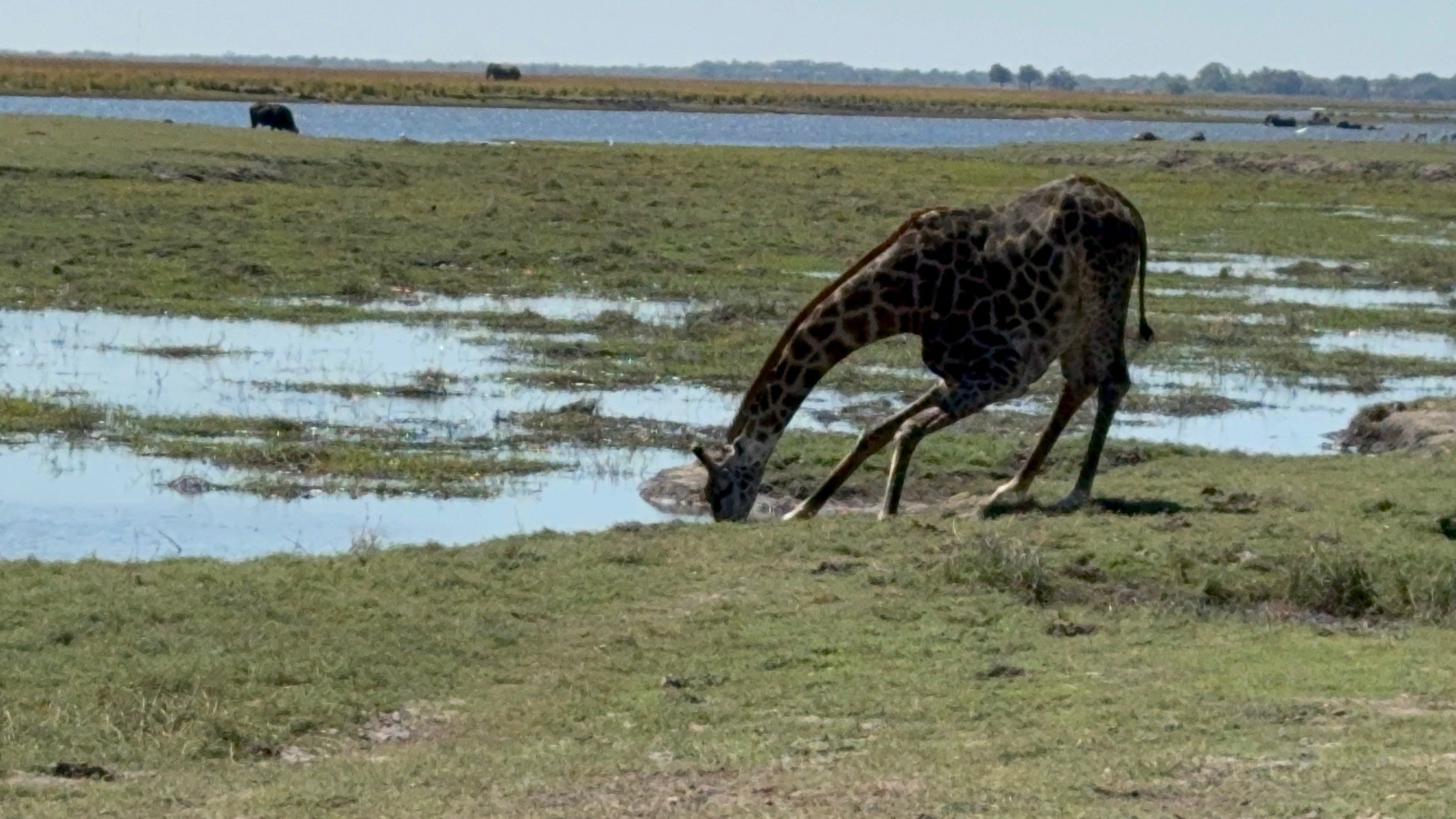
You haven’t known real anticipation until you have seen a giraffe trying to drink at the riverbank. Quite the process, that. It’s tough enough, I suppose, when a creature is blessed (or cursed) with such a dramatically gangly frame, but our thirsty friend also had to worry about the moment of vulnerbility that folding all that footage created. She’d glance around carefully, like a driver at an intersection, start to kneel, then see movement and pop back up. A few steps forward and few back, then she’d bend again. Finally, when the proverbial coast seemed sufficiently clear, she laboriously folded up as best she could, like a ballerina doing a révérance, and lapped a quick guzzle before striding ponderously away.
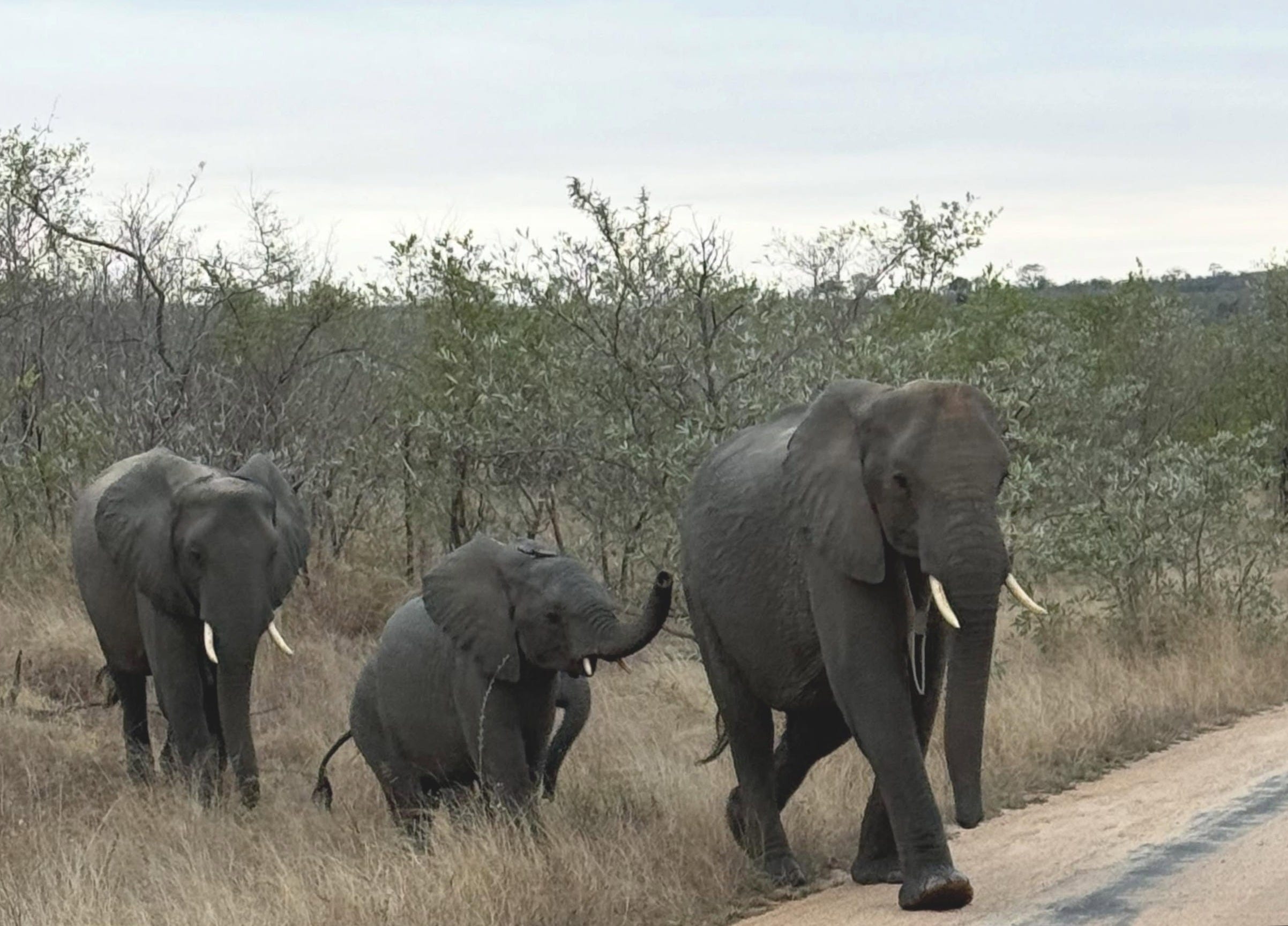
On a river cruise that afternoon, we were privileged to see a family of elephants swim the river to get to an island for greener grazing. It is amazing how well they glide through he water and how unbelievably adorable they are—especially the babies. Once on the island, clutching with their trunks, they’d slap at their sides with sheaves of long grass it to shake out the dirt and foreign particles, then stuff the crunchy goodness into their mouths. If elephants are walking poems, I imagine they’d say, in a basso profundo:
“It’s alright, humans.
When you turn back to your world,
Where empires fall and wars ravage life--
After floods and storms
Wash away the pretty houses of humankind,
We’ll be here, chewing grass and walking slow, in moving memories.
Return here…we’ll know you, even after great spans of time and space
And you shall watch us swim again, and we shall smile for you."
That night, in Victoria Falls, we attended a dinner and drum show at “The Boma,” a kind of dinner theater in Zimbabwe, with a drum show, which, as a drummer, myself, I was looking forward to. At the door, we were all promptly decked out in colorful African dhukus of our choosing (I chose the one on top of the pile) and had our faces marked with special paint. This sort of thing normally makes me feel like an absolute ass, and this was no different, but at least I wasn’t alone in being an absolute ass. (Be an ass with friends, whenever possible.)
The restaurant was as close to a tourist trap as you get in Victoria Falls. The dinner was all buffet style…not bad, not great…and we did indulge in the mapone worms again, for which they handed out certificates. (You know…that kind of place, if you are picking up what I’m putting down. This was not Miss Flatter’s front yard.)
In short, it made me miss the elephants again.
The drumming was a little disappointing. Some years ago, I did an intense, if brief, self-study of African drumming (in that case, West African) in preparation for a piece I was composing for film licensing. So, I had a sense of the elaborate and intense nature of the art of African drumming.
These drummers were incredibly strong, physically, with unshakable time. Djembe playing takes great endurance. But I didn’t hear any of the nuance I have found in other African drumming. I have heard mind-blowingly intricate patterns in previous live recordings that were simply not present here.
To underscore the touristy bit, everyone in the place was given a smallish djembe. I played along with the patterns of the Boma drummers, but the experience was a little like trying to recite Keats at a football game with all of the non-drummers sort of flapping their hands at the skins like fish flopping on the deck. (I say this in all without malice. It was good fun, and our group shared a lot of laughs, but I do wish at some point I would have had the chance to play seriously with some African drummers.) And if I found the patterns boring (which I did) it all could have been by design…to make the average tourist feel like they were part of it all. So I shall de-snobbify myself now.
That said, one of my favorite moments was seeing David, who had been blessed with extra paint at the crest of his bald head, sitting across the table, eating intently with one hand and absently grazing his drum skin with the other like he was spreading butter.
As usual, though, the people mattered most. Our driver, Smart, had told us his son was a chef at the restaurant. The young man’s name was Ancient. We asked our waiter if Ancient was there and he came out. We told him who we were, that his dad, Smart, was driving us, and he smiled, shook our hands, sat with us for pictures, and thanked us profusely for bothering to say hello. Again, the people we met on this trip left you with a warm glow. Nothing felt perfunctory or patronizing…it felt like we had made a new friend and that we had deepened our connection to his father in the process.
It was a fun night, when all was said and done.
DAY 12
What if I told you Karen and I would soon lie, belly-down, at the edge of a three-hundred-and-fifty-foot waterfall to crane our necks over its edge? Well, we would.
First thing on day twelve, though, was a tour of the actual Victoria Falls site, with Smart as our guide. He led us around to different angles of the falls and expertly commented on the history of Dr. Livingstone, the falls themselves, and the flora and fauna of the area. The views of the falls were magnificent, as advertised, with billowing pillows of mist thrown up at the sun to carry vivid rainbows. These falls made Niagara look puny, and there was a wildness to the area that punctuated the majesty of what we saw.
As we reached the final vista, we saw some people across the Zambezi, on the Zambia side, picking their way out toward the fall’s edge. “That’s where we’ll be later,” Karen said, smiling. (We’d already booked it…nothing I could do now…) Seeing those people up there really drove home how daft the whole idea was, but manliness demands stoicism, right? Would Indiana Jones have balked? Or Bogie, in his role as Charlie Allnut? I nodded enthusiastically and glanced across the river again, invisibly tightening up the old biceps, just to reassure myself.
Later, at the Explorer’s Village, Karen and I were gathered up by a pre-arranged taxi that would take us over the border into Zambia. The driver was the soft-spoken young woman I mentioned earlier, who said she never got tired of the animals.
We transferred to the cab of a young man (whose name I forgot to record) who would drive us across the Victoria Falls bridge to the border checkpoint into Zambia. It was one lane, and we got well over the bridge before we spotted big truck rolling toward us in the opposite direction.
After a quick, “What the…?” our driver began to reverse back across half of the bridge, with pedestrians and cyclists teetering inches from his door handles on both sides. I helped him along with silent “Hail Marys” the whole way, and we gave him hearty round of applause when we were safely back on the Zimbabwe side and hadn’t bumped any pedestrians into the Zambezi River. He was unopposed in the next attempt, and, as we entered Zambia, we were lifelessly glared at by military officers with AK47s. They were just protecting their border, but it makes one pause…
We had to, of course, show passports on the Zambia side. The weathered building was packed with lines of people, jostling between the chipped paint of the walls like livestock.
Our driver boldly led us across the humanity. He could not have been much over five feet tall, but he instructed us to stay close as he blatantly ignored the lines and delivered our passports to the window. He had friends behind the glass, but we did not make a whole lot of new ones for ourselves in the lines.
The two women behind me seemed angry but amused at our audacity. They just looked each other, like, “Get a load of this guy.” I mumbled something about following our guide, trying to smile and shrug off the responsibilty. I had expected a row, honestly, but we got out unscathed. He did the same thing on the way back, cutting through another jostling crowd, this time getting a talking-to in Shona by an imposing looking, chap with a furrowed brow and his large, brow-furrowing friend.
Outside, I asked our driver: “Do people ever get really mad when you do this?” He grinned and threw up his hands: “Yeah, all the time.”
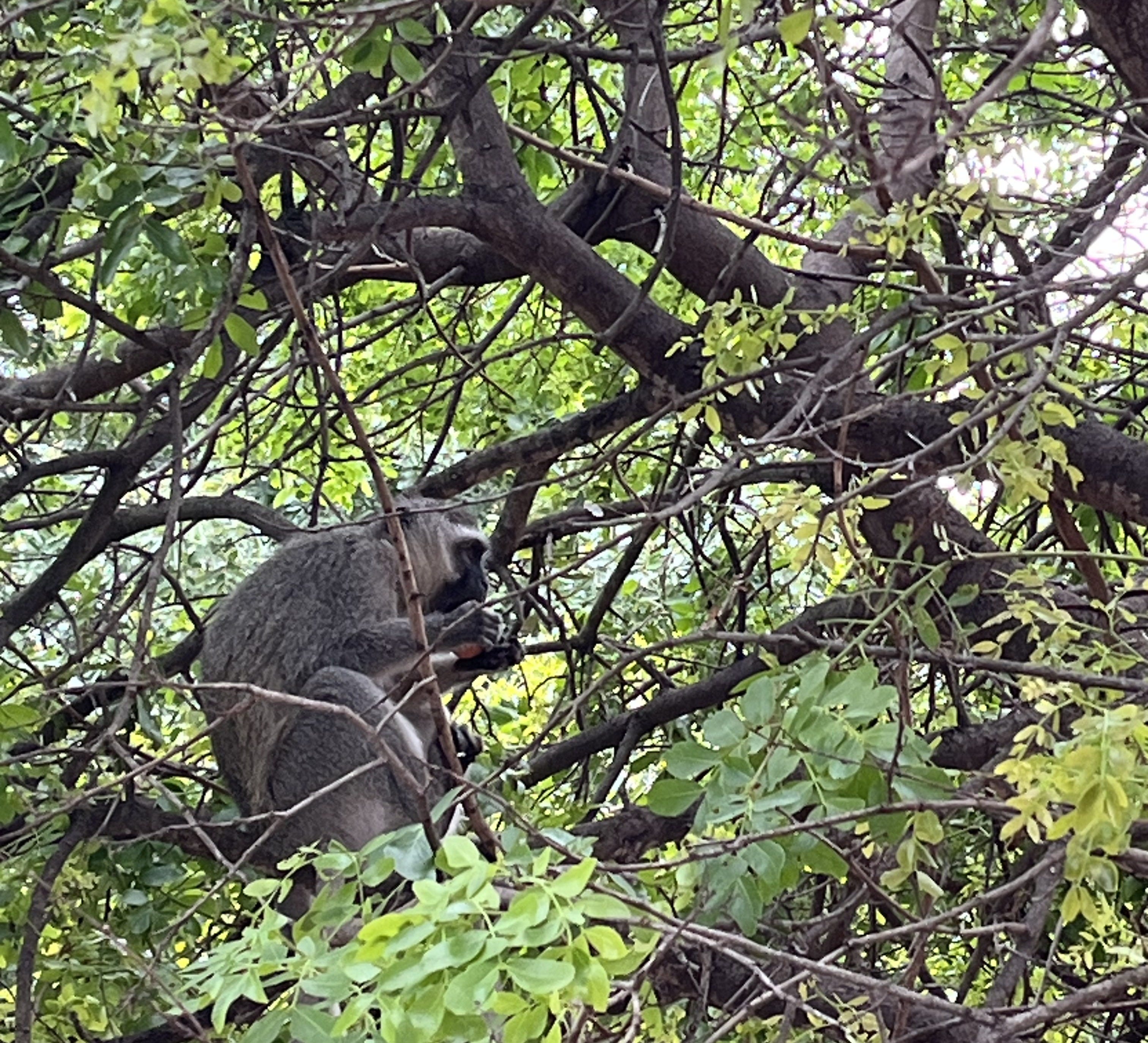
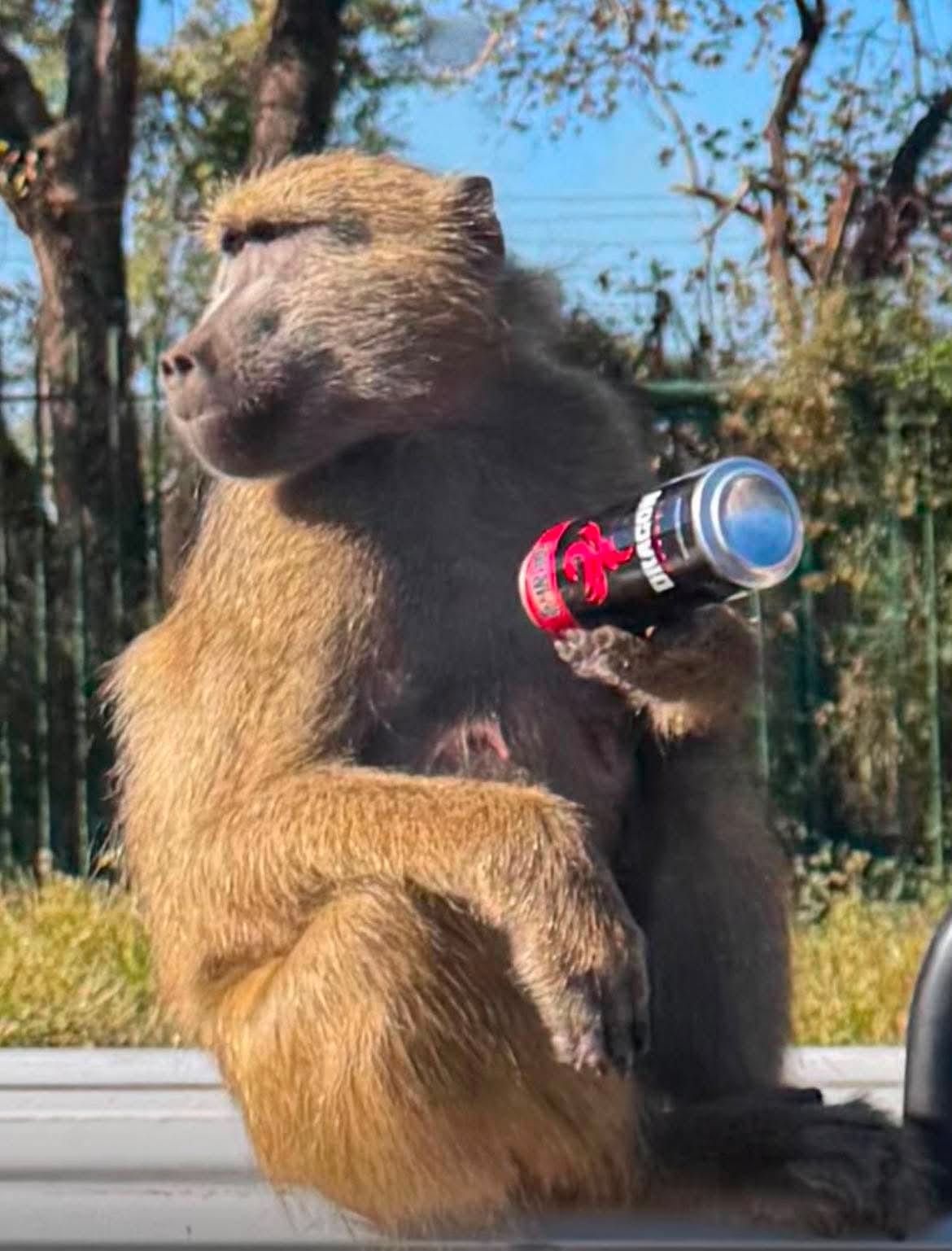
Back in the cab, we passed close to a baboon perched on someone’s car. He was gnawing on a soda can. “This is my cousin,” our driver said. “He wants to see your passport.” He then laughed heartily at the joke. No way, I thought. If I even hold it up, this crrrrriminaaaal will steal it. This is the fellow:
We soon got to the boats for the ride out to the edge of Victoria Falls. When we arrived, a Saudi woman was raising an energetic stink because she had booked for four and the tour company only had two registered.
“This is a bad company. A bad company.” She was barking to a Zambian in company uniform who was smiling broadly back as her as if an apocalypse on his birthday couldn’t dim his mood.
“Sorry…I am sorry…” he kept saying, the smile widening. “I said I am sorry two times!” and he burst into laughter as if the discovery of repetition delighted him. “Two sorries!”
They eventually remedied the issue for her after very much (and very boistrous) fuss.
As I said, this was a side-adventure for Karen and me, so we were not with our usual companions. We did, however, meet a Brazilian dad and his two grown daughters who would make up the rest of our small falls-defying group. One of the daughters, Marianna, spoke excellent English and was very friendly. The father, Fabio, was a rock climber who’s been to the US, but he and the other daughter, Francesca, didn’t have much English. They were all very nice and we got along well, communicating through Marianna.
A speedboat took us on an exciting, serpentine route to Livingstone Island. It strikes me now that this might have been the most dangerous moment of the trip. The speed and the weaving were partly to fight the current of the river leading to the falls.
Once we stepped onto Livingstone Island, It would only be a short walk out to the edge.
There are two main pools there: Angel’s Pool and Devil’s pool. Sometimes, as on this day, Devil’s Pool, the most dramatic view, is closed when the water is too high. But we got to see Rock Pool, where we all got to get near the edge as the guides took multiple pictures of us with our phones. (By multiple, I mean, literally, hundreds.)
I could have done without the posing, between you and me, and just would have liked to enjoy the moment without photographic evidence. And I am sure, if Debbie from our group is reading this, she is cracking up because, in one picture, my sideways pose looks something between George Costanza and tthe famous Fabio from romance novel cover fame. (I agree…it looked hilarious.)
No, I won’t publish it here. Shh. No.
While I was lying belly-down in Angel’s Pool, peering three-hundred and fifty feet down, I remember feeling a brief, rubbery sensation in my legs (which were being held at the ankles by a guide). It was a quick feeling, but I remembered it from another adventure. Many years earlier, standing at the top of a thirty-foot cliff over the Upper Gauley River in Virginia, getting ready to jump into the water, I’d felt a new sensation: the body’s self-preservation system kicking in, saying: “Uh…you do know this is a giant waterfall, right? WTF are you doing?” I wasn’t conscious of fear either then or now, but the body was and it was sending a memo: “Just for the record, idiot…” (Never not be afraid…”
This time, I did not leap into the water as I had on that day in Virginia, of course. But…risk and reward. Thousands of people do this crawl to the edge each year, so I was okay with the odds. (No one has ever died there while on a supervised tour like the one we were on.)
Part of the Livingstone Island package was a delicious “gourmet” lunch on the island. The meal tip-toed along at very leisurely pace which made it quite a project to get to our riverboat trip for that evening. We thought we’d have to cancel, but thanks to the guide-heroics of Princess, we got back and changed and onto the boat in time.
The cruise was what we needed after a very full day: quiet, calm, beautiful sunset, drinks and snacks. Debbie and Carol were off meeting some protected elephants in person, so we joined Paul, Michelle and David on the boat.
For me, the highlight of the boat ride was a young Middle Eastern boy who had decided sixty-five-year-old David was his new best friend and plopped himself right next to him for the duration, away from the rest of his family in the center of the boat. David, a natural conversationalist, effortlessly talked to this kid for a few hours. It was underscored how cool people who travel a lot can be. It was a fun visual contrast, too: David, a tall, dignified-looking man in his sixties engaged in earnest discussion with chubby eight-year-old boy who was asking about things like whether there were sharks in the river.
Debbie, Carol, Michelle and Paul, were great conversationalists as well, with a natural easy way with new people. After all, that’s the point of travel, right?—experiencing other people in other cultures. And as I mentioned before, I was inspired by their acceptance of others, and I have taken it as a challenge to myself. I can be cynical, but I like it better trying to find the best in people.
That evening we had a farewell dinner with Princess and the rest of our gang.
We also had a third birthday cake.
As I may have mentioned, Michelle was celebrating her 60th birthday on this trip and we benefitted, peripherally, by enjoying that confecionary tirumvirate in various lodgings along the way. (Cake three was the best one yet, no question.)
To cap off a packed day, we all went to see a show in a littler theater only a few steps across from the lodge: “Simunye: The Spirit of Africa.” It was cool. Yet, I couldn’t help thinking about paradoxes again. Just outside the door, there were dirt roads and people trying to survive by selling carvings and plastic bags full of mopane worms, and we sat taking in an amplified show with a synthesized score and robotic lights. The show itself? I thought the music was cool, honestly (modern and synth-driven), but the show itself was mediocre, overall. The kids were incredible dancers and there was energy galore. Should you see it if you go there? Yes. It was fun and it supports the local economy and any little bit helps. Maybe I was just too tired to love it. It had been quite a day.
Day 13
Debbie and Carol and David were going to catch their flights in the late morning, so we all got up and had breakfast together. (Our flight was not until 6PM.) We said our goodbyes to those three at the front of the lodge with handshakes and hugs. We’d miss them. I would, in a second, travel with any of them again. But no time for mushiness.
Michelle and Paul would be staying on an extra day after us. The four of us went to lunch at The Lookout Café, from which you can enjoy lunch and a view of the falls. We shared each other’s company (as well as the company of baboons, warthogs and mongooses).
Our cab on the way back was blocked on a narrow street by a van that just needed to back up a little to let us through. I mean...a little. Maybe four feet.
I don’t know what the point of contention was, because the drivers were yelling at each other in Shona. I imagine it consisted of, “Dude, if you back up a tiny bit I can get through,” followed by, “Why should I back up? I was here first. You have plenty of room man.” “Bruh, no I don’t. There are rocks there…they will puncture my tires…”
Eventually the other guy backed up sloooooowly and, to my amusement, the whole exchange had seemed very good-natured and light, even though they had been yelling. The rival driver even chuckled at us as we went by him and our driver just sighed wistfully, smiling. For God’s sake, they were even pleasant when they argued.
When we got back to the lodge and looked through our booking info, though, we started to realize, stomachs dropping to the basement floor, how difficult it was going to be to catch our connecting flight in Kenya. We’d worried about a quick transition time ever since we booked it, but, now the app showed our flight out of Vic Falls was going to be delayed by an hour.
We sat in the lobby with Princess (who was making calls on our behalf) and Michele and Paul (who were also making calls) to try to figure out what we could do. God bless them all…they were so concerned and helpful. I think the stress showed clearly on our faces.
I have never taken a trip I didn’t want to get home from, I’ll tell you that. This had been a spectacular, experience, but it was time. Facing the possibility of having to spend an extra night in an airport in Nairobi, especially because even if we got home on time, I’d have one day to rest before having to play two jet-lagged gigs with my band, was cripplingly disturbing.
We did what we could via the phones and then decided just to head off to the airport. We said goodbye to Michelle and Paul inside. Paul was a relatively quiet guy, but as we got in the van to leave, I saw him standing at the exit of the lodge, waving. I think he felt how concerned we were about the flight situation and the guy just wanted to be there for us. I found that as moving as his wife, Michelle, volunteering to make calls for us as we traveled. Good people.
Princess and Smart came into the airport to help us get squared away. After talking to a woman whose niceness was not coupled with an impressive ability to comprehend our problem with the connecting flight at Nairobi, we appealed to a lady next to her who typed some things into the computer and simply said, without emotion or explanation: “You will be okay. You will make your flight.”
“We will?” I said.
“Yes,” she said, taking a sip from her water bottle.
What could we do but trust at this point?
The long and short of it is that, after a two-hour flight to Kenya, we literally had to run through the airport. Our plane had already boarded, and we got a phone message that, to paraphrase, we might be royally screwed. We ran at full speed and were stopped by a woman in uniform, who said, “Why are you running? Are you Matarazzo?”
We told her we were and she said, “You will be okay. We are holding the plane.”
This was the second time in Africa a thing like this happened. We were deeply grateful. As we finally plopped into our seats, sweating and panting, Karen and I only had the strength for an off-center fist bump.
We were going to fly to Paris where we would have a glorious six-hour layover. (Glorious because it meant we would not have to run anywhere.)
Our flight home from Paris to the US was eight hours, during which I wore headphones and watched movies. My sonic isolation had apparently saved me, because when we landed in Newark and I pulled off the headphones, a French lady was lambasting an Asian family for letting their kids chatter and whine for eight hours straight: “Eeet has been et hours of theese… Enough!”
My bag made it back to Newark, but Karen’s was still in Nairobi. (We watched it move around the globe through our air tag app, but it eventually landed on our front porch a few days later…with a broken wheel. Ah, well.)
We were picked up at Newark by Jeff, a good friend and fellow musician with a rideshare company of his own, and when we got home, our grown boys and our dogs were waiting. The boys had ordered a pizza joint dinner and the table was paper-plate-set with obvious care, and the dogs were over the moon to greet us.
I remember thinking of the glory of the animals we have seen but, fact is, you just can’t beat dogs. It is easy to be critical of humanity for all the things we have done wrong vs. nature and vs. each other, but as majestic as the lions in Zimbabwe are, and as magical as swimming elephants appear, look at what we humans have accomplished in domesticating dogs. Is there anything more wonderful than the love we share with them or than their loyalty and love for us?
I will never say it is not worth it to explore the world. It’s hard work, no matter how you slice it. But we’re all bigger on the inside of our souls than we are on the outside, and travel makes humans grow exponentially if we are really paying attention.
The wonder of Africa and the identity and survival struggle that we witnessed were eye-opening. The beauty of the people we met (both in our group and among the locals) was life-affirming. Learning of the limited opportunities available to such wonderful and intelligent people was heartbreaking. Watching the paradoxical presence of the modern and the wealthy next to the traditional and the poor chipped the heart and claimed small pieces.
But all of this lends itself to a deeper understanding that when we try to generalize people, we are always wrong in our conclusions. It’s only through travel that we can really feel how diverse humans around the globe are. People of African descent are not all the same; white people are not all the same. Culturally, Asians in America are different than Asians in China or Asians in France. Only a fool thinks of those who share an ethnic background belong under the same umbrella. Your world and mine are not the only ones.
That said, sitting at the dining room table and enjoying a slice of local pizza, sharing our adventures with my sons and breaking off crusts for the dogs is every bit as wonderful to me as a nighttime game drive in the bush of Karongwe. My dogs are just as magnificent as the elephants on the savannah. Travel is worth it because it enhances home, but it can never replace it.
A carved giraffe now sits atop our bookshelf as a constant reminder walking out of door and following path to path is essential.
I’m a better man now than the one who stepped on the depatring flight in Newark, because my window to the world has become that much wider. The people I traveled with and those I met on the journey softened my cynicism. The conditions I saw showed me both the strength and the beauty of the African people. Braison, M’dala of Mashingo, embodied for me the paradoxes of the country: a leader in his village and a leader of foreign travelers who knows how to book a flight online but also how to keep insects away from his garden with rabbit urine. He embodies the kindness and the toughness of the places we saw and the lack of pretense in the African spirit.
I look, now, from where I sit writing, out of my back door and I see the green foliage of the woods around Big Timber Creek that runs behind our house. It so happens that Walt Whjitman used to live here and walk along the creek. It was he who said, in “Song of Myself”:
I celebrate myself, and sing myself,
And what I assume you shall assume,
For every atom belonging to me as good belongs to you.
As we are all connected, the woods are filled with deer and I think of them bending to crop food from the ground and I know, at this very second, on a spot our safari truck occupied for mere moments in Karongwe, one of their food-chain counterparts—an impala or a kudu—is doing just the same, culling and keeping one eye open for predators.
I know that a small part of my heart lies in the sands of Chobe and part of my heart remains in the streets of Soweto. They will always be there. But maybe losing parts of your heart is as much of a beautiful paradox as Africa itself. Maybe every time you lose a piece of your heart, the thing actually gets bigger. Maybe the heart is not just a muscle but a net that gets wider and wider as you cast over the worlds you have visited over the course of a lifetime.