Showing posts with label education. Show all posts

Wednesday, March 16, 2022

No, We Shouldn't Replace "Algebra" with "Home Maintenance"

Okay. Enough is enough with this "they should stop teaching (academic subject) and start teaching ("real life" subject) in school.

No, Social Media Guru, we should not replace Algebra, Physics and World Literature with "Laundry 101," "Home Maintenance" and "How to Balance a Checkbook." (Who even does that anymore, anyway? What's a checkbook? For God's sake, if you are going to be critical, at least be up to date!)

And, no, the fact that you were never asked to solve a quadratic equation after high school does not prove that you wasted your time in learning about it. Do you really think that any educator ever seriously thought that knowing how to explicate a Shakespeare sonnet was going to either save your life or put food on the table? Not a one, I can assure you. 

The purpose of all of those "useless" classes is to strengthen your brain. (If football players are never asked to do push-ups during a game, why, in the name of Jehovah, would they ever do them in practice?) 

See, miraculously, I was able to figure out how to do laundry, to operate a toaster and to apply for a mortgage without coursework on it. This may be because I can explicate a poem. It may be because I wrestled (admittedly, without success) with the Pythagorean Theorum. Whatever the cause, I can read a box and make macaroni and cheese and I never had one culinary arts class! 

Education is not just about the dissemination of facts. It is not just skills and memorization. It is the development of the human brain through challenge and intellectual exercise and critical thinking exercises.  

And if we want to take it a step farther, what's the point in taking a class in which you learn something you can master by watching a six minute YouTube video? (I never had a home maintenance class, but I have done plumbing and electric work because (1) I can look things up and (2) I can think.)

The last thing we need is to turn education into an entirely practical and superficial pursuit. I loathe math, and I even had to go to summer school for Algebra II, but I am still glad I had to take it. It expanded my brain. It helped me to grow new synapses. (Synapses? Psychology? When am I going to use that?)

Would it be nice to teach high school kids how to manage their money? Yes. How to change the oil in their car? Yes. But should these things replace traditional academics? No. Electives? Sure. 

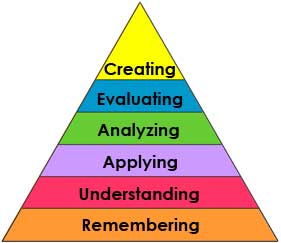
A famous guy in education is Professor Harold Bloom. His learning pyramid is almost sacred in the field. (The lowest levels of learning are at the bottom; the highest at the top):


We want kids to approach the top of the pyramid. Some people need to fix the cars, sure. And there is nothing wrong with becoming a mechanic, don't get me wrong, but we won't get any innovation in cars if kids don't reach for creativity, analysis and critical thinking in school. 

There is a reason why the most successful people are readers, lovers of art and philosophical types, even if they are scientists. 

Once, a local celebrity, Pat Croce, who, at the time, owned the Philadelpha 76ers, came to guest teach my sophomore American Lit. class. When he got there, he asked what we were working on and I told him: The Transcendeltalists. He turned around and quoted Emerson. (What? A sports team owner? Shouldn't he have have stuck to finance and business classes?) 

If we teach kids nothing but the practical, we're setting up for a pretty lame world. 

So stop it. Really. It's a foolish and short-sighted argument. 


Wednesday, September 29, 2021

Thoughts on Teachers and the Profession

My dad was a musician. Full-time. Never taught, never had a lame side-job. I'm always proud to tell people he managed to make a living in music all his life. Maybe because of this, my dad also carried that old "those who can, do; those who can't, teach" mentality. He was especially hard on musicians who taught. He said they were always the worst players. 

Who knows? I have known music teachers who couldn't play their way out of a wet paper bag, but I have known a few who could "shred." (I'm a part-time musician, too, as well as an English teacher.)

I became a teacher by accident. I studied literature as an undergrad, not because I wanted to teach, but because I wanted to learn about books and to become a better writer. I studied literature in grad school, for the same reason. When I was starting grad school, a friend asked me if I intended to teach. My response was (and I quote): "Eeeew. No."

But then, I was offered free tuition and $20,000 per year to teach writing. Clearly, the proverbial no-brainer. I had no idea what I was doing, but I tried my best and got better as I went along. In the process, I discovered that I liked teaching. Decades later, I am still doing it, on the high school level. 

Maybe because of all of this, when I was a department chair and I was interviewing potential new teachers, I would ask them: "What do you like more, teaching or studying literature?" I wanted them to say that it was the literature they liked most. It always seemed a little artificial when someone became a teacher because they had "always wanted to teach." It's not that there is anything wrong with that...it's just that, in English for instance, I have known teachers who seem like they are in it for the summers off and who never seem to have read a book. I wouldn't want someone like that to teach my kids English. (Side note: In interviews, I would often ask a candidate what his or her favorite book was. If the answer was either not immediate or it became a resultant flood of books he or she could not decide between, I'd pretty much decide against that person.)

The thing is, though, I don't grant immediate reverence to my fellow teachers. I once saw a bumper sticker that said: "Honor Teachers." I wanted to take a Sharpie marker to it and put the word "Good" in the middle. Why? Because there is nothing more dis-honorable than a teacher who "phones it in" or who gets tenure and spends decades complaining in the faculty room and draining his kids of their love of learning. I have known tons of those. I have also often been dubiously entertained by those who declare "I'm a good teacher," as if the statement makes it so. (My gut is that those who say that are likely not to be very good.) 

I don't think one should get automatic kudos just for picking a profession. One needs to care and to work and to -- when it comes to teaching -- inspire. 

That said, I think many people outside the profession don't understand the challenge of teaching. (My dad: "They get summers off! They lead the life of a child...") If the job is done right, teaching is gruelling. There are a ton of jobs out there that are as tough as -- or tougher --  than teaching, but teaching offers particular challenges that few jobs do. Teachers have to put on five shows a day (on average). You know how worked up you get when you have to lead a meeting or prepare for a presentation once in a while? We do that numerous times every day to a decidedly unprofessional audience that isn't always inclined to sit nicely and let us do our thing. And we have to look happy and motivated when we're depressed, grieving, fighting cancer, etc. 

Clichéd as it may sound, there is also the idea that we are pretty much working seven days -- with grading, planning, etc. (I mean, the good ones.) Not only are we working seven days, but it's hard to feel "done" at the end of the day. Assessment is important, so we often work in the evenings, too. Even when there is not concrete work to do, the good ones are driving around and sitting on their living room couches thinking about how the day's lessons could have gone better.

The most difficult challenge is that we need to read the moods and deal with the mood swings of hundreds of kids each day -- engage in an exercise of emotional intelligence and play mental chess games to "get through" to each young person in our charge. And, the heartbreakingly moving thing about teaching young people is how much they need us. Each day, I face my students thinking: every one of these people is someone's child; I need to treat them as I'd want my boys to be treated. A self-imposed burden, but a heavy one, nonetheless. It does wear on you. 

In truth, by the time summer rolls in, we're pretty fried. But, heck yes, it is incredible to be able to look forward to two months of down time. Let's face it. Of course, that is, if we get it. I have worked summers, teaching or doing administrative stuff, for almost all of my career. Many of us do. And, then, there are others out there laying sod and serving sandwiches in the summers to make ends meet.

Among us, though, there are numerous teachers just surfing along; turning their profound moral mandate to help in the development of young minds into a game of figuring out how little work they can do and still garner the respect they think just being in the profession grants them. Having spent time as an administrator, I can assure you: there are tons of teachers out there like that, so they deserve your (or my dad's) most scathing criticism and they should be ashamed. (But we don't do shame anymore; at least, not in the United States.) It's not too strong a statement to say that those kinds of teachers disgust me. 

The ones who realize the depth of their responsibilty? Trust me. They work as hard or harder than you do, so just think twice about the blanket eyerolls and spat critiques of "summers off."



Thursday, July 11, 2019

Morlocks and Eloi

Morlocks from the 1960 film.
Maybe it's all an anti-elitism movement. I dislike snobs, too. I go into towns in my area, sometimes, in which it feels like the population sees itself as better than everyone else. It stinks to be in a restaurant and feel like you just are not posh enough to be there. But we can't create a society of mechanical oafs whose closest thing to a dream is to break rocks for a good living. 

I'm a guy (and I have made this point lots of times on this blog) who has respect for the blue-collar workers who can do stuff I can't. To me, higher education does not make you better; it's just a different path. But I do think everyone, from bricklayer to barrister, ought to be cultured. Being cultured should not be a dividing line, it should be a common thread. 

Because of all this, I'm getting sick of high school-bashing. It feels very much the same as my recent "Dirty Jobs?" post. I'm getting tired of posts that say something along the lines of "stop teaching algebra  and start teaching personal finance." Or, one I saw recently, that said:

ME: How do I do my taxes?
PUBLIC SCHOOL: Shut the ____ up and square dance. 

Haha. Funny.  Here we go again. Of course, in the grand scheme, how important is square dancing? I mean, it's pretty irrelevant, and I'm not sure how many schools still really do it. My son had a PE class in dance, last year, and they did more current dances.

But, how horrible would it be to live in a world in which we only teach our kids the practical? I'm all for home economics and personal finance for a quarter or for a semester, but this replacement of literature or algebra, in meme-logic, is an asinine thing to suggest. Just as with the job thing ("college is stupid and the trades are good") the black-and-white zombies have the loudest voices.

My uncle, a lifelong educator, once shook his head and asked, with great sorrow in his voice, when colleges became trade schools. Whenever it happened, he's right: they did. They started out as places meant to, mostly, teach people how to find God; they evolved into places of "higher earning" in which the ivory-tower-dwellers tried hard to turn base metals into gold and then they became places people attended in order to strengthen their understanding of the world. Now they are a place to go so you can "make good money."

Let's not call for our high schools nix anything that one you can't use in everyday life. Maybe if we concentrate on higher-level thinking skills -- things at the top of Bloom's "Learning Pyramid" -- people will be able to actually figure out how to write a check on their own. Don't you think? It seems to me that the skills that these people want taught are things any intelligent human ought to be able to figure out for himself.

A good reader who has read Shakespeare can certainly read a recipe; therefore he can cook. A good mathematician can certainly figure out how to balance a checkbook on her own. It isn't that hard if your brain is in good shape. If you teach a person how a fishing rod works, in physics, he not only will be able to fish, he will be able to make his own rod and eat the rest of his life.

We need contradict the loud and proud dumb-downers. Let's not become Wells's Morlocks and Eloi. Let's produce a society of plumbers who read Shakespeare and professors who can install garbage disposals. (I did it once.)


Wednesday, September 26, 2018

The Sterilization of American Education

I teach a composition course to high school seniors. It is a pre-college Composition 101-102 course, meant to prepare them for next year. I have been using the latest edition of the same college text for about ten years.

Each year, the example essays I use change with the editions. This year, I have found myself dissatisfied with the reading selections and I have gone back to the previous editions for many of the essays. At first, I was thinking it was just a question of copyrights or other editorial choices, but, just last week, I noticed a trend:

Every essay about anything relating to the pains and trials of human existence -- like death, divorce, addiction, abuse, etc. -- has been eliminated. The choices are all light or clinical/academic now. It occurred to me that the publisher is avoiding "triggers" in the text, since so many colleges are being pressured to avoid or to carefully warn about possible emotional "triggers" in their teaching.

The solution to selling a composition textbook in this climate, I suppose, is to eliminate all emotion and conflict so "triggering" won't be an issue at all. Education is a business, after all.

I'll be finding a new text for next year. How's that for business?

There's a reason my classroom is not stainless steel and porcelain. There is a reason I decided to dedicate a lifetime to studying literature: it's because I think it helps me and my students to stay sane and happy. Without that benefit, it becomes an exercise in vowels and consonants.

We cry for a reason. We get angry for a reason. We need those emotions to keep ourselves healthy. If we can't cry or argue together, where are we? If educational institutions are bullied into keeping everyone "comfortable" and "feeling safe" at all times and in all situations, where will the friction for the sparks of intellectual and emotional exploration come from? Where will the healing come from?

And, you know, if, when studying or discussing an emotional piece, I see a sign of how deeply a kid might be hurting, there is a professional counselor to whom I can refer him. And If I refer him to her, who knows what horrible event might be avoided? -- suffering for that student or for others?

If I never know, the couselor will not know. If we save that kid from tears for two, three, four weeks, will we eventually have to save ourselves from that kid or save that kid from himself?

Our philosophies as a society are wrong in almost every way. We're a room full of old, dry newspaper with a faulty electrical system. 

In the end, maybe risks and dangerous ideas in the classroom are the blueprint for being safe outside.

Monday, September 14, 2015

Please Understand "Special Ed."

I suppose this one is kind of a public service announcement.

Last night, I had to go to a meeting for my sons' CCD program (Catholic catechism classes for public school kids) and the speaker, at one point, told everyone that her son had been "special ed." when he was in school. Sympathetic nods ensued among the crowd and then she went on to list her son's numerous issues, which included severe autism and (I quote) "mental retardation." The boy had a habit in school of violently attacking other children at the slightest provocation -- or with none at all.

ADHD? 
This is, of course, something to be sympathetic about. It is a great burden for a parent to have to carry. But I think the sympathy comes a little too quickly when someone simply says his or her kid is "special ed." What people need to understand is that, at least in the educational system in the US, "special ed." is a very broad and it is generally misunderstood by those outside of education.

Yes, a child with severe problems is "special ed," but so is a student with slightly different learning processing tendencies than those of other kids. Had there been "special ed." when I was a kid, I am sure I would have been "classified" for math. I am very poor at processing mathematical procedures; I even "zone out" very palpably when reading certain instructional texts, to this day.

In our high school, we are fortunate to have an exceptional and extremely dedicated special education director, Mrs. Mary Ann Scott. "Scotty's" job is not only to help the kids in her program with their work during certain periods, but to instruct the teachers as to which modifications are necessary to apply to those students while in their classes; these modifications can be as simple as seating location preferences or they can include extra time on tests or orally-presented questions (etc.).

What these modifications do is not to -- if you will -- hit the ball for the student, but to get him or her out of the dugout and into the batters' box. Scotty helps with the stance: back elbow level; weight on the back foot; eyes on the ball...or...wait...maybe you need to squint your left eye to see better... She helps kids with special needs to navigate around their differences in approaching learning.

Thank goodness this wasn't my kid...
So, special ed. is neither, necessarily, a classification of severely impaired or challenged kids, nor is it a feel-good game of musical chairs with plenty of chairs for everyone. What it is is a guiding light through the forest for those whose minds work differently than those of others.

I have had special ed. "classified" students in the most advanced English class we offer (AP Literature and Composition) -- a college-level class. I can bet good money that Einstein and Shakespeare would have been "special ed." had they gone to school in the United Stated in the twentieth or twenty-first centuries...

...but we also cannot forget the severely challenged kids that fall under the special ed. umbrella.

What I hate to see is the immediate reaction people have because of their preconceptions about special ed. I have seen parents actually curl their lips in disgust and snort when asked if their child has any special needs -- as if they have been insulted. That doesn't work out to fair, no matter how you look at it. It's a reaction that comes from ignorance about the program and what it means.

What it comes down to is that "special ed." is education as it should be: a look at the individual student; an assessment of his or her learning style (whether the limitations are severe or minor) and a response to his or her needs...to get that student onto the "field" with the other kids so that kid can show his or her stuff.

Special ed. prejudice is no different that of any other kind. Generalizing about these students is unfair and it could be very bad for them. They need what they need as individuals and it is the responsibility of schools and teachers to provide that.

When I was in school, many of my friends thought I was "dumb" because I got low grades in certain classes. I sometimes thought I was "dumb" as well. (The best my teachers could do was to tell my parents I was "not working to potential." They were right; they just didn't really know how to help except to tell me to try harder.) My graduate school professors would disagree with both my friends and with the younger me about my intelligence. I'd like as few kids as possible to be wrong about themselves the way I was. Maybe I would have done better if I had known the truth (whatever "done better" means...)

I also want to see the kids who need lots and lots of help get it when they need it. Everyone needs to understand, however, that there are as many kinds of "special needs" students as there are fingerprint patterns on them.

So, next time someone says her kid is "special ed." don't jump to the sympathetic head-shake; but, do listen. Sympathy might be needed and it should be given. Sympathy, but not pity. Sympathy gets things done for those who need it. Pity feels like a sense of superiority. Yes, it could easily have been your son or daughter in that story.

Special ed. is about one thing: helping each student reach his or her own personal potential despite differences in learning stylesYou can take that most literally.

(I certainly welcome the views of other educators and parents on this...or stories.)


Wednesday, November 27, 2013

On Controlling Teacher Ego

Teaching is a profession that puts one in danger of developing a big, fat ego.

Every time a student comes back to visit, after a semester at college or after a few years, it is a great confidence boost. You think: Well, if this student stopped to see me, I must have mattered. Of course, it could be the student was on his or her way to see another teacher and made eye contact with you and didn't want to be rude. See? There are variables.

The other day, however, a student came to visit and she said, "If it wasn't for you and Mr. K (another English teacher in the school) I would have never have..." I had to disagree. This girl had immense talent and a passion for the written word when she entered our classrooms. The other guy is probably the finest teacher I have ever known, but I think he would agree with me. (He retired, so I didn't get a chance to discuss.) I had to tell her: "No, not really. You were good to begin with. Don't give us the credit for your achievements."

And it is always true. None of my students who have gone on to success in letters or in education or, specifically, in the field of English, owe that success to me. At best, I played a small part. All of those really successful students would have reached great heights with or without me.

If I ever make any remotely profound impact on a kid, it is in making him or her aware of his or her talent. That part is important, and I take it seriously. And it is not easy, because it requires earning the student's respect; if the student does not respect me, he or she won't really care about my perception. That, in itself, is a tall order. Somebody has to be able to see it, after all. Beyond that, sure, I can help, but...

Friday, September 13, 2013

Scholars From Two Millenia

The scholar, 1900: 

He studied for one primary purpose: to learn. He was embarrassed not to know at least a little bit about various important things beyond his scholarly scope. His clothing and his hair were not a priority (which also means he didn't purposefully attain a disheveled look). He was well-spoken, whatever his specialty; his grammar and diction reflected a rounded education. He met with colleagues for lunch and they talked about concepts across their disciplines. (The archaeologist; the historian; the physicist; the economist; the lawyer and the English professor would debate about, say, the place of religious icons in the past civilizations.) His house was filled with books -- on shelves; next to the coffee pot; under the tea cup; by the bedside. He was fascinated by his field. He studied it to do it. Still, he knew Bach and Shakespeare and Bruegel. At home -- cutting the grass; painting fences; walking the dog; on bike rides -- he thought about what he had been discussing in class that week; he lived with what he studied. In his spare time, he met with groups of fellow enthusiasts; he may even has started a "society" or two. Beyond all things, he pursued original thought. He was on a quest for his own place in the pantheon of the intellectuals before. He wanted to leave his mark on the world...

Monday, July 22, 2013

American Ninja Education: Education Lessons from American Ninja Warrior

The American educational system ought to take a lesson from American Ninja Warrior.

Ever see it? It is a contest that originated as a show in Japan. Basically, the ultimate goal it to complete the world's most difficult obstacle course. Here is a run from the qualifying round. Most people don't finish the course, at all:


As I said, this is only the qualifying round. The key point here is that the athletes who try this course have never seen some of the obstacles they are going to face -- the developers of the contest surprise them with new obstacles ever year.

Friday, May 31, 2013

The Wrath of Ptolemy: Why "A" is the New "C" in American Schools

We have all heard people complain about American schools. A little too much, I think. In general, we do a pretty good job. I do, however, believe we often go about it in silly ways. If you ever want your confidence shaken, though, you should do something that I just did: do level-placement of high school freshmen for the upcoming year.

What we use are three things: middle school grades, previous standardized testing and our own placement test (standardized, as well).

Father...
On the application information form for some of the area schools, there is also a spot in which the teachers can say whether they think the student is on a "high" level, a "middle" level or a "low" level, in a particular subject. (This will be important later.) Here is the worst case scenario that I have to deal with -- and it happens quite a bit:

A student (we'll call him Copernicus) shows testing that puts him in the twentieth percentile (very low). His teacher rates him as "low." His grades? As and Bs, even from that very teacher.

Now, if I take the evidence of the testing and place Copernicus in the regular level classes, Copernicus's dad (we'll call him Ptolemy -- just because I like silent Ps) calls me up and says he wants Copernicus in honors classes because the kid has all As in middle school. I mention the testing. Ptolemy tells me Copernicus is just a bad test-taker. He has anxiety issues. His performance in class is a clearly successful track record.

Wednesday, May 15, 2013

Like, Einstein Cool

A local radio station has been running a contest for area schools: "The Coolest Teacher." Each morning, they randomly select an area high school and the kids are asked to text the station with their vote for the "coolest teacher" in the school.

What would have been your guess, say, twenty years ago, for the most-often selected type of teacher? What departments do you  think would have yielded the most "cool teachers"? My bets would have been on English, history, art, music -- the classes in which kids could be inspired to think and create.

I know the first thing people might say in objection to my conjecture is that I am an arts person, so, naturally I would see it that way. But, in the past, don't you agree that no one would have made a movie about an inspiring calculus teacher? The inspiring teacher was always someone in the humanities. Think: Dead Poets Society.

Well, who do you  think the overwhelming number of "coolest teachers" are in this contest? You guessed it: math and science.

Monday, February 25, 2013

Found: The Ugly American

I'll make the statement, first: I was in class yesterday with a guy who just plain disgusted me.

Now, we of the Sesame Street era and we of the Judeo-Christian backdrop have been taught not to judge others. (A lesson I think we have taken a bit too far -- which has been transmuted into: "Never give an opinion about someone else;" or, "never say when you think someone has done something wrong." But that is for another piece.) Those of us of this sort of background might react to my statement, above, as a horrible thing to say.

But, notice, that I did not say that the guy was a disgusting person. He just plain disgusted me. I had a visceral reaction to him: "Yuk."

He didn't stink. He wasn't unsightly. His actions, attitude and manner simply disgusted me, from the beginning to the end of a four-hour class.

Him.
He sat behind me and to the left. At a glance, I saw that he was a few years older than I -- maybe in his mid-fifties. He was a guy who was changing to the teaching profession from something else (I can only assume this decision was entirely driven by his desire to coach sports, because that is all he referenced, all through the class, decked, as he was, literally, from head-to-toe in Adidas wear.)

Friday, February 15, 2013

Bad Love: A Valentine's Day Massacre

Alright. Yeah. Yeah. I'm gonna do it. I'm gonna trash Valentine's Day. I can't help it. It drives me crazy, so I'm going to drop the box of chocolates in the mud and grind it squishingly down with the boot heel of cynicism.

I did hear guy say "Happy Singles Awareness Day," today, which I like -- but that is neither here nor there. Valentine's Day is lame. Not only is it lame, but it is a microcosm of lots of things that are wrong with the typical American perspective on life.

Call me a stick-in-the-mud. Call me a Cupid-killer. Call me Broxton Von Fleederdoingenstein. (If you want.) I'm not backing down from this.

And, no, this is not just a ploy to release me from the responsibility of getting chocolates and roses for my wife. So sheddep.

No, this is a question of (yet again) the individual versus society; it is a reaction to the constant pressure society puts on all of us to "fit in" -- to become part of the groupthinking hordes of brainwashed toe-draggers.

Wednesday, February 13, 2013

Someone's Child: The Heart of Education

In American education, we do a lot of talking about scores and percentiles and norms. We do a lot of averaging. We standardize and we cluck our tongues when students don't meet a standard. When they don't stack up to other kids, we sometimes "classify" them. Some of this serves a purpose. Much of this is beneficial in helping kids to reach their potential.

But most of the time I look around me and I fall out of the "we" that does all of this. I feel miles from the faculty room talk about "these kids." These kids -- as if they are machine-stamped, consistently flawed duplicates of one another.

One can crunch numbers. One can make "data-driven decisions" about academics. One must. But analysis and policy and curriculum are not the heart of education.

Friday, December 7, 2012

One-Click Learning?

Wow.

I had a pretty complex post started for today, then, something happened.

In my creative writing class, I wrote up some notes, on the white board, of a "character sketch" I want my kids to do for next meeting. I went through the particulars, explaining each piece of info I wanted them to come up with in their sketches and giving examples of a character I'd created.

The last thing I said was: "Make sure you have this in your notes -- there is no handout and I won't be posting it on my website."

As I was packing up and as the kids were shuffling out, a student casually walked up to the board and held up her cell phone to click a picture of my notes. "See you Mr Mat!" she said, smiling, stuffing the phone into her bag.

Teaching, today, really is a fascinating profession.

Friday, September 28, 2012

The Ballad of the Eagerly Terrified Poets

I'm teaching a creative writing class this year for the first time in several years. I have a great bunch of kids -- nice, eager and engaged. Still, I've been reminded of several things about teenagers and creative writing, but in a more vivid way than before.

Little children create without hesitation, but once we hammer them with a heapin' helpin' of schoolin' -- into their teenaged years -- they become terrified of it. I'd even go so far as to say they are embarrassed by it. Most of them anyway.

This is what I meant awhile ago when I referenced an American over-emphasis on science and math. As I said before, these subjects are important, on many practical (and necessary) levels, but they tend to bully away the humanities; science and math tend to become the rock stars and the humanities and arts are just the road crew: the show couldn't go on without them, but they never get the groupies or the spotlight.

My teenaged students are terrified of "doing it wrong" when I ask them to write a poem, even when I let them do their own thing; maybe especially so. If I give them a free-verse poem with no constraints and guidelines, they will write one and ask if it is "okay." All I can do is to respond by saying, "Of course it's okay." I make it a point of saying that before I look at the poem.

Friday, September 14, 2012

Symbolic Stupidity

I’m an informal type of guy. Jeans and T-shirts are my favorite. I hate formal functions. Oddly, though, I find myself repeatedly arguing for formality in certain areas, especially manners. So here is the new one: education. We need more formality; more classicality; because, I will me honest with you, I can’t take any more ridiculous attempts at “statements” or “symbolism.”
A few years ago, I was watching a show on TV about a tattoo parlor. Tattoos are not my thing -- not unless they have real meaning. I respect the talent of good tattoo artists, but the only way I would permanently put a picture on my body is if it meant something big. Like, I understand getting a tattoo if all of the people you fought with in Afghanistan got the same one. I dig why people get portraits of departed loved ones. That works.
Don’t get me wrong: I’m also cool with someone getting a tattoo because they like the aesthetic -- no meaning; just making one’s self look the way one wants. That’s fine, too.
But, in this tattoo show, a bunch of people would come in and utter something like: “I want to get a tattoo of a tarantula, because I have been through a lot of change and the tarantula represents that.”

Friday, February 24, 2012

Terry Pratchett's Cohen the Barbarian and You

Every day of my life is kind of a pursuit of a wish: the wish that my students will grab some of the wisdom that the great minds of literature have set down for them. The juicy apples just dangle there above them, but I can't do the picking and hand them out. It only works if the kids climb the ladder themselves. I can hold the ladder so it doesn't fall, but ... well, you get the tired metaphor.

In high school, I saw myself in Hamlet. I looked at him and I saw a guy who thinks too much,  but, more importantly, I saw that the definition of thinking too much includes thinking one's way straight through the time when one should have acted. That revelation made a big difference in my life. Many have survived various act fives as a result.

Friday, January 20, 2012

The Great Teacher (A Parable)

The school was a great, open field. The Great Teacher watched from the sunlit hill.

Three teachers stood before his class, next to a great stack of bricks -- special bricks, that were called "facts."

The first teacher picked up a fact-brick and held it out. One at time, the students approached and took the offering from his hands. When each student was supplied, the teacher commanded: "Now, keep returning to me and put your bricks in a stack. You will make the biggest pile possible, for I will hand you many, many bricks before the sun falls."

The Great Teacher frowned.

Wednesday, January 11, 2012

Big Food

Today, my students, in a class called "Literature of Science Fiction and Fantasy," began an annual project: "The Sci-fi Invention Project. " What they have to do is to come up with an invention -- a machine of some kind -- that solves a social problem. I've gotten glasses that prevent racism; I've gotten machines that stop drunks from driving; I've gotten anti-obesity devices, anti-stupidity hats, force-fields for preventing street violence and the like.

I've also gotten a lot of machines meant to end world hunger. These devices often have to do with syntheses that result in food.

"Ions" come into play, a lot. And various waves named with Greek letters.

Well, the gist of the assignment is that the year is 2038 and the inventor has to present his or her invention to the class, which plays the part of "NECSI" -- the Neo-Earth Committee for Societal Improvements. The inventor's goal is to convince NECSI to send the invention proposal to the President, in the Green House (the name was changed, for obvious reasons, some time in the 2020s).

Friday, September 30, 2011

Aristotle Jones: Personal Archaeology for Teens

Every year, around this time, I assign a paper to my high school seniors. It is called "The Learning Experience." In the paper, the kids write about a change in their perspective on something in their lives. It can be anything. One student might write about the day he discovered he liked onions. Another might write about the day he realized his mom was a good mom, even though she was strict. Another might choose to write about a calling to the priesthood, for all I know.

It is an assignment that satisfies the need to expose the students, from a writing standpoint, to some important Aristotelian modes of rhetoric, namely: process analysis, narration and description. But, more importantly, it forces these young people to learn something about themselves -- another branch of old Aristotle's areas of interest.

It always surprises me how lost they look when I ask them to do this. It scares me, a little, year-to year. But, when it is all over, my conclusion is always the same: a) most people regard themselves as a bag of sand that just walks around doing stuff and b) with only the slightest prompt, these same people can learn dig in the sand and find important artifacts -- learn to do enough personal archaeology to step onto the path that leads away from "the unexamined life" that Aristotle, himself, warned against: "The unexamined life is not worth living."