Showing posts with label time. Show all posts

Wednesday, October 31, 2018

"The Span of Life"


The Span of Life

"The old dog barks backward without getting up.
I can remember when he was a pup."
-- Robert Frost

I couldn't resist -- the actor's
name is Gaten Matarazzo;
right time period and all. 
That's one of my favorite poems of all time. If I am, daily, a drag-racing car, that poem is the parachute deploying at the end of my rubber-burning run. Each time I see it, pseudo-paradoxically, my world slows down so that I can take in exactly how fast things pass.

Many, many summers ago, I was racing my orange, banana-seated bike around the newly-constructed bank that was built next door to my house in the middle-class town of Voorhees, New Jersey. The bank was equipped with two excellent features for kids: One was the big, windowless brick wall in the back that was perfect for practicing tennis or for a Wiffleball backstop. The other, of which I was taking advantage on this day, was the ebony-smooth, newly-asphalted space around the building which allowed impossible speeds that felt like pure floating.

Banks simply were not open for business on Sundays, then, so my parents had no problem with my hanging out there, especially because they could call me home for dinner from an upstairs window.

So, this particular Sunday, I was by myself, just "practicing" for the big races of the future. But having gotten bored, I started pulling stunts; practicing "wheelies" and generally zig-zagging and unsafe speeds in every direction with the kind of physical lunacy only kids can muster.

You'd think I would have noticed the big, white, concrete divider that jutted out next to the last parking spot, but...somehow it slipped my mind. I crashed hard into it, flew over the handlebars and slammed down with my arm stiff, which severely hyper-extended my right elbow. I left the bike behind, cradling my arm, and I walked back to the house in tears.

My parents expected a sprain, but our family doctor directed us to the hospital. It was pretty bad. The X-ray showed that a piece of bone in the elbow had cracked and detached. I honestly don't remember what they did -- whether they took out the fragment or not -- but I was casted with an old plaster-type tubular letter L and admitted to the hospital for a night of observation.

I was terrified, of course, of spending the night away from home in the hospital, even though -- maybe because -- I was surrounded by other unfortunate adventurers of my general age. My parents were going to go home and get me a few things and they asked me if I wanted anything in particular. What I really wanted was Snoopy -- a stuffed Peanuts character that I slept with every night. (He was an odd creature, stuffed with something relatively hard [sawdust?] and he had no tensile strength in his neck, so the head flopped over sideways. His ears were of black, floppy plastic. But I loved him.) As I say, I wanted Snoopy, but was afraid to look like a "sissy" to use the un-P.C. parlance of the day. As luck would have it, the kid in the bed next to me was provided, in that very opportune moment, with a blue, stuffed duck by his dad. I would have my companion that night. Shame averted.

It was a long night -- fortunately broken up by a Phillies game on TV in which Mike Schmidt hit two homers -- that lead into a long morning that lead into a barely edible lunch of peanut butter and jelly, after which my parents came to collect me. All-in-all, Snoopy and I made it through okay.

I wore the cast for quite awhile -- so long that my arm showed visible atrophy when it came off -- and, then, we followed-up with my pediatrician. I can still see his face, half-and-ruefully smiling, when my parents asked about possible long-term effects:

"You'll be fine, young man. You shouldn't have any problems unless you become a pitcher [I did] or if you get into anything that requires a lot of repetitive motion in your right arm [I became a drummer]. All that aside, though, you probably won't feel the effects until you are in your forties or fifties. You might have issues then."

Fifties? That was forever in the future. We all left feeling pretty good about the prognosis. There was a chasm of decades before us all before we needed to worry. We stopped at McDonald's on the way home for a merry feast and I spent the rest of the day watching cartoons, my mind free and clear...

Just now, I picked up a mug of tea and lifted it to my lips. My elbow was shot through with a recently familiar ache; it is a tooth-achey feeling that has been bothering me for the last four or five months. It's not getting any better. (I turned fifty last January.)

The span of life, indeed.

The setting of the story has changed. One of the characters is gone. But I can still smell the hospital room and and feel the firm pillow of Snoopy's sawdust body on my cheek. I can still hear the whisper of Harry Kalas's voice on the low volume TV as Schmidt's bat swept in a perfect arc: "The one's outta heeeeeere...."


Wednesday, July 11, 2018

Joseph, 2018; Guiseppe, 1618

So many little things are so profound but we spend so much time fixated on the wrong aspects of those things.

My sixteen-year-old son got into the car yesterday, having been sent into the school office to take care of a little piece of business. He got it wrong.

I found myself lecturing him: "You need to stay focused on the thing you're doing and not on the thing you are looking forward to doing. I know you want to get done and leave, but..."

Within seconds, I saw myself sitting in the passenger seat, in 1984, being told the same thing by my own agitated father. Immediately, I smiled to myself and told my son that I had been in his seat, both quite literally and quite metaphorically, many times. My dad had told me the same, exact thing (over and over).

In that moment, I felt deeply connected to my dad again. I also felt overwhelmed by the profundity of the truth -- what I really think Keats meant by "Beauty" (not aesthetics but the profound) in his famous "Beauty is truth, truth, beauty" line.

This particular truth is that life is a continual rewrite of our past and of the past before our past. We look at the work our parents did and we separate the good from the bad and try to improve on the bad and to capture the good in what they did for us. We try to evolve into better parents -- and people -- than they were, no matter how good they were. (I know I want my boys to be ten-times the man I am.) We go one and on, generation after generation, era after era, doing this.

It is also true that what we so often comically write off as "I sound like my mother/father" is really the echo of an epic story that goes back to the beginning of every family line, back to the first sea-fleeing slime the was to evolve into our ancestors. (In my case, probably slime with glasses and too much affinity for bread.)

So, yeah, I sound like my dad sometimes because my sons often sound, act, succeed and fail,  just like I did. And that is powerful.

It is so powerful, that it makes me realize how unimportant it is to dwell on sentiments like "Oy, kids today..." when their sometimes annoying traits are really profoundly beautiful and really proof to me that the spirit of the Matarazzo roots going back to the very beginning of it all. Somewhere perhaps, in Renaissance Italy, a Matarazzo and his son were in the cart, the boy -- with dark eyes, mysteriously like my own son's -- looking sheepish and the father looked at him and said, "Devi rimanere concentrato sulla cosa che stai facendo..."

Powerful.

But here's the rub: The kid still needs to learn to take care of business. Not dwelling on the mundane in the face of the profound is wise, but letting your kids become irresponsible is profoundly wrong. It just ain't the end of the world, though, when your kid leaves his socks on the floor. So many things in life are like this. Problem is, the more one realizes this, the more people look at him (we'll call him "Chris") like he's crazy.


Wednesday, August 10, 2016

The Analog Man

I got a new watch the other day. It's an automatic watch -- the kind that winds itself through the motion of your arm through the day. You move; things spin; it winds.

I am not sure why I like watches so much. I'm not a jewelry or clothing kind of guy. It might be echoes in my DNA of the grandfather I never met, Joseph Tancredi, a watchmaker from Philadelphia. (He also made timers on bombs for WWII.) He died when my mom was way too young to lose a father...

Maybe there is enough of him in me, though, that I have an affinity for the things. I'm not rich, so I can't really afford to own more than one or two, but I like having one.

The one I got, as I say, is an "automatic," or self-winding watch. The finest watch I have ever had, but not so fine by the standards of the real collectors.

I've never wanted anything digital, even when I was a kid and the hideous -- but strangely seductive -- calculator watches came out. I want to see hands and Roman numerals. I want to hear a tick. In this particular watch, there are small views into the workings. You can see some of the jewels and a spring and some working cogs (or sprockets -- never was sure of the difference, ever since Spacely Sprockets and Cogswell Cogs from The Jetsons first raised the question when I was a boy).

The other day I watched a video about care of automatic watches, because, when I get something new, I feel about a week of a real need to know all there is to know about it. I have even been reading about the history of Bulova, the company that made the watch...

At any rate, the guy in the video said something compelling:

"The beauty of having an automatic watch is that at some point human hands have had to come in contact with it to balance it, to regulate it and to get it to run... It's when that craftsman, that watchmaker, assembles that movement and breathes life into it that it gains, well, kind of a soul."

Yeah, man, I'm all in. I was an analog kid; I'll not turn into a digital man. You can have your Apple Watch with its perfect time. I'll set my watch daily and think about craftsman and the springs and the sprockets and the hundred tiny parts that move each other like tangible harmony; none of them virtual; none of them holographic.

The digital men can sit bolt-upright or slide out of their plastic and metal chairs, sterilized and cool. I'll be reclining in the crook of an old tree, a mile away from my phone if you need me, aware of the time but way more concerned with how it passes than whether it is flawless...


Monday, February 1, 2016

A Footprint in Time

Last week, we attended the "Night of the Arts" program at my sons' school. My boys are in the choir
and in the band and their performances, under the new music teacher, who is excellent, were outstanding. At the end of the night, though, a slight problem: the handle on my son's trumpet case had broken.

Let me tell you about the case, and the trumpet it contains. When I was in middle school, my father, who made his living as an arranger and a trumpet player, decided to buy himself a new horn. He went with a Bach Stradivarius "'73 Lightweight." It was an very expensive instrument; today, to give you an idea, the trumpet lists for around $4,000 to $5000.

My dad played it for awhile, but decided, in the end, that he liked his Yamaha horn better and he went back to that one. So, when it came time for me to start playing trumpet in the school band, he handed me the Stradivarius and said, "Just be careful with it." I have to say, deserving of it or not, I played it for quite a few years, and not a dent.

My son received the treasured (and expensive) family heirloom with the same instructions, and he is also doing well with it.

When the case handles broke, I went to look online for a replacement case. The case my father had (a Bach case), in an updated form, costs $300, so I decided to simply look for replacement handles. I found them and ordered them, so, problem solved.

Before I ordered, though, I wanted to measure the broken handle. For this, I needed to take it off of the case. As I unbuckled the ends, I had to pause. That handle had also been a replacement for the original one. It struck me pretty hard: the last pair of hands to buckle that handle onto the case had been my dad's.

He's gone now, but, that small thing he did remained done until that moment. A moment, from the past, overlooked and, in the grand scheme, unimportant was preserved. That moment in which he simply fixed that case was preserved as long as that handle remained buckled. A silly thing, isn't it? But it always seems to be those things are the most profound evidence of a person's existence -- things from the everyday that endure like footprints in time.

It feels a little like I brushed my dad's hand when I took that handle off -- like we touched each other, if only in the most brief and ethereal way.

Monday, January 25, 2016

Dancing with Catherine, Again

I remember sitting in a classroom at Rutgers University, in a class with my teaching hero and most inspiring professor, Robert Ryan, an expert on and a deep lover of British Romanticism. Sadly, this is not a reference to his brilliant teaching, but to a simple statement that he made, in passing, one day, that has stuck with me ever since. He simply said, "I have been teaching for twenty-five years, and..."

I remember thinking: "Imagine, having done something for as long as I have been alive..." I was in my twenties. I had been in existence for less time than Dr. Ryan had been teaching at the college level. It seemed impossible. It seemed...so far away.

With the release of my recent collection of piano music, American Sketches [No, I am not ashamed to promote it, even when promotion is not the purpose of a blog post! CD version is available HERE.] I mentioned that it is comprised of music written over the last three decades.

What the hell happened?

The oldest piece was written at Penn State in 1987. I remember lamenting my state; a young man -- as I saw it -- who wanted to be a composer but who was being forced to get a non-musical degree by his musician parents. I'd walk, at night, through "the quad" of the Mont Alto campus under outrageously beautiful night skies so full of stars it looked like a movie effect.

Not even sure who took this, but there I am,
bottom right, blue shirt
with white sleeves, Mont Alto, 1987...distant
and still so close, thanks to that piece of music,
written only months before this.
On some nights, I would walk into the old, empty Science Building, and the auditorium would be silent and the piano would be free: a beautiful Bosendorfer grand piano. Other nights, some other misplaced artist would be at the piano. On those nights, I would stomp angrily back to my room. But on the nights I got the piano, I'd sit there for hours, enjoying the solitude and enjoying the atmosphere of the old theater, writing piano piece after piano piece. That's when "Dancing with Catherine" was written.

It almost didn't make it onto the CD. In my mind, I had labeled it as immature -- a piece from my late teens that I had outgrown, harmonically and compositionally. But my wife remembers it from our early days -- when I would play it for her. I was twenty-four, then; she was nineteen. She has always loved it and she convinced me to put it on the CD. So, I did include it, smack up against one of my newest and most ambitious pieces, the "mini-symphony," "The Widow's Walk." I like it there. I like the contrast; I like the truth of it. (A composer simply cannot lie when he writes music; to write instrumental music is to open the living room curtains wide...)

I like that the early me and the current me are contrasted; innocence and experience, if you will. But what really moves me when I hear it is the "time machine" aspect of it: there, in "Dancing with Catherine," is an exact record of my nineteen-year-old mind; its feelings and thoughts; its frustrations and ambitions; its dreams... It is a record of uncountable truths.

...thirty years ago. Astounding.

Wednesday, May 28, 2014

Time for Change: Taping Over the Digital Clocks

It was a high-level standardized test. A room full of very smart kids. "A" students. Honors students. He looked up at the clock. He looked at me. He seemed...uncomfortable.

"How much time to we have left?" he asked.

I looked at the board, where the exam's end-time was written in huge, black, block numbers. I looked at the clock...

"I, uh, can't really see the clock..." he said.

He was in the front row. The clock was large, round...clear, dark numbers on a white face. I looked him. He looked at me. He looked away...ashamed.

We both knew the truth.

He couldn't read an analog clock.

"You have twenty-three minutes," I said.

"Thanks," he said.

Friday, April 5, 2013

Ample Space to Breathe

Albert Bierstadt
We in the field of education are lucky, about one thing in particular: vacation time. Some think the life of a teacher is easy. No, it is not. In fact, I would argue (and have argued, I think) that the months during which we work are more intense than those of many occupations. The fact remains, however, that we do get some nice, extended stints of time off. This is good.

I've been on Easter Break (it's okay for me to say that, because I work in a Catholic school -- I recall reading once, in a piece by Dave Barry, that he found it strange that kids in public school, at holiday concerts, were only allowed to sing about the weather) and, this morning, it occurred to me what a wonderful thing it is to wake up and not have a destination to reach or a pressing thing to achieve, at least immediately.

Friday, November 23, 2012

Internalized Einstein: Grown-ups, Kids and Time

One of the big mysteries of maturity is why or how the perception of the passage of time changes -- why time seems to go so much faster as we get older. Conjectures include biochemical brain changes and increased actual activity, often as a result of responsibility -- a greater amount of time spent working for others and not playing for ourselves. But I think it might be that we, somehow, lose the  connection that kids seem to have to Tao. Kids are so much better at just being that adults are.

"Aragorn's Quest"
Yesterday, my eight-year-old was playing a video game called Aragorn's Quest. I played it first, a year or so ago. I enjoyed it very much and I completed the entire game. He played it after me, and he finished it as well. 

Yesterday, he was playing it. "That was a pretty darned good game, wasn't it?" I said, watching.

"Yeah," he replied. "How come you don't play it anymore, Dad -- if you liked it so much?"

"I don't know." I replied. "I don't much like playing games after I have finished them -- it's not fun to me."

"Oh," he said, sounding a little perplexed by this answer.

When it comes down to it, I'm a little perplexed by it, too.

Monday, November 19, 2012

Kites, Cardigans and Good Ol' F.U.

My great uncle sported a "high-and-tight" haircut and a buttoned-up collar. He was a product of Fork Union Military Academy -- which he always referred to as "good ol' F.U." I think he went to F.U. because he had been more of a behavior issue than because he had been the "military type" as a young man; he had a quick wit and a hearty smile; he was a bit impish. Family legend has it that he was stronger than the average ox, having once lifted a car off of a little girl's leg in the 1950's -- back when squat-lifting a car by its bumper was a pure-metal job three-times more miraculous than it would be today.

As kids, my sister and I would spend Friday nights at the house he shared with my grandmother in South Philadelphia; Mom worked late and Dad, for many years, had a steady gig at the legendary nightclub, Palumbo's, in town. These visits consisted of a meatball-sandwich dinner (on the greatest Italian bread in the history of the world), before my dad left for work, and, then, of all the TV we wanted and all of the M&Ms and ice cream we could cram into our maws. My sister and I would draw (and draw and draw...) and play invented games and watch ridiculous nineteen-eighties shows like the unintentionally surreal Dukes of Hazzard.

Monday, November 28, 2011

Christmas Time Capsule

I imagine it might seem odd for me to say, since I have often proclaimed my distaste for marking occasions, that I happen to be a lover of history -- world history, American history and even personal/family history. I'm fascinated by the real benchmarks of time: a newspaper from 1938; a picture of my parents as teenagers; my hand to the wall of the tower of London; an old film that captures life on a regular day in 1906 . . .

But sometimes -- maybe most of the time -- the little things can be most profound. For instance, every year at this time, I get to shake hands with myself from the year before.

Always, around the end of November, I open up our outdoor Christmas decorations. And when I do, I get to do a kind of personal archaeology: I get to deduce what mood I was in when I packed up; where my head was at that freezing, rather gloomy time. (Were things tossed into the boxes and bags, or was everything neatly wrapped up and placed into careful categories?) What I get to see is how much "Chris 2010" was thinking about "Chris 2011."

Wednesday, August 31, 2011

Summer's Slow Goodbye

In my part of the world, summer settles softly to an end. There always comes a week that whispers the season's slow goodbye. The long stretch of woods behind my house becomes quieter. The grass under my bare feet starts to feel chilly at night. The air carries that scent that I can only call the smell of September.

My sons start to get sad that school is coming, their eyes a little wet at bed time, and I find myself telling them all of the positives -- that there are more summers to come; that Halloween is just around the corner and Thanksgiving and Christmas after that; that we can look forward to building snow forts and jumping into fallen leaves. (I've never been the type of dad to try to pretend that school is a blast. I hated it too, even though I loved to learn -- maybe because I love to learn.)

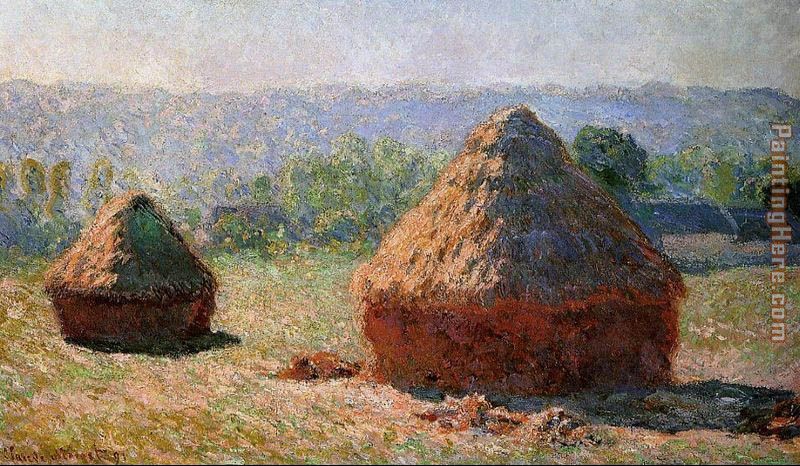
Monet's "Grainstacks at the End of Summer"
I believe in the wonder of all of these things I place before my sons, but I still feel heavy in the heart when summer ends.

Life used to be marked clearly into sections when I was a kid. When the last day of school came, it felt like I needed to break into a run and keep going until the ocean waves flared into white plumes around me. It felt like I stood at the ticket gate of a vast carnival filled with infinite rides. Now, summer comes, but it feels more like it flows around me, as if I were a stone in a stream, until the river finally goes dry.

Wednesday, June 15, 2011

Remember Me?

(I was listening to the rain today and thinking of people in my past -- those I loved, lived with, studied with, made music with and passed by among late night shadows -- and this came out:)

Remember me? How did I come through your life?

Was I a volcano, a crater or an iceberg upon the planet surface of your brain?

Do you remember me in a chilled, leafy wind,
     sitting on a crumbling city wall, in a city smelling of city rain,
     looking like I was in need of a shave and some poetic truth?

Do you remember me singing and playing in an empty auditorium
     as you watched through the double-door windows -- or standing in the firelight
     in winter woods?

Or was I a cheek-kiss at a party or a handshake, stepping down from the stage?

Was I sweating on a field, running hard next to you among young men seeking
     glory?

Or was I your boyfriend's roomate?


"Rain," by Childe Hassam

Friday, December 31, 2010

Happy New Life!

In almost exactly twenty-four hours, I will perform -- quite literally perform -- my yearly hypocrisy. I will sit on a stage and play the drums in a band for New Year's Eve. When the clock strikes midnight, I will play "Auld Lang Syne" as if I give a flying cupcake. In reality, I have never cared about New Year's Eve, nor about many other markers of time and transition.

Others see the new year as a new beginning and they see a reason to mark graduation from kindergarten through college. But I simply am not, and never have been, moved by these things. I'm not sure why. I do think maybe we should not place so much importance in transitions and time-markers, especially regarding a goal that just about everyone achieves, like high school graduation. (If I ever win a Nobel prize for literature, there may be a party in order . . .)

Friday, December 3, 2010

That Kind of Time

Click pic for source
Okay, so we might as well stick with the "time" theme this week. You know what I am sick of? People who say "Man, I wish I had that kind of time on my hands" to people who do things like, oh, I don't know -- maintain blogs, carve pumpkins, make art or pursue anything outside of the mundane chores both required by everyday life and created in order to give its drudgery an illusion of purpose.

These gloriously busy, condescendingly grown-up people are usually the same ones who love to brag about never being able to sit still. "Oh, I am not a sit-around kind of person. I have to be doing something." So, I guess I am supposed to clap. Bravo(a). You don't like to sit around. You're in the fray. A suburban warrior. Woot.

With the proper accolades graciously and sincerely distributed, I would now like to point out two things about myself:

Wednesday, December 1, 2010

Finding Nowness

Recently, on The Art of Manliness blog, in an article called "Being Fully Present as a Man," I  found that Brett and Kate McKay had written about something that has been floating through my dome since I first heard John Mayer's song "3X5":

Today I finally overcame
trying to fit the world inside a picture frame
Maybe I will tell you all about it when I'm in the mood to
lose my way -- but let me say:
You should have seen that sunrise with your own eyes
it brought me back to life
You'll be with me next time I go outside
no more 3x5's

Monday, November 29, 2010

Every Captain's Dream

Many have said it: Time is a river. We all ride this river, but we each experience it uniquely -- we feel the journey differently, depending where we are -- where the river bends; where the bubbles rise; where the rocks scrape the bottoms of our boats. And it is on a boat that we ride and that boat is filled with those who share our trip, whether by accident or by design.

As she goes, we spy scenery going by. When we look away from it and put our heads down to some task, either on deck or below the planks, we miss what is passing. Then we stop and say: "When did I get here? Where did the mountains go? -- the ones I remember so vividly from once before?" If we stay on deck and watch things passing, looking into the distance, it feels as if time is passing slowly. But if we watch the water rushing past our sides, we feel we are outracing the wind and maybe the river itself, though that is foolish, and days become minutes.

Friday, September 17, 2010

On the Lonaconing Trail

Every day I drive on a road that was once a Native American path for journeys to the sea and that became, for some time at least, the longest highway in the world.  And, every day, I pass a particular house.  For years I would wonder whose it "is". Now I wonder whose it was, as it sits empty and crumbles into a beautiful decay.

This road is bullied, on both sides, by businesses, gas stations, billboards, cell phone towers, abandoned lots with grassy cracks, apartment complexes and diners.  But the house I see every day squats a few feet down off of the road, on a property of a few acres that muscles away the artificial ugliness around it like a crew-cut Samson grunting between crumbling pillars.  It's a small green house with a glass solarium on the front.  Behind it, there is a matching green barn with an old winch poised over the upper door for lifting the ghosts of hay bales.  It is surrounded by trees and clumps of high, brushy grass that stretch off into the distance as far as I have time to see in a leftward glance at sixty miles-per-hour.  There used to be two cars parked next to the door in the mornings; small ones; modest ones.  Most days I would wonder about those people in that eccentric house in that unlikely location.  Now I wonder where they have gone.  I wonder whose house it was.

It's on an easy-to-forget curve in the road that stagecoaches once clopped around so much more slowly than we daily travelers do.  Sometimes, stepping out of my car, I question whether I've ever really seen the place at all.

Among the brush, streaked with brown rust stains, there stands a giant satellite dish, next to what's left of a brick stove.  The dish has to be ten feet across.  It looks desperate -- pleading for a signal from any source from anywhere. 

In the end, I do know whose house that is, on the long road, standing its ground among businesses, towers, lots and motels; dropping in and out of the minds of those who see it now and again; sitting in its own temporary oasis, quiet in a noisy world, full of forgotten history and facing its misty future.  In the end, I know exactly whose house that is.  It's mine.