
Prologue
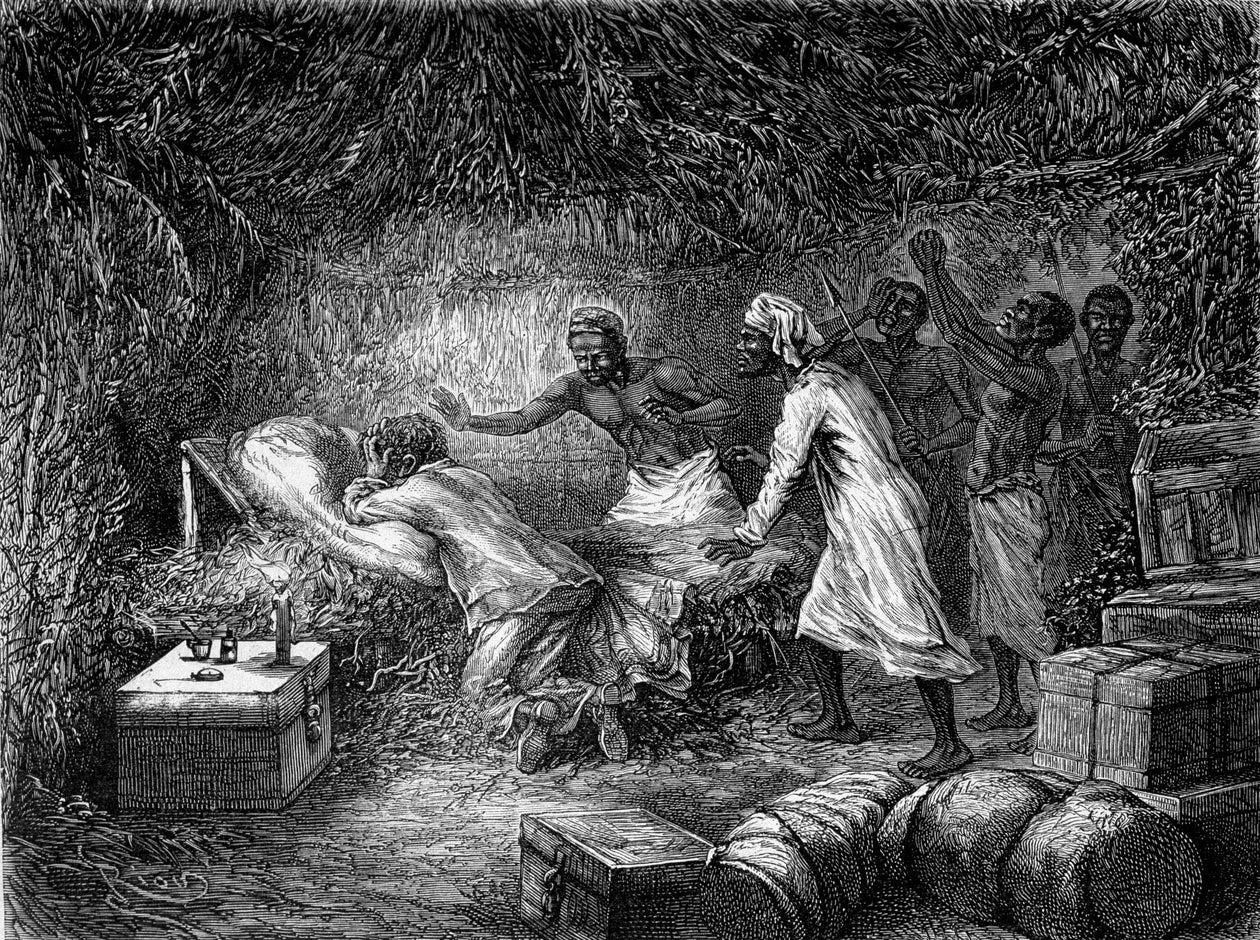
In 1873, the legendary explorer and physician, Dr. David Livingstone is said to have died while deep in prayer, in a village in what is now Zambia. His servants, Chuma and Susi, found his lifeless body kneeling by the bed and they decided that, while most of him should certainly be returned home to England, his heart, which they knew “belonged to Africa,” should remain there. In short, the good doctor’s body was finally interred in England at Westminster Abbey, but he literally left his heart in Africa, buried, they say, at the base of a mpundu tree.
My wife Karen and I made a twelve-day journey this summer across a lot of the continent, from Cape Town through Zambia. It was a powerful experience in so many ways.
And so, less dramatically, and minus the rather presumptuous amateur field surgery of dedicated friends, I, too, left at least a few pieces of my own heart in Africa. But it seems to me that the only way to leave some of one’s heart behind is to have it break just a little. Pieces had been definitely chipped off over the course of my experiences there, and they now lie here and there under a thin layer of rust-red Zimbabwe sand…or maybe blown like leaves into a refuse-covered corner, in the streets of Soweto where the wandering goats snuffle for food.
But let’s take our time getting there. You can’t rush a story as deep and wide as Africa.
Africa felt like a land of paradoxes—both pleasant and disturbing ones. The places we visited, like South Africa and Zimbabwe are, essentially, newly emerged into self-possession of the proper people: the native Africans. Apartheid only ended in 1994; Zimbabwe relatively recently gained independence in 1980 and Zambia only broke from England in 1964. When one visits these countries, it’s evident that one is witnessing an ongoing emergence of infrastructure and governance and a transition of the traditional into the modern, free of colonial or of white European oppression.
I’m not a historian, but is it going too far to say that these countries are weathering a period that is similar to America’s Reconstruction after our Civil War? Change of that magnitude doesn’t happen without massive growing pains and some of those pains are shown graphically in highway ramps to nowhere and in rail yards full of mis-guaged trains worthlessly/expensively rusting in a yard outside of Johannesburg. A society can’t just wait for the dust of revolution to settle and then add water to stir up a perfect government like a some powdered drink. Forty or fifty years is not enough time for imperfect humans (as we all are, by definition) to whip up a perfect world.
As I travelled and hung on every word of the people we met, it was hard not to disappear into my writer’s brain to wrestle with the pain and the paradoxes I saw. My wife, Karen, and some of our travel companions occasionally noticed my “absence” and asked if I was okay. I said I was fine, but the real answer was that I was and I wasn’t fine. I am an empathetic person to an almost alarming degree. Heart-cracks were forming from the moment we entered Johannesburg, for sure, but we need to get there in this travel narrative first and, in doing so, we’ll walk through a lot of joy and laughter and adventure as well…
I need to make it clear that this is not going to be a white American piece about how sad I am for the Africans. These people are not in need of my journalistic rescue, nor do I see them as victims. I found the South Africans, Zimbabweans and Zambians incredibly kind, funny, insightful and confident without arrogance, not to mention deeply educated both in global affairs and in terms of every area from environmental science to politics to bushcraft. For now, let’s keep a broad definition of “paradox,” and I’ll explore the idea as we go, if you don’t mind sticking with me…
Part One:
Days 1 to 3: Cape Town
There is nothing heartbreaking, at least on the surface, about Cape Town. It was the perfect place to decompress after twenty-plus hours of flights, from Newark, New Jersey, to Johannesburg to Cape Town.
Cape Town is a classic resort town, with a slightly hipper “Jersey Shore” atmosphere down by the Victoria and Alfred Waterfront, which was just a few minutes’ walk from our hotel, the Portswood. That hotel is crafted around a building that had been used to hold prisoners (including Nelson Mandela) who were bound for the long-term prison on Robben Island – the architects even preserved some of the original walls and cell bars in the dining area and lobby – but…it wasn’t emphasized. Before I noticed, our guide had to point the "prisony' parts out.
Down by the water, Cape Town proudly displays a big, air-conditioned Ferris Wheel and people lie about in the grass wearing earbuds and feeding the gulls (which I swear have a different accent than the gulls in New Jersey); there are gift shops stocked with cheap trinkets priced at double their worth. Buskers abound, some of them aggressive enough to put a pungeant arm around you and demand American dollars, others soft-eyed and deferential and just hoping for a few Rand. As it is everywhere, the better artists were the least agressive. There are booths at which to sign up for boat and helicopter jaunts. You get the picture.
We arrived a day before we were scheduled to meet our guide, so we explored a bit on our own. Cape Town is a place in which Europeans, Americans and Canadians can feel like they have not yet stepped into another world, even though the rest of our destinations to come would be poignantly different than home. It may have been a strategy of our tour company: get them comfortable before you challenge them.
Still, anyone who travels at all knows that reading about cities abroad can stoke the fires of reluctance. The fact is, though, that cities are cities, for the most part. We had heard warnings about Cape Town. (Of course we did. Your average vlogger sounds cooler if their trip was sketchy.) Some cities are more dangerous than others, but any city is dangerous for a fool. Common safety sense goes a good way. But Cape Town felt way safer than Philadelphia, near where we live. We were fine and felt comfortable everywhere we went, even in the non-Uber cabs we were advised not to take.
Fear can be such a powerful thing. This trip, from exploring places that were unfamiliar to experiencing wild animals within arm’s reach, was a constant reminder that fear is mostly exaggerated of caution. It’s often baseless and in this information age, while reading up on things should be helpful in preparation for just about any adventure, caution and preparation can be downright crippling.
I once saw a post about the “proper way to take a book off of a shelf” and I remember thinking: we are just so overinformed and bored, as a species. Imagine thinking: “What if I am taking books down the wrong way?” Enough already… One person says, “Sure, use Uber in Cape Town” and another says, “My aunt Louise was stabbed and left to die by her driver.” What’s the option? -- Dorito breath on the couch for the rest of forever...or do you pick a point at which to stop listening to the advisers?
As for the people of Cape Town, it immediately struck me how nice they seemed. Not just “nice.” They were disarmingly sincere. Everywhere I have gone in the world, I have felt a certain “vibe” from the local people. Here, I was immediately relaxed. Their voices were sweet and melodic, but not in an artificial way. In my limited two weeks of experience, South Africans are real.
I don’t think I walked past a person who didn’t nod or smile. People on the street and maids and maintenance men in the hotels all looked you in the eye and asked after your day. The servers in the hotels had a wonderfully balanced aura of service with dignity but never with arrogance. They were not self-consciously threatened by serving others as I feel many Americans are; equals can serve others without shame, and the South Africans felt relaxed into that idea. No one carried a need to assert either their equality or superiority.
Yes, I know that “one may smile and smile and be a villain,” and I am not enough of an imbecile to think Cape Town is devoid of wrongdoers, but I know what I experienced in those days and it was worlds away from the stylized obnoxiousness that becomes apparent within an hour in Philadelphia or a New York City.
On day two, by fortunate mischance, we met was a bespectacled, energetic and interesting young cab driver named Vernon. (Our luggage had not made it to Cape Town from our, like, six-second layover in Johannesburg, so we had to take a cab back to the Cape Town airport on the second day.) When Vernon asked where were from, and we said “the U. S.,” he waded right in, with no fear and with complete absence of malice.
“Can I ask a question? What are you people doing over there?” he said, smiling back at us in the rearview. I could see his eyebrows hovering plaintively above the upper rims of his black-framed glasses.
He was referring to Donald Trump, we quickly came to understand. We had a very brisk talk about politics during the twenty-minute trip. He was vehement about the negative effects he saw, half a world away, because of Trump’s administration. When I asked him how many of the Americans he drove were Trump supporters, he paused and thought and said, “One guy. Once.” Vernon was very adamant that Trump is deeply disliked in Africa. One man’s observation, of course, but…there it is. Even a divisive topic like politics felt friendly and productive, though.
(Later, another driver, amusingly, asked us, “What is up with Florida? How come every time I hear a weird story about America, it happens in Florida.” I mean…it was hard to argue…)
For the ride home (bags acquired), we had a less talkative driver on whose radio we heard Phil Collins, Sting, Madonna and Tina Turner. A week or so later we’d hear Bon Jovi on the speakers at a rest stop. I just remember shaking my head, trying to imagine the level of fame these people have achieved. John Bonjovi is from my home state and his songs are played at rest stops in South Africa. Mind boggling, especially for a musician like myself who thinks he’s pretty cool when he plays in nice local venues.
That evening, we met our guide, Braison. (He is named, we found out later, after a family friend – an English doctor – who delivered him.) Braison is a Zimbabwean from Mashingo with a soft, rich voice and a gently imploring face. The more we got to know him, the more we liked him. Everyone in the group, I think I can say, felt this way.
I was immediately struck by his stated desire to reverse the perceptions the outside world has of Africa by planting fertile seeds in the minds of his groups. He does not like the way Africa “reads” to the outside world. Even so, it never felt, over the subsequent days, like he was exercising some rigid re-education campaign. So much of what he taught us shone light into places none of us would otherwise have seen: the more intimate truths about Africa. I know, for sure, that he changed what I understood about the culture and the continent.
With Braison at the head of the hotel conference table, we got to know our fellow travelers. There was a family of four ladies from California and Brooklyn: Dr. Ellen, her daughters Julia and Emily, and Emily’s wife, Jordan. Our four new Canadian friends included Debbie and Carol (Catholic school teachers, like me) and Michelle and Paul, a married couple. Paul is a retired Honda electrical engineer and Michelle, who was on this trip to celebrate her 60th birthday, is a social worker. We all got along from the start. After the initial meeting, dinner conversation flowed and it was clear that we’d be doing a lot of laughing.
That night, it was established that Debbie, Carol and my wife, Karen, were going to be quite the impromptu singing group who would entertain not only our immediate little travel gang, but people on other safari vehicles out on the savannah..as well as neighboring diners in restaurants...
For our first of many paradoxes, consider: Braison is a man who carries an iPhone, uses apps, watches sports on TV, navigates airports like a pro (well, he is a pro), enjoys good wine, has a deep knowledge of everything from bushcraft to world politics and, yet, with full dedication to his culture, lives in a little village in a house he built himself, with a tin roof – a luxury he could afford because he works outside the village. (The others are thatched.) With all of this in mind, we are also talking about man who paid a dowry of cows be granted permission to marry his lovely wife, Grace (whom we’d have the privilege of meeting later). Braison stands astride the two worlds of tradition and change and, for that, and many for other reasons, he was a master teacher when it came to African culture.
There is NO intention in what I write, here, of ever condescending to or of ridiculing Braison’s way of life. Quite the opposite. I find his lifestyle admirable. He is a respected member of his village who is called “m’dala,” which, literally, means “old man.” Braison is not old at all; the title implies wisdom and a kind of grace under pressure as recognized by his fellow villagers – a level-headedness they recognize as an attribute of a true leader. From what I would come to understand of the man, I am not at all surprised the chose him as a leader.
He spoke often about the desire of his people to retain their culture and language and traditions in Zimbabwe (and around Africa, as well) while improving conditions for their children. This idea is, for me, the real (pun intended) elephant in the room in most of the places we visited. Emerging from repression and holding on to tradition is a hell of a magic trick. Braison and our second guide in Zimbabwe both showed us that it can be done but that maybe, as a culture, things are also being lost — in both a positive and a negative sense — in deference to progress and growth.
If the eyes are indeed the soul’s windows, there was a panoramic view into real Africa behind Braison’s gaze. The man woke up caring and went to bed caring. His job as a guide seemed like a true vocation, in the most spiritual sense.
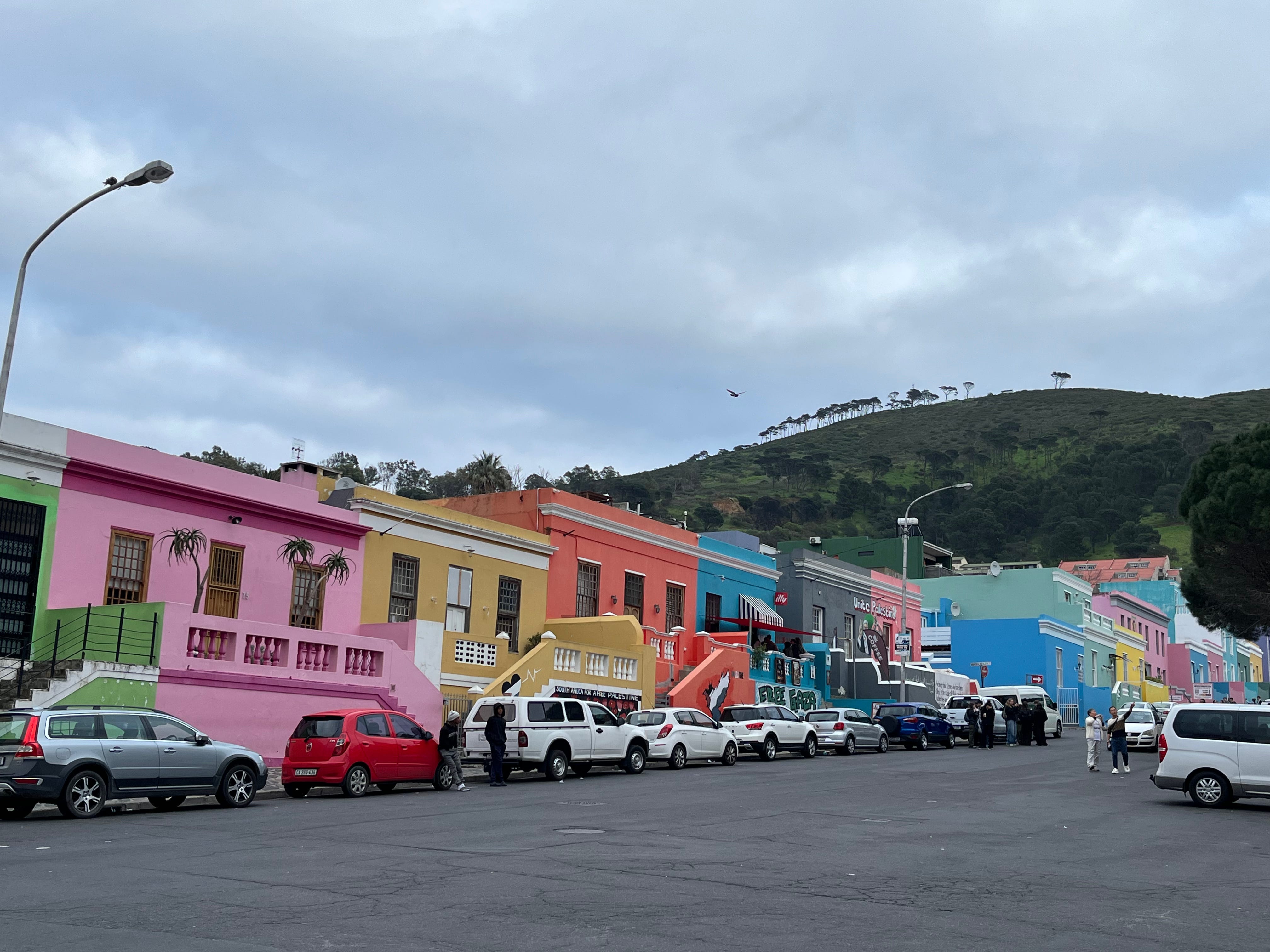
We started our first full day by walking the Bo-Kapp district of Cape Town, which was originally built in the 1700’s by the Dutchman Jan de Waal as affordable housing for freed slaves and which is, now, a thriving, multiracial community with bright, vividly-colored buildings, brimming with folk art and punctuated with pro-Palestinian sentiments emblazoned on many of the walls, which I found interesting. The streets were relatively empty that morning, but we were passed by groups of runners who were, I guessed, training for an upcoming run advertised throughout the city. None of the groups who passed us failed to say good morning.
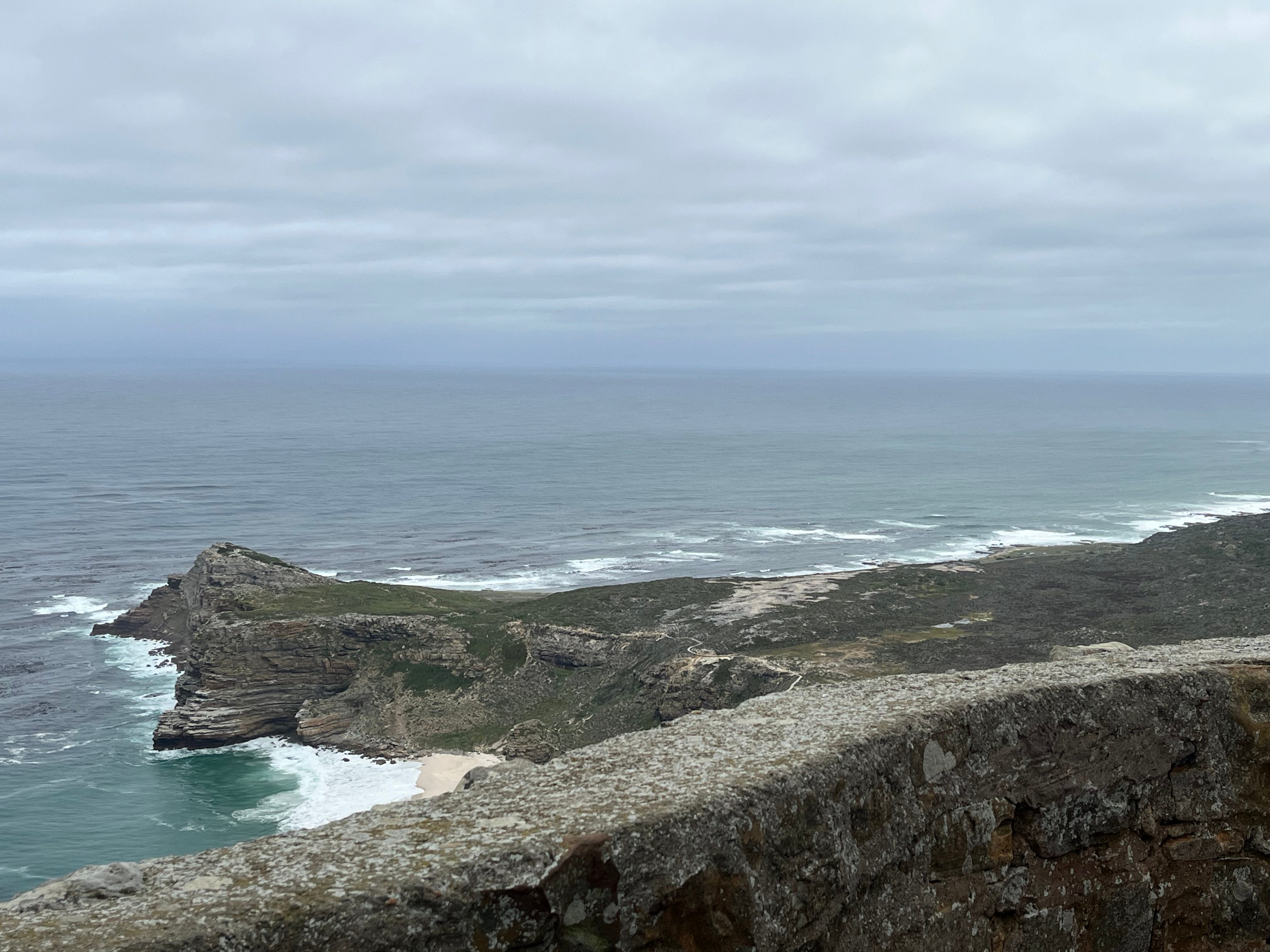
Soon after, we drove down to the Cape of Good Hope, where Karen, Debbie and I climbed the lighthouse stairs and enjoyed a moment of the view at the southernmost point before Antarctica. (Our new friend Carol [Debbie’s travel companion] had awakened feeling sick that morning. At breakfast she’d asked we felt okay, as she was worried dinner the previous night might have been an issue, but we were ok. She’d wind up spending that day in her room with some other kind of bug.) The views were spectacular, of course, and the wind was whipping up quite the chill.
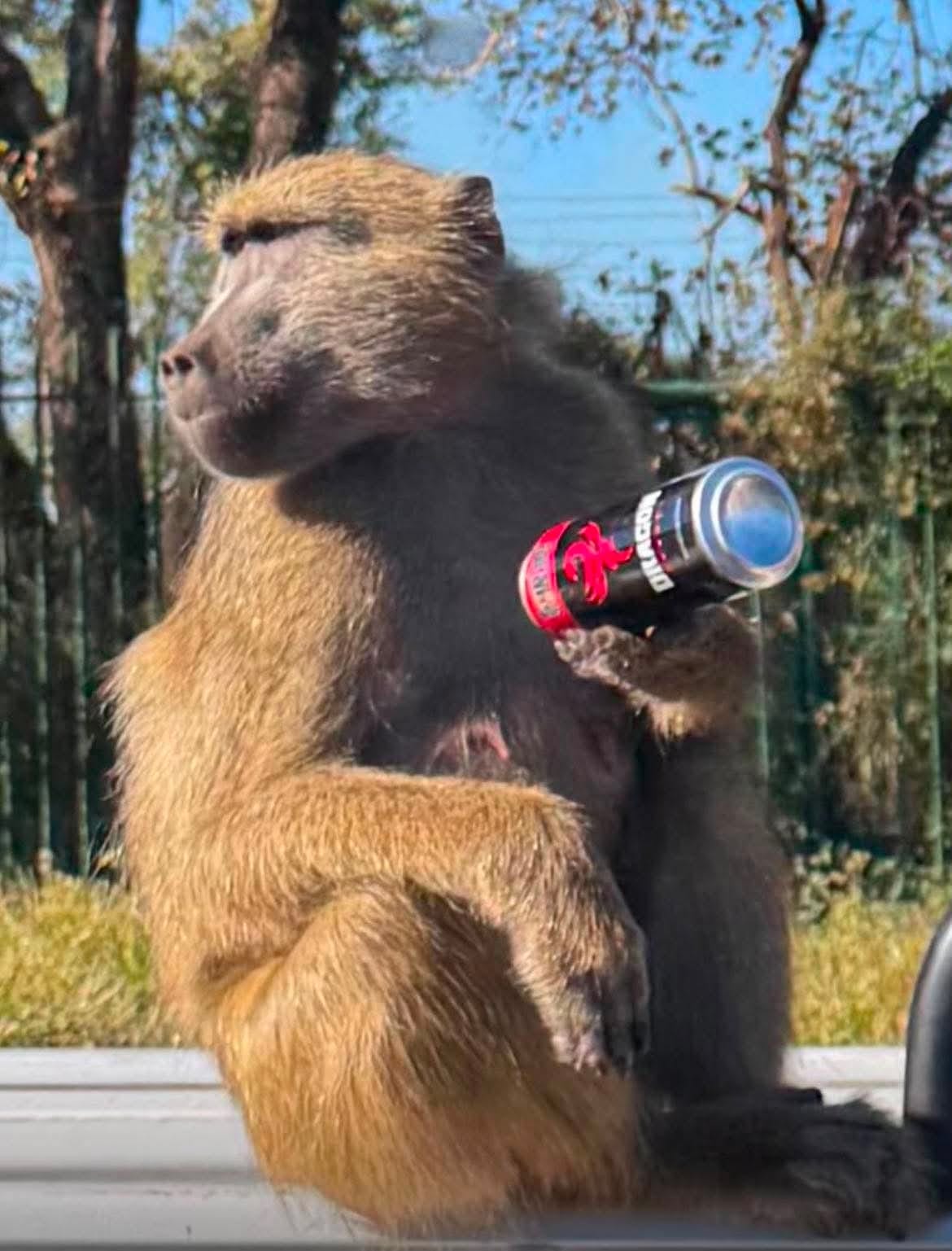
It was on this leg of the trip where we spied our first baboons, after having seen severall signs warning us that baboons were, in fact, wild animals that could be dangerous. Braison labeled them, with his rich, rolling “r” as “crrrrreeminals” who will steal the hat straight off your head if you didn’t watch. (More on that later.) He emphasized how “naughty” they were, which became a humorous theme on the trip, especially for Michelle, who made me laugh every time she imitated Braison: “Naughty!” What I loved, though, is that, sure, it was funny calling them “criminals” but you could hear the sincere frustration in Braison and in other Africans: these creatures were a real pain in the butt. To us, they were adorable scamps; to Braison, they represented stolen shoes, ransacked rooms and ruined gardens.
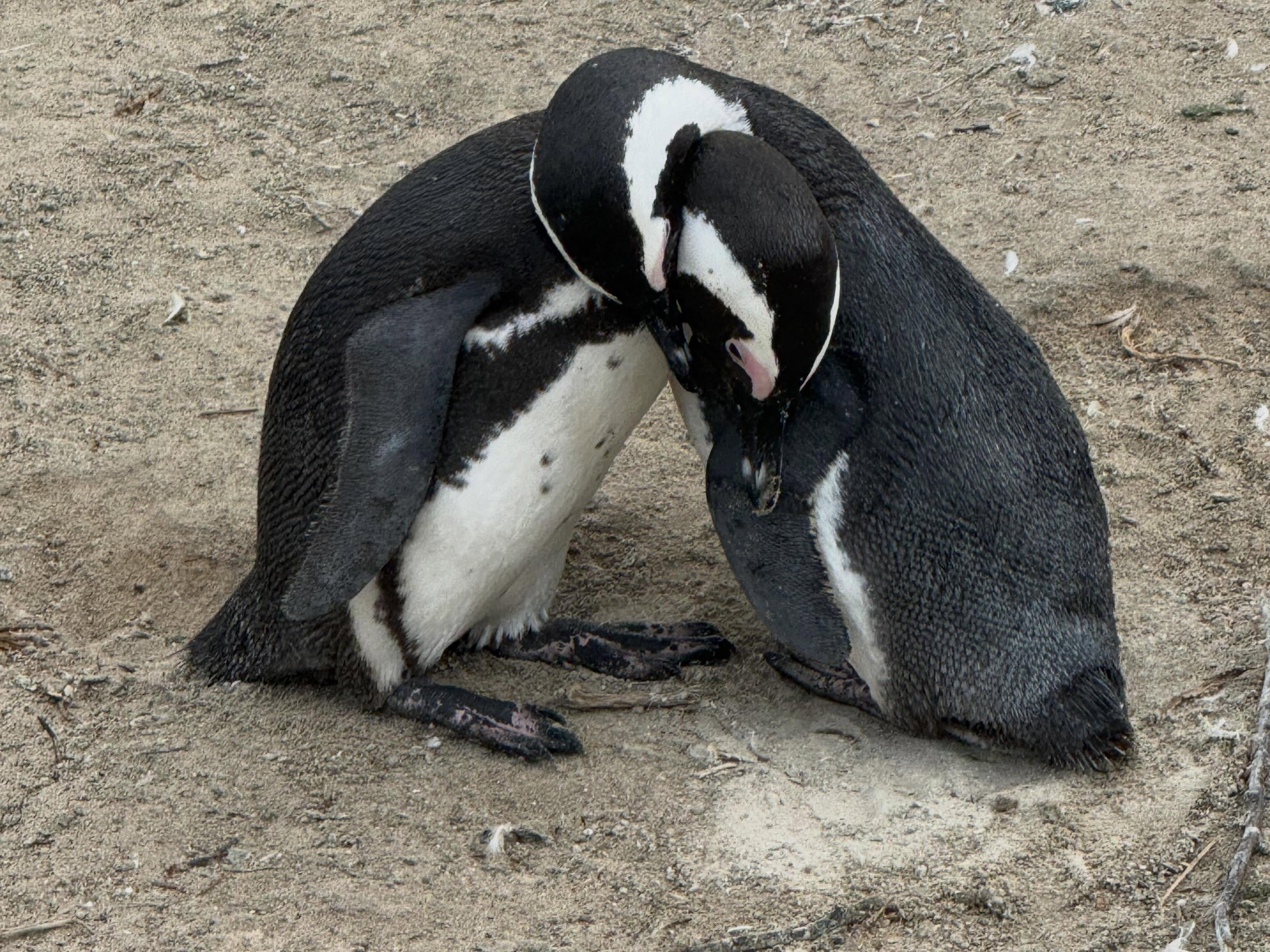
Next came our chilly and drizzly visit to Boulders Beach for a close-up gander at the uber-cute African penguins. Adorable doesn’t sum it up. As they wobbled laboriously around, begin cooed at by the tourists who loved their awkward old-man shufflings, I couldn’t help imagining one of them finally having had enough and climbing up onto a rock to say, “Yeah, but you should see us SWIM!”
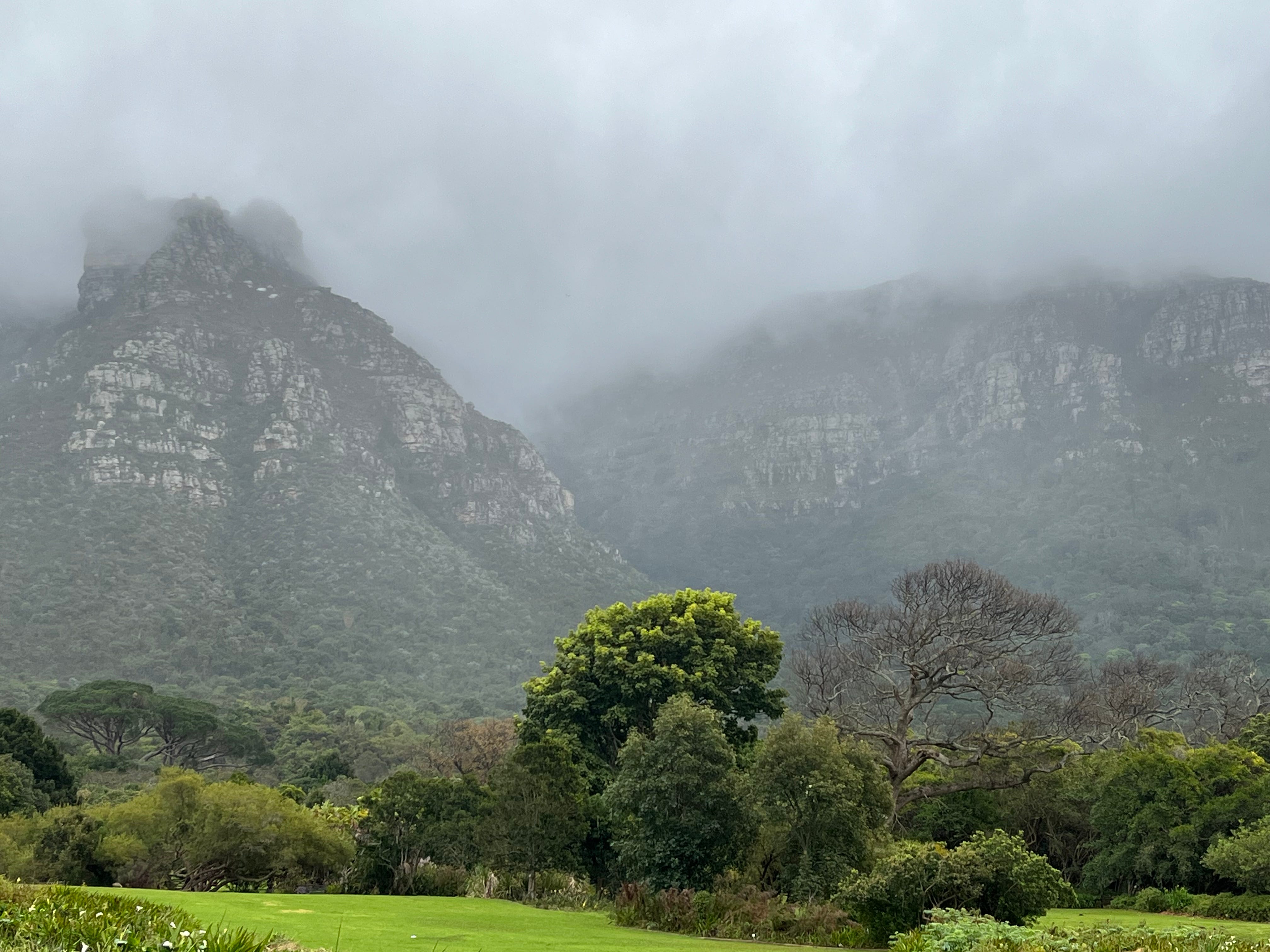
En route back to Cape Town, we visited the lovely Kirstenbosch Gardens where we were guided by an elderly gentleman – Bernard, I believe his name was – who swayed corpulently in front of us, seemingly unconcerned about the microscopic, needle-cold rain that was passing straight through our jackets. He wore good rain gear and exhibited excellent knowledge of the flora. He also had a great store of gender stereotype jokes that were just short of appropriate, especially considering our predominantly female group, but I get the impression he was too plucky to be mad at, even for the ladies. Old dudes always seem to get a pass on stuff like that.
Regardless, my eyes were drawn, the whole time, to the lush green mountain peaks that brooded over the gardens. This was easily one of the most sublime landscapes we saw during the trip. I have never been remotely interested in botany (even though I once took a class on it at Penn State to fulfill a prerequisite slot) so my eyes were drawn to the surrounding, deep green majesty the whole time, reducing Bernard’s jokes and lessons to a distant backing track.
That night, I had the honor of having dinner with Braison, Karen, and Debbie. (Sadly, Carol, was still very sick that night and could not join us, but fortunately, she was up and running the next day!)
There was no set group plan for dinner, but Braison had offered to meet anyone of the group who was interested so he could walk us to the good restaurants at the waterfront. Only the three of us came down to the lobby, so we walked through a light evening rain over glowing streets and walkways to a restaurant called “Karibu” that he recommended highly. At the door, Braison started to say goodnight, but he happily accepted when I invited him to stay and eat with us. I’m so glad I did. It was one of my favorite nights on the trip.
Braison is a gifted storyteller and an excellent listener, and he shared stories about his life with us, including the tradition his people have of burying a newborn’s umbilical cord. When “his day” comes, Braison's body will be buried there. That is not just home – it is “home-home,” he said.
I found that many of his stories, while unfamiliar to me and maybe, at first, a little off-putting, were, after some thought, incredibly touching. His culture was one of deep meaning and of connection to origins, but also about self-sacrifice. Realities in early African survival have certainly informed the evolution of the culture.
That day, in the van, for instance, he had told us a very powerful story (which I doubt I can share as effectively). He taught us about the “bushmen” of Africa’s past. They were nomadic, so everyone had to do his or her part in the hunting, gathering and shelter making. There usually came a point, though, at which “grandpa or grandma” was too old to contribute and had to be left behind. This may sound unconscionable to many people of our less survival-oriented times, but, as I interpret it, the message was that the elderly person could grant a gift to the younger by easing their burden.
It was literal self-sacrifice. The old man or woman would remain behind in a small shelter and wait for the end. The hungry animals would come…the cycle of life would continue. I found that quite profound. There is a beautiful balance of surrender and control in this – choosing the time to die, but not really committing suicide; it was the sacrifice of a life for others. If “taking a bullet” for a friend is admirable, why would this not be the same? It would be interesting to see Christian theologians wrestle with that morality, but it felt somehow right to me—and natural, in the truest sense.
Is this another paradox? Superficially, it sounds so cruel, but it is simply necessary, where survival is concerned, to not be an obstacle to the survival of others. When life is about subsisting and not about thriving, what choice is there? There were no nursing homes and no guarantees of sustenance. I have often thought that our comforts in Western culture have made us unhealthfully bored. We complain about the silliest things. What if you contributed to the downfall of your tribe? Of your family? I know I would gladly sacrifice myself for the benefit of my family without a blink.
And so, conscious of the almost embarassing irony, I turn back to our top shelf meal at Karibu…
At Briason’s recommendation, I had ostrich with a side of chakalaka; Karen had a venison plate with kudu, impala and springbuck, which was all delicious. Ostrich, I found, felt a little like fillet mignon but had its own uniquely wonderful taste. I really can’t compare it to anything…not even chicken. And a definite thumbs-up on chakalaka, which I had never had.
The conversation was as good as the food. On top of Braison’s gift of gab, Debbie (and Carol, too, we’d already seen) felt quickly like an old friend and there was never an awkward moment in the conversation.
After one of the best meals I have ever had, we were surprised by what I found to be a truly moving musical performance.
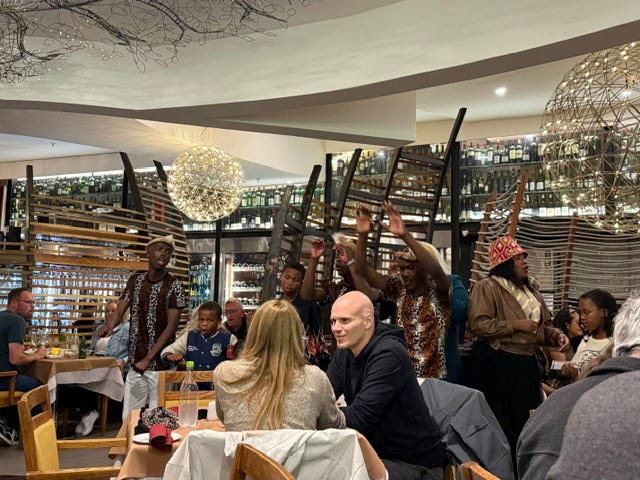
A group of kids – maybe ranging from ten to eighteen years old – stood a few feet away from us to perform some traditional African music, accompanied by a young man with a djembe drum. As they began (they were behind me) Braison said – and I love how it sounded more like an instruction that an option – “You can turn your chair around.” I did. He didn’t want me to miss this, maybe because he knew I was a drummer and a musician, but certainly as a matter of pride: These are our children. Hear them. This is why you are here.
Their voices were as powerful as any operatic singer’s. The young man on djembe was excellent (I own my own djembe, so I have some idea of his skill level). Their chant-like melodies and simple, open harmonies really affected me in a way I did not expect. In short, these kids moved me to tears:
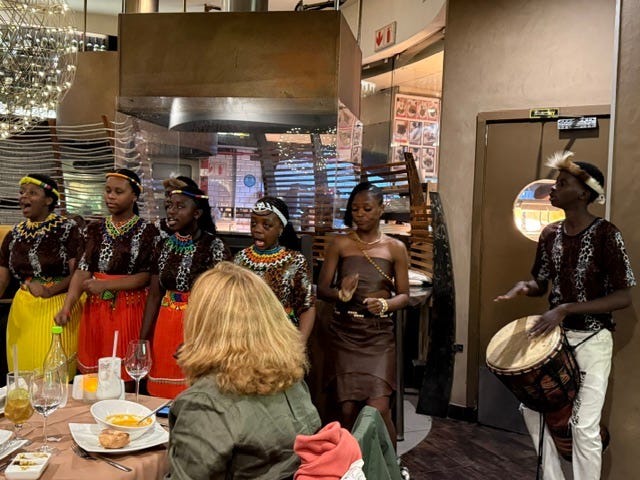
What was it that hit me so hard? Whatever it was, I found it difficult to speak afterward. I guess it comes back to sincerity. There was none of the posed remoteness of other young performers that I’ve seen in other places or cultures. There was no attempt to “be cool” – a compulsion by which my own high school students often seem completely hobbled. Somehow, in other places, "cool" is equated with "bored." But there was no subtext behind their eyes that said, “My parents make me do this for my college resume.” These kids believed in what they were doing: delivering African tradition to travelers. They were doing what Braison placed so much importance, upon: showing outsiders the real Africa, all through strong voices and wide smiles.
Within their rhythms, and running through their tune, there was the span of ages. There was the continuation of a song wrought millennia ago around a fire on the savannah. In it lay a deep oral history, and it rolled out with flash-flood force, covering you over, not to drown you, but to propel you further into the interior of a continent’s soul; to cover you in the emotion of the place. It was about the heart, not the head. We don’t know anything, truly, until we feel it, do we?
One thing Braison mentioned to me was that he used to love listening to his grandmother (amusingly, an everyday, all-day smoker of ganja, was grandma) tell stories. Is there anything more important than story in a culture? (As an English teacher and as a writer, I have wrapped much of my life around story.) I couldn’t understand the language of these young people, but it did not matter. I felt their story.
One of my biggest complaints in American culture is the lack of sincerity I feel around me (call me Holden Caufield, I guess), which is born out of a cultural preoccupation with seeming “cool,” as I mentioned above. What else can we expect when our role models in youth are movie stars, pop stars and athletes? (Not that African kids don’t idolize some of the same types.) But Africa was underscoring that people are simply not the same the world over. Of course, I knew this before boarding the plane, and so do you…but…to feel it is more important than to realize it, intellectually. This is a good place for a sermon on the importance of experiencing other cultures, but I will spare you – you get the point.
When we left the restaurant, the restaurant owner, a white South African woman with short hair and big glasses, hugged Braison, whom she knew (and, by her own words, loved), and then proceeded to hug Karen, Debbie and me. It was a real hug. A hug that meant something. A thank you hug. “Welcome to South Africa. You are so lucky to have Braison as your guide,” she said.
Indeed, we were.
On the third day, we were free to roam. The cable car to the towering landmark of Table Mountain was closed for maintenance, which was a shame, but we took a cab Signal Hill, a vista with beautiful views. Guns are still fired at noon atop the hill in remembrance of the cannon that used to fire to warn of ships in trouble off of the cape.
Our driver, Owen, was from Soweto in southwestern Johannesburg and he talked about the place’s dark history that we were scheduled see up close in a few days. He referenced the Soweto uprising.
He was a pleasant guy who, after a conversation with a parking attendant, laughed and told us how cool he still thinks it is that South Africans (as he had just been doing) would regularly speak with each other in two different languages and understand every word.
He was a good egg. As we explored the hill, he’d driven some way down the path to wait for us to walk back, but it had begun to drizzle (I have, indeed, “blessed the rains down in Africa”…or cursed them, as you can see), so he came back up to meet us. On the way back, he spilled his heart about Apartheid and his home neighborhood of Soweto. Knowing we would be visiting there, he encouraged us to pay close attention and to take away the truth of the sufferings of his people under that so-very-recent racist regime.
The rest of the day was shopping, especially for some warmer clothes for safari in Kruger National Park. The rain and cold were more intense than most of us expected, so morning safaris would be icy. Everyone in our group was second-guessing their wardrobes by that point, prompting unplanned visits to the Cape Town mall. I bought a hooded sweatshirt and Karen picked up some sweatpants and a hoodie, as well. (I had packed five pairs of shorts that I never wore. It was, in fact, African. winter, but we didn't expect it to be as cold as it was.)
Karen and I had nice dinner alone that night at the waterfront at “The Knysna Oyster Bar and Restaurant.” My seafood curry meal was almost as good as the ostrich at Karibu.
The next day, we all had to catch a flight back to Johannesburg for the next leg of the trip, so we went early to the room to pack and record the day. (Each night, I’d write notes in a journal and Karen would sketch the day’s events.)
Days 4 and 5 Johannesburg and Travel to Kruger
After a two-hour flight on what I think might actually have been the same plane that took me on my senior trip to Florida in 1986, and then shouldering our way through charlatan “porters” who pawed at our bags at the Johannesburg airport, we got on a small bus with our driver, Calvin, and headed toward the city proper.
On the way there, Braison taught us more about Apartheid, Mandela, Oliver Tambo and the forced relocation and mistreatment of Black South Africans by the Apartheid government. (Owen would have been pleased we were learning this.) In short, many people were ushered into districts like Soweto (“south-west township”) to live in poverty and overcrowded conditions, in a time in which all their rights were being stripped. The Apartheid government had even issued a passport meant only for Black residents, called the “dompas,” which quickly got labeled the “dumb pass” and was famously and courageously ignored by Nelson Mandela and other protesters.
Soweto, today, is still not a flourishing environment. The streets were eerily empty on the day of our visit. One would occasionally see a woman walking while balancing a basket or water can on her head. At the roadsides there stood ramshackle houses, some with homemade signs signifying an iron worker’s or tombstone maker’s shop. Several houses were labeled as beauty salons and others as lunch spots, but most looked like they had been empty for years. Some areas were carpeted in trash, and goats sniffed around in the piles of plastic bottles and empty bags. It was jarring to see brand names like Coke, Doritos and Lay’s at the feet (and in the grinding mouths) of the scavenging animals.
We had been scheduled for a visit to the Hector Peterson Museum, but it was closed that day. (It was a holiday: National Women’s Day, which probably explains the emptiness of the streets on a Monday.) We stood for awhile in the cold, windy courtyard until our site guide joined us.
Young Hector Peterson had been shot and killed at the age of twelve during the Soweto uprising of 1976. School children had gathered to protest the enforcement of the teaching of Afrikaans in school. The kids wanted to learn in their native language.
That horrific day turned into an infamous slaughter that opened the world’s eyes to the evils of South Africa’s government. Sam Nzima took the famous photo that made its way to North America in the hands of a Canadian journalist and it blew the cover off of things:

We pivoted to visit the nearby Regina Mundi parish, a Catholic church in which the children, on that day in ‘76, had tried to take shelter during the attacks by government soldiers and police but were shot through the walls and through the roof. The bullet holes are still visible, very much by design.
I don’t know what I was praying for when I sat in the pews, but I crossed myself and said an Our Father. It was a Catholic church. I am Catholic. I think maybe I was just praying for reassurance that our world is not the hell on earth it was on that day and for the repose of those children who died for daring to try to be heard. I remember, as a kid, learning that the Our Father is to be said with the confidence that God knows what you want better than you do. So…whatever I was praying for, I hope He heard. Sometimes you must send your heart up to the clouds, I guess, and just hope.
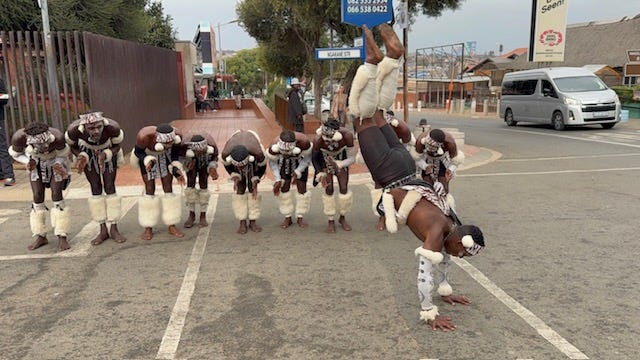
The Nelson Mandela Museum, which we also visited, was the home of a great man, but it was small and crowded and it squatted in the middle of a modest but busy Soweto neighborhood. Outside the museum, there were vendors and we watched some men performing a Zulu dance. Unlike the children in Karibu, this was an intense and war-like affair. The men thumped their feet on the asphalt street with such resounding force that it should have shattered their ankle bones. I swore they would leave dents.
Their eyes were fierce as they acrobatically danced, flipped, chanted and kicked. Even as they passed around the basket for tourist money, their faces did not carry a humble “thank you.” There was challenge in their eyes: “Don’t you dare look down on me for this. We’re the sons of warriors.” I held the collector’s gaze and, when I nodded, he did not nod back, but he did not turn away.
And as if the sets in a play had been changed during the pit band’s transition music, the curtains opened and we found ourselves in the elaborate Southern Sun Rosebank hotel in central Johannesburg. The staff formally greeted us in nametagged jackets with little fruity drinks and porters took our bags to our room, calling us sir or ma’am. There was tipping. (There was always tipping…it is a big part of the economy .)
I was not in the mood for a drink or a hot towel. I was not in the mood to be served or smiled at, even. I kept seeing the eyes of those dancers, needing our money but needing more to assert the power of their culture because an oppressive government had herded their fathers and mothers into (essentially) ghettos and left them to rebuild without sufficient support.
I kept remembering the bullet holes in the church. No, thank you, I don’t want a fruity beverage, Susan. I moved on from the mood eventually, but at that point, I was pretty preoccupied with the not-so-new realization that humanity is anything but civilized, despite all our pretenses – that the civilized ones in Africa had been those living in thatched huts, before Dutchmen, Englishmen, guns and soldiers arrived with the notion that superior technology equals existential superiority. Europeans just couldn’t leave people alone…we see the ripples even in America, in the historic struggles of our Native Americans.
That night, we met some new travelers who’d be joining us for the next leg of the trip. We were joined by a really cool family from just outside of London (Jim, Charlotte, Johnny and Aimee) and a fellow American from Santa Monica, in California, David, who was probably the most seasoned traveler I have ever met and a good-hearted chap at that. We had a lovely dinner together and the newbies fit right in with the original crew.
We were to set off on a long drive to Kruger National Park for a safari game drive the next morning, so it was up to the room after dessert: notes, sketches, packing and sleep.
(As we were milling about in the room, I pointed out to Karen that I didn’t think we’d had a single real converesation the whole trip. We laughed about it…there was just so much to take in…)
I couldn’t get out of Johannesburg fast enough, to be honest. For me, it resonated like a cracked bell and there was slaughterhouse stench of death and oppression even hovering over my fillet mignon at dinner. It’s hard to shake the feeling of standing in a church in which children – children – have been slaughtered. Yeah, I knew something of the history before, but to be there was, again, a whole other thing.
Travelling isn’t always about fun, though, right? -- it’s about understanding our world. These kids were not killed in ancient Rome in the Coliseum. They were not brutally sacrificed to the gods millennia ago in some Aztec temple. They were shot (about 180 of them) in full public view in 1976 while I was happily and safely playing with Matchbox cars in my suburban back yard in Voorhees, New Jersey. At moment like that, one realizes one really has nothing in life to complain about. Clichéd? Maybe. But that is how clichés are born: they are often proven realities.
As is often the case, the misery of human cruelty was, thank God, soon soothed by the presence of animals. We were headed for our safaris. The next day was travel to Kruger National Forest. If anything can heal the human soul, it’s elephants. As I grow older, I am increasingly convinced of the superiority of the rest of the animal kingdom. The Romantics knew it: Nature is teacher, doctor and escape from the horrors we create with filth-spewing machines, mathematics and greed. I needed it Nature now, and Africa would not disappoint.
(Please visit again for part two, next Wednesday…)
Also, feel free to follow on my Substack: https://chrismatarazzo.substack.com/

No comments:
Post a Comment