
(You can read part 1, below!) Day 6
Calvin had us rolling out of Johannesburg in good time toward Kruger National Park, and we would be about ten hours in the van. The trip, of course, was well-planned, by Braison and Calvin, with stops at some beautiful sites: “God’s Window,” “The Three Rondavels” and “The Potholes.” They were breathtaking spots—the “breathtaking” part being sort of augmented by a groping, frigid wind at each elevated vista. (It was African winter and our first days fell into an especially chilly and rainy stretch.)
I want to come clean and say that the African landscape has never been my favorite environment, aesthetically. Yeah, I’m a neo-Romantic—all about leaf and tree and stream—but the nature that resonates in my heart is painted in gradient greens, with hills like frozen ocean swells dotted with deciduous trees hissing in breezes over lakes. I have always seen the savannahs (and I feel this way about the American West, too, which I have been known to compare in appearence to a construction site) as sort of lifeless: brittle, tan, dusty.
I was in Africa for the culture and for the animals, so I expected little from the landscapes except dry and sun-bleached vastness. But, on a continent so massive, it’s not a great idea to generalize only by what one has seen in pictures. One glance at the views we witnessed and you could see the dramatic truth, deep in the valleys and high on the rock walls. Africa has raised its own grand cathedrals to Mother Nature. I know that now. I can even say that its cliffs were painted by more creative masters than America’s and I have have looked up, in the naked sunshine, from the bottom of our Grand Canyon and taken in its colorful, mile-high walls. Africa doesn’t care what I think anyway…she just sits with her hands folded, immovable and iconic. She knows her power.
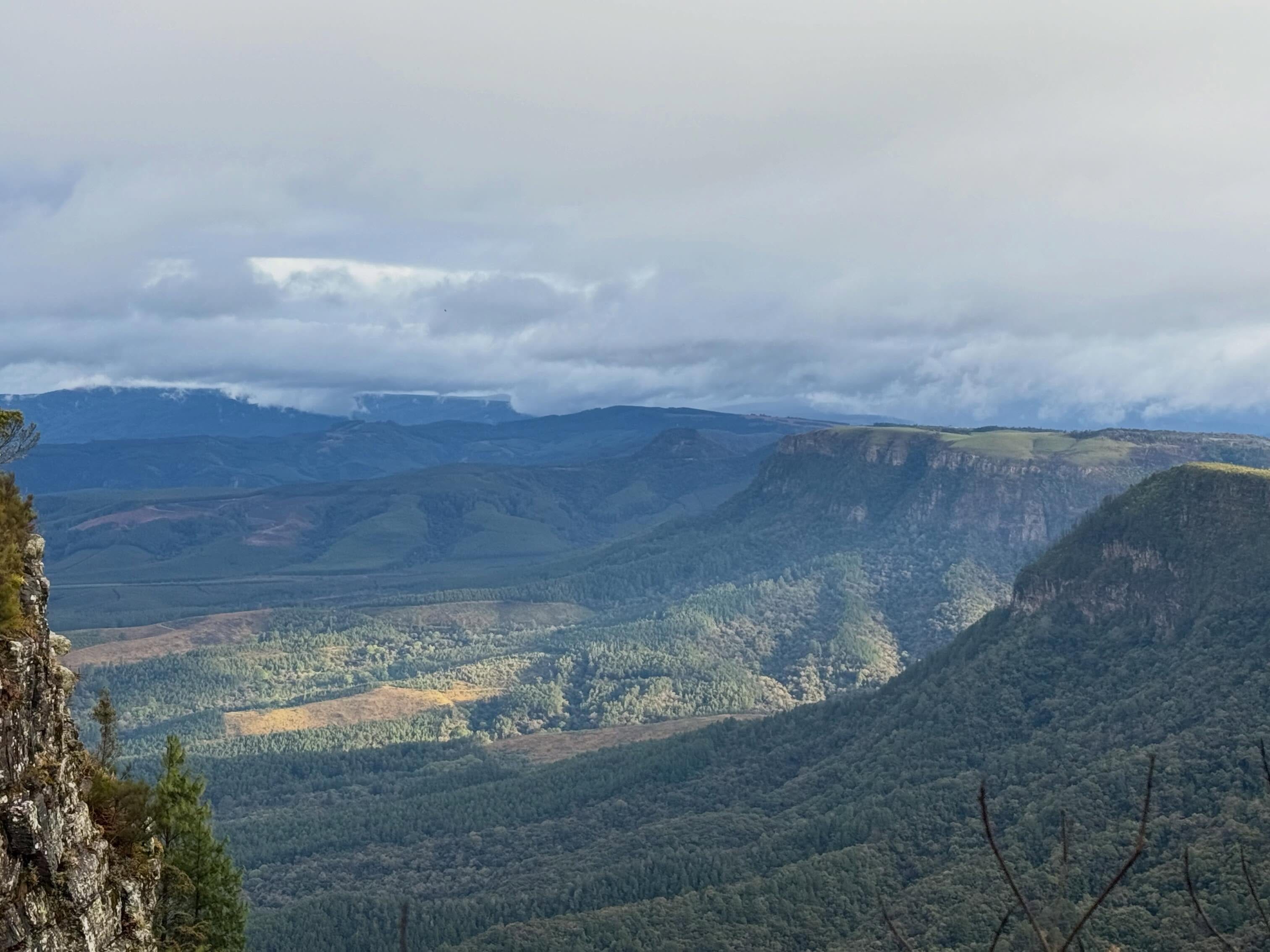
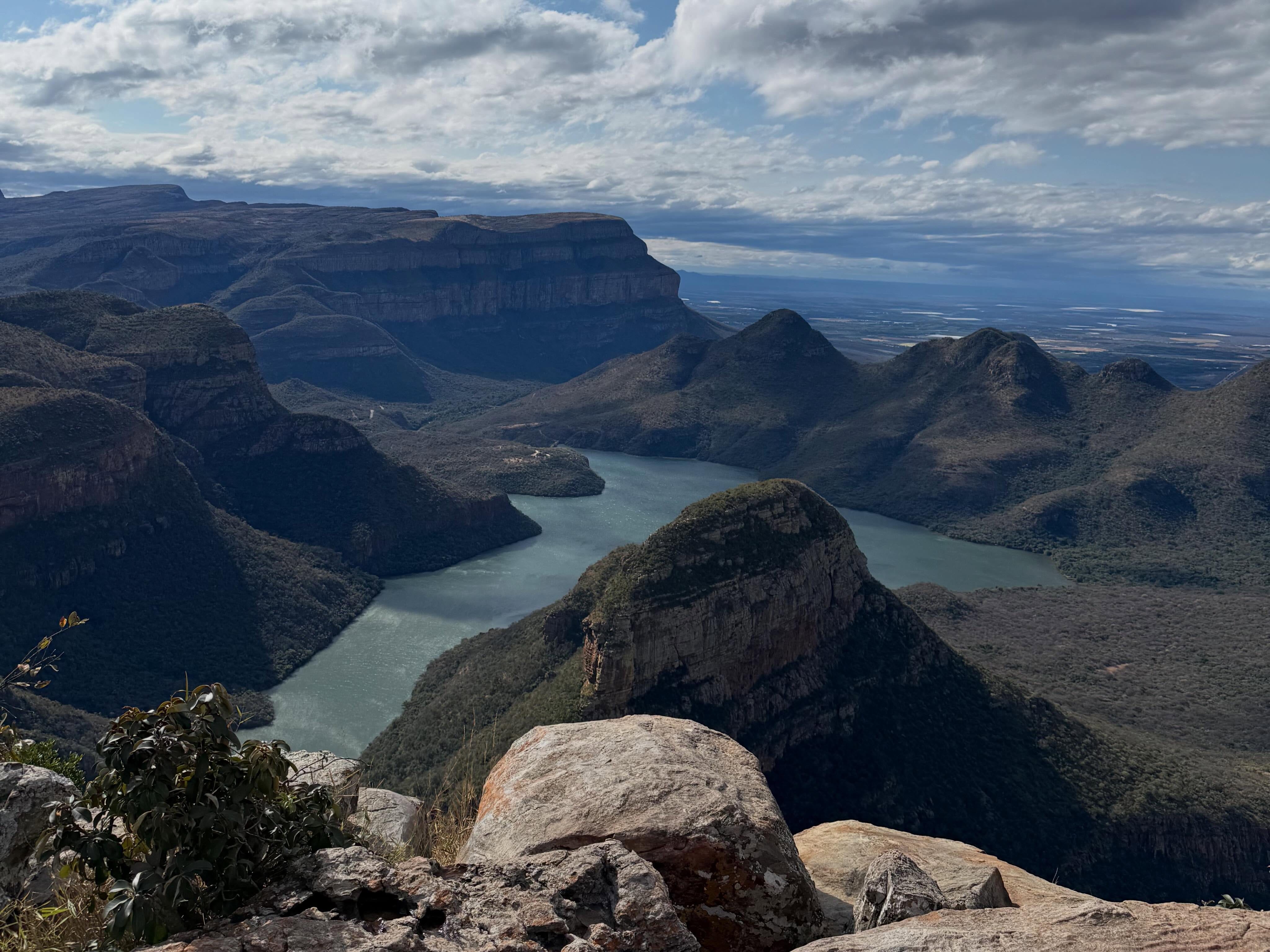
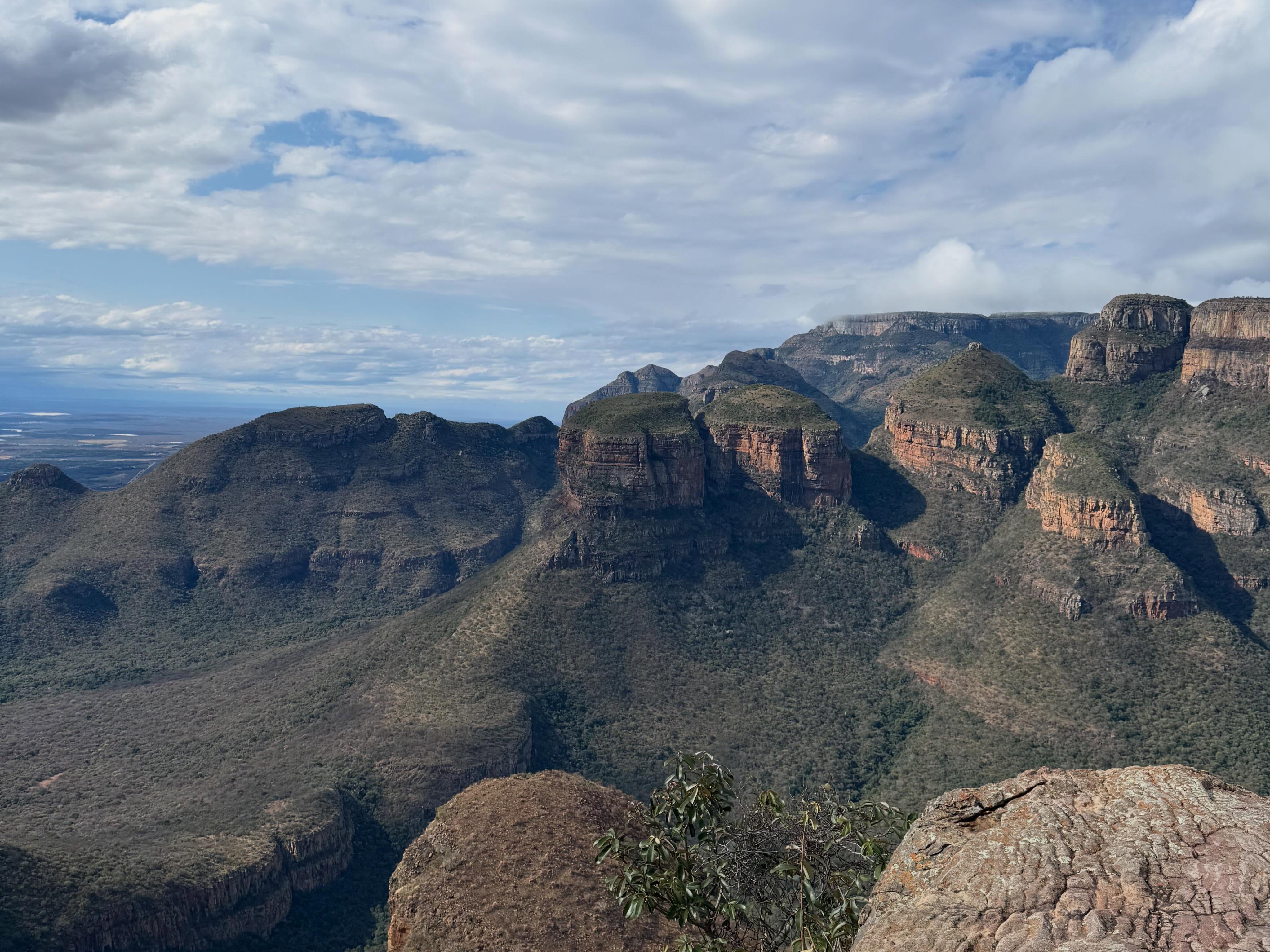
For lodgings, in Kruger, things turned a degree more rustic, but it was certainly not a question of “roughing it.” (It struck me as we arrived at each hotel or lodge that we had no idea what to expect from one to the next. I suppose we could have checked ahead, but….) Our next base was called “Umbhaba Lodge.” That evening we enjoyed a nice “South African dinner.” (Sometimes it felt like all we did was eat, honestly. A few times I turned to Karen: do we really have to eat AGAIN?)
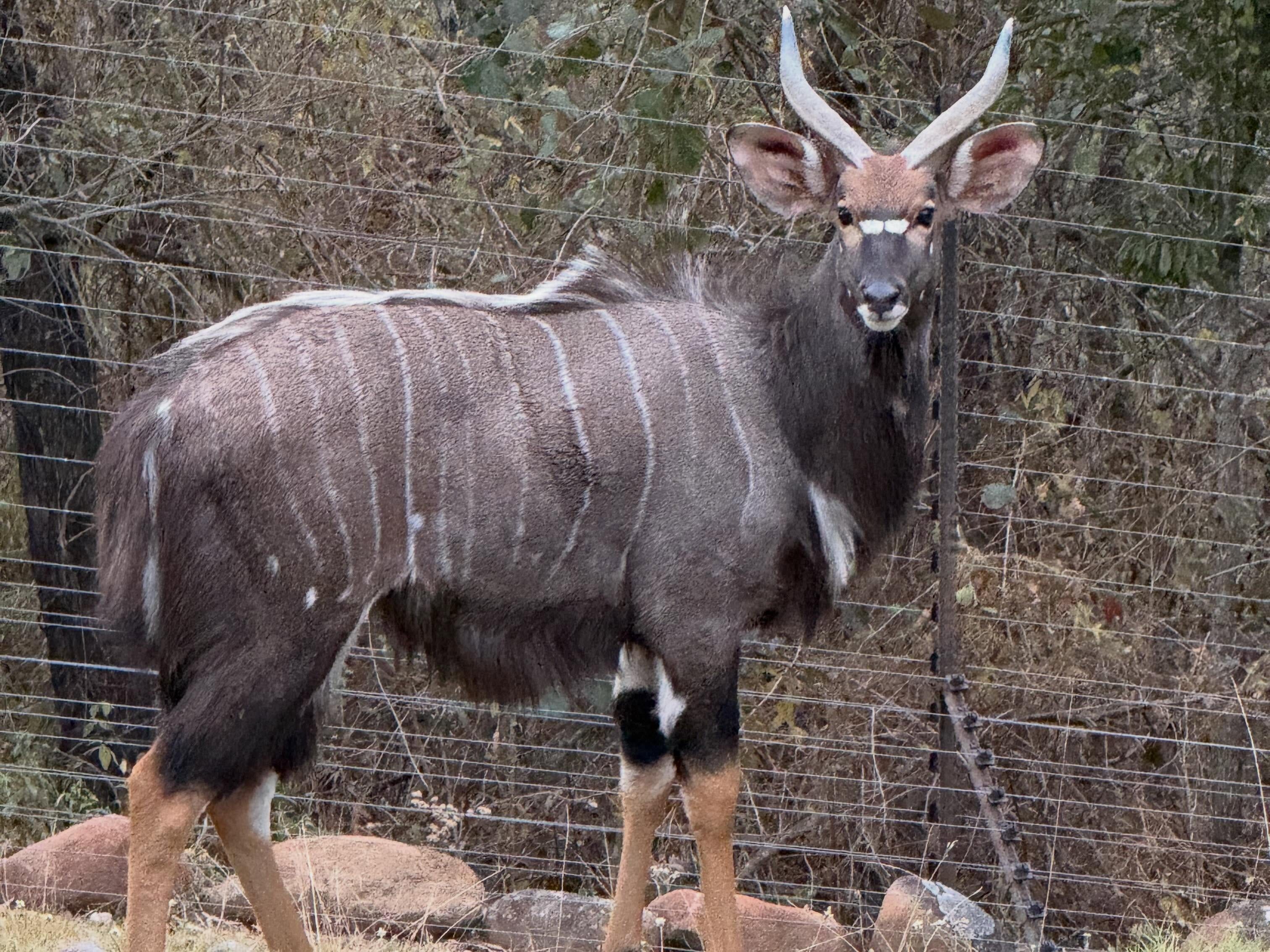
On a walk around the grounds, after dinner, we came face-to-face with a family of nyala. The males looked like patchwork creatures from Oz—I couldn’t help but think of “The Gump” from Disney’s weird and wonderful Return to Oz movie. At first, I thought the nyala were behind the wire fence along the line of the bush, but as we got closer, I saw that this had been an optical illusion. We could hear them breathing, and the big male puffed once with authority and in a tone I didn’t love.
Karen got some close-up pics, but, later Calvin told us that this had been a questionable idea. The males could and would charge to protect their familes. You live and learn. The important thing is that you live, though, and still get a picture of a nyala.
Alive and well-ish, we grumbled awake at five in the morning for a cold-and-rainy, day-long game drive through Kruger, which was a little disenchanting, at first. The rough Kruger roads were as busy with motor vehicles as a Richard Scary book.
The road was semi-paved and rumblingly pocked, bulging in spots (the guides called it the “safari massage”), and jammed with various safari company vehicles, as well as personal cars. The safari guys were clearly pros at navigating the environment, but the private hoopties were obviously their albatrosses, causing log-jams by not knowing how to maneuver. We spent much of the day jostling for glimpses of animals. (“Don’t look at the bush, look through the bush,” Braison had said. I tried, but I was never the first to see anything.)
This wasn’t, yet, the Wordsworthian communion with the Sublime that I had envisioned, but we’d get there in due time. Fact is, though, when true Nature is present, it will resonate down to your bones and pull you out of the present, just as the Grasmere poet always promised.
This trip was a “bucket list” item for my wife, Karen. She’s always wanted to see the animals in Africa up close, having had serious thoughts of moving to Africa to work with animals when she was younger. For me, it was a welcomed adventure—as an experience and as material for later storytelling. Admittedly, it would not have been my first choice for our next big trip, but I would never have passed up the chance at the adventure. Besides: what kind of a husband would not want to be present to witness his wife’s happiness in achieving a lifelong desire? The trip, for me, was fulfilling in many ways, but its greatest moment was being “surprised by joy” on that day.
We were lucky enough to witness a herd of elephants patiently parading through the bush and out over the road, passing only feet from the truck, ears slowly flapping like great and ancient sails, their trunks swinging languidly or daintily reaching to cull a quick snack from the branches.
If any animal fits the definition of “magnificent,” it is the elephant. But it has to be the elephant of the savannah, not the elephant of the zoo. The elephant of the zoo is diminished by captivity. There is sadness in the elephant of the zoo and there is a mist of defeat shading its eyes. In the realm of the savannah, the elephant is the true benign and all-powerful monarch. Self-assured and unafraid, but peaceful and gentle, it radiates wisdom. Whether that wisdom comes from the poetic view we humans have of them, or whether the poetic view we have of them comes from their true auras, I will never know. What I do know is that they unexpectedly moved my heart the way a beautiful piece of music does…when there is a powerful swell in the orchestra that lifts the top of your head off to let your soul fly around the room (as Emily Dickinson once described it). My eyes filled with tears at first sight.
At that same moment, Karen, already in tears, leaned over to hug me. Her head fell briefly on my shoulder. We share good hugs on a regular basis, but that hug was another thing, altogether.
See, you do these things together when you are married. You support your spouse…and his or her joy actually becomes yours. Your souls are married in this way, if you’ll grant me an on-the-nose point. You don’t just have feelings at the same time, you share feelings within the space of a heartbeat.
At that second, every headache of planning and travelling for this trip became worth the frustration, and, all at once, there was nowhere in the galaxy I would rather have been.
Karen and I really only call each other one thing on a daily basis: “Pal.” Early on, we’d not only become best friends by accident, but we decided to cultivate that as a marriage philosophy. She hugged me because we are pals, and pals are there for each other. Pals stretch out of their comfort zones for each other. The hug was a “Thank you for being here” and a “See, what did I tell you?” all at once. It was a truth.
I’m not in any way trying to imply that I’m this great guy for “tolerating” a trip that was not my first choice. I am a winner in this scenario, too, for having had the privilege to be there. Karen has been so good for me in so many ways, but one of them is in pulling me into corners of life I would otherwise have let slip by, both physically and mentally. I think we have done this for each other over the years, in various ways.
So, I am not bragging about having done this “for her”—it was as much for me. We both were augmened by this experience, believe me. I have lived a life defined by a constant quest to know and to feel and to capture things in writing and music. This was the first moment in which I felt Africa herself and it was as much because I was with Karen as it was because I could have pressed my palm on the grey body of an elephant.
In that moment, a strand of energy threaded from the heart of Africa, through the ocean-deep elephants’ eyes and into the hearts of one couple’s embrace. You just don’t get that in front of the TV.
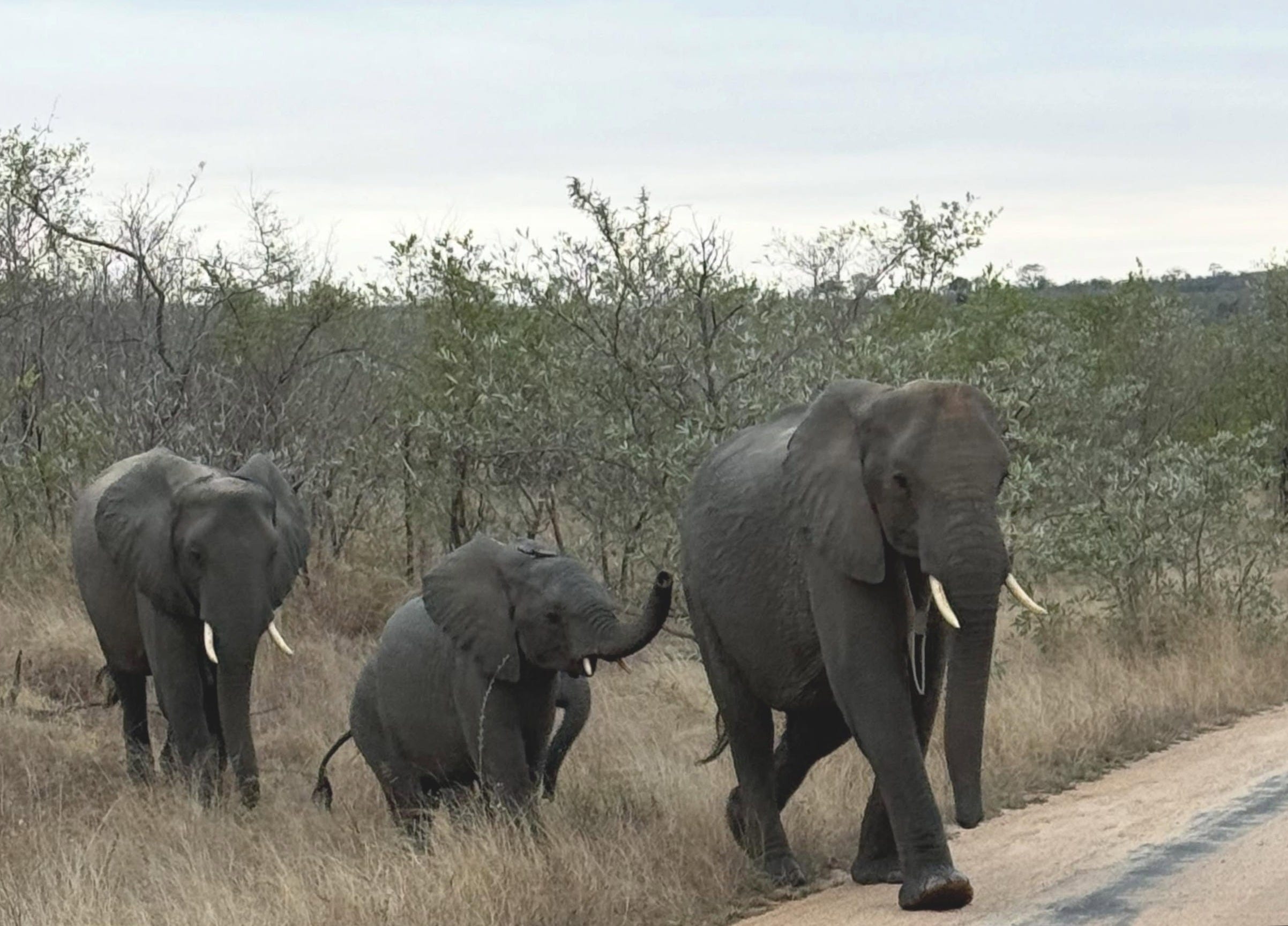
With all that said, in the course of that day, the wildlife we witnessed seemed endless: giraffes (who always look just a tad offended), a baby hyena (that timidly sniffed our truck’s wheels), wild dogs fresh from a kill, slathered in blood, hippos (those tiny ears are one of God’s funniest bits), crocs, lionesses, wildebeests, monkeys, baboons, etc. There was no shortage of sightings, and it almost made you forget the smell of diesel and the shrieking brakes.
I was a little annoyed by how crowded the savannah road was with cars, sure, but I was also delighted by the drivers’ exchanges as they waved, fist-bumped and discussed (in a language I couldn’t understand) where the best places for animals were. Were they selfless buddies? No. Tips might depend on how happy their passengers were with what they saw, so they were helping each other make a living. They were colleagues.
(Tips. There were tons of tips everywhere we went. We might have spent a thousand American dollars on tips, alone, during the two weeks.)
As we sped down back to the lodge on paved roads in the open truck, our faces being playfully buffeted by a strong but pillowy wind, swaying trees that looked like bushmen on the hunt stalked along the side of the road. I smiled at Karen and she squeezed my arm. We had come to see animals, and boy had we.
But the real safari experience (at least as I see it) was awaiting us in Karongwe Private Reserve on the next day.
Day 7 and 8
We left Umbhaba Lodge at nine in the morning for a three-hour drive to Karongwe. Our new lodgings brought us a conga beat closer to dancing the ol’ rustic mambo. This one was called Chisomo Safari Camp. (“Chisomo” means “blessings.”) Here, our “rooms” were free standing, wooden-framed tents of thick canvas. Of course, the canvas walls all almost led to some Buster Keaton comedy moments when I’d forget and casually try to lean on them while brushing my teeth…
The tents were well-appointed, though, with a fridge and shower, toilet, etc., but it felt a little more like being “out there” now. We were surrounded by nature. Our front door opened onto a deck that overlooked a grassland area in which we’d see giraffes and kudu doing their daily things.
At the orientation (you needed one, here) we were clearly instructed not walk without a staff member back to our tents at night because of the possibility of animals stalking a midnight snack and we were also told not to leave the doors unlocked because the monkeys would open them ransack the place. And speaking of monkeys…those criminal elements of the animal kingdom…
I really should have been better prepared. I should have asserted myself. Hadn’t Braison warned us? Hadn’t the staff?
Lunch was buffet style on a kind of open-air dining deck that was sheltered by a thatched roof (as were all the structures) but the sides were open to panoramic views, fresh air…
…and monkeys.
I saw him clearly: a saucy little chap: a vervet monkey. He was sitting about thirty feet away, perched on the intersection of the rail on the far end of the dining area, plotting. Scheming. Evil on the inside…adorable without. Formulating a devious blueprint for a heist. Concocting his battle plan. From that distance, he looked small and maybe even cuddly…
“How cute,” I thought, like a lummox from New Jersey. I gave him a vacuous grin wqhen I should have given him the business.
“They are crrrrriminals.” Sure, I hear it now, but at that moment, I had forgotten the warnings from people who lived there, harassed daily by these mafioso primates; these vine-hugging mini-Kongs; these imps with boopable snoots. I can almost see that little thug tilting his head, grimacing at me like a fuzzy Dirty Harry. “Cute? You think I’m cute? Funny how? Funny like a clown?”
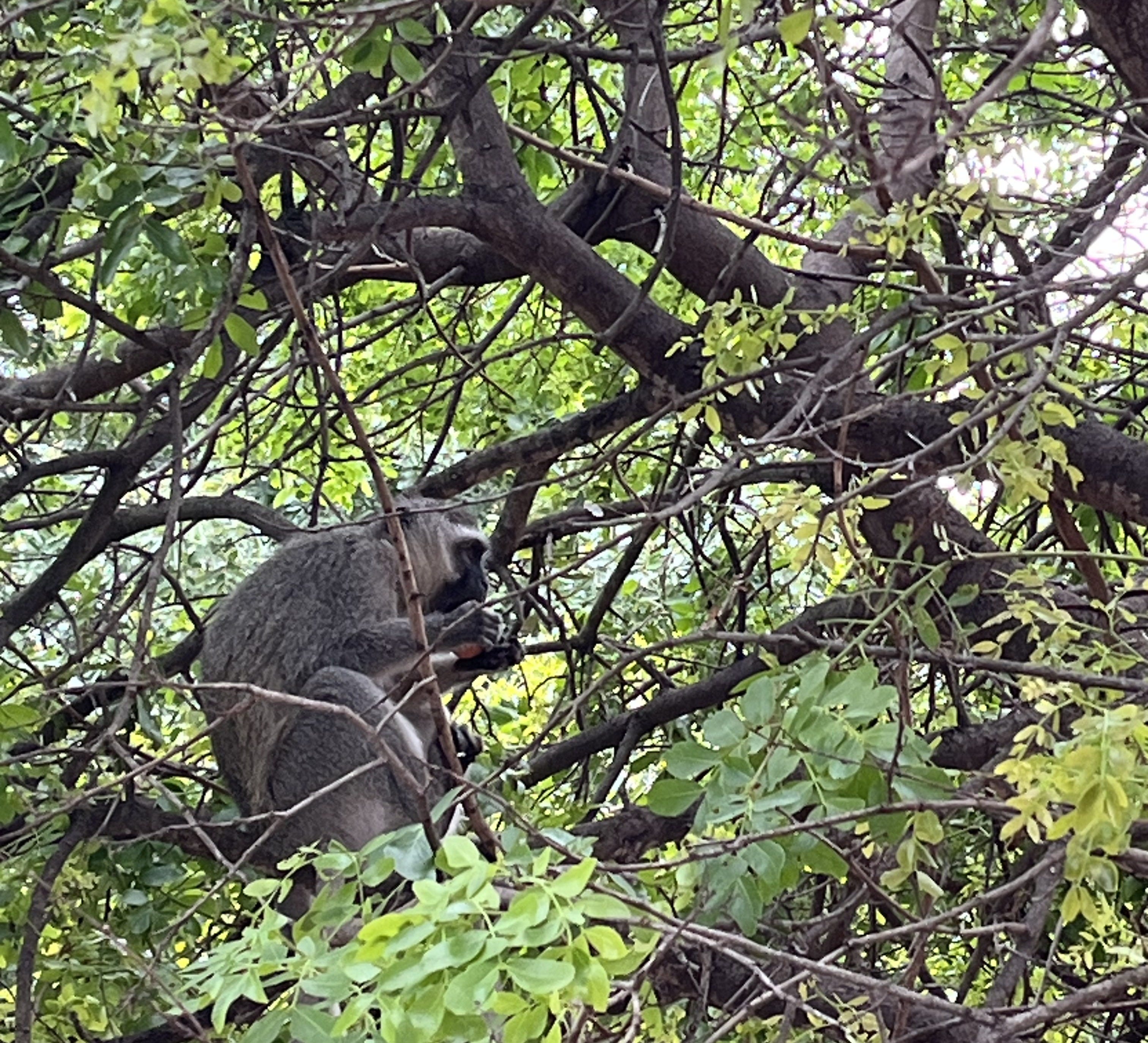
But, no…I grinned like a two-bit tourist, and I took my eye off of the little fiend.
I should have run at him, flapping napkins, to eliminate the threat, but I dropped my bag near my chair and went to load up on grub. As I was walking away, Jordan set her plate at the spot next to me and then went to get a drink, also forgetting the menace. Returning, I sat to eat…
…and there he was, quicker than a cricket fart: The Thief. He pounced, sending up a tinkling rain of spinning silverware, his dirty little opposable-thumbed feet briefly gathering up the alabaster tablecloth for balance.
Cut to slow motion as I turned, eyes wide, my cheek puffed full of roast potato, as he locked eyes with me, swiping up a dinner roll blindly from Jordan’s plate. I swear, in that moment, I could hear him mumbling tauntingly…in English.
Time froze over the course of three heartbeats, and his face elocuted what his monkey tongue could not, eyes narrow as a movie cowboy’s at high noon: “What are you gonna do about it, human? Heh? Heh? [Taps his metaphoric six shooter handle wth a fingertip]. That’s what I thought. Evolution, schmevolution! THE ROLL IS MINE!”
Before I could say, “Hey, stop right there, you…” he clambered along the rail and onto a branch, gnawing on his baked booty and grinning a two-toothed grin, crumbs raining down like celebratory fireworks. Wasteful? So what?—he knew he could do it again anytime. He was a befuzzed Ninja. A four-handed pilferer.
Had I seen a single primate middle finger pointed brazenly upward as he absconded through the bush? Was there the fading echo of demonic tittering trailing behind his egress like an invisible kite’s tail?
Criminal. Very naughty.
Our first game drive in Karongwe happened that afternoon and ran until nightfall. This was more like it: the nature experience I had pictured. The bush was thicker and more remote-feeling here, and the dirt paths were so close on each side of the truck that we’d have to duck at times to avoid face-whippings. When the engine was shut off to watch, the silence was complete.
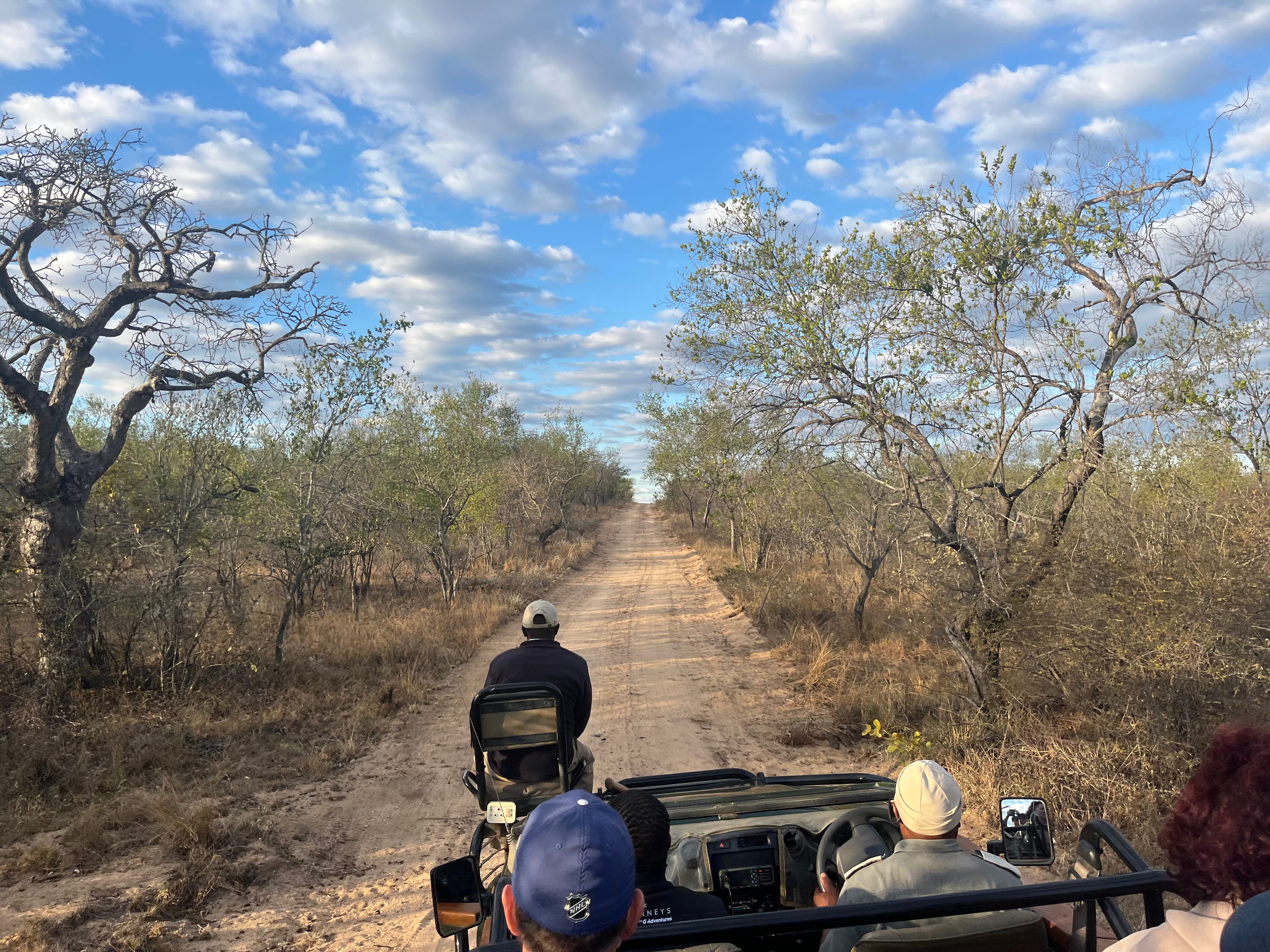
Our driver was Freddie and, at the very front of the truck, on a bolted-down chair at the end of the hood our tracker, Oriole, was perched. Our group split up, and in our truck were Karen, me, Carol and Debbie, Paul and Michelle and David. It felt now like we were truly in the bush…dirt roads, only occasional contact with other vehicles. There was no roof on this truck, so the visibility was complete, opening to view that would have given Montana sky-envy.
At first, we cruised for maybe an hour and saw a few zebras and a giraffe. But then we spied about ten imposing vultures, their wingy shoulder pads high up on either side of their faces, standing like goth club bouncers in a naked tree. This meant, of course, that there must have been a carcass nearby. And if they were not picking at it, that carcass was likely guarded by something bigger. Something cooler.
Sure enough, we found it: an ex-giraffe that had been thoroughly munched by lions leaned against a tree, as if in the middle of a fall, its rib cage gracefully but gorily curling upward from the blackened spine like slats in the frame of a great medieval ship under construction. The poor fellow had been picked mostly clean, except for the legs, which seemed nearly untouched. The giraffe’s offal was melting into a fly-orbited soup in an indentation at the base of its extended neck.
He must have been older, Freddie said. Lions don’t usually take down young giraffes. Still, it was hard not to feel sad for any giraffe—maybe the sweetest-looking animals on the savannah. They live their lives with a kind of gently awkward gracefulness, enemies to no one but the odd leaf.
Then Oriole spotted them: The Brothers. They were camouflaged by the waving pale grass: two male lions who had, according to Freddie, been kicked out of the pride and were fending for themselves. The two lads were stretched out, loafing in a post-feast state of half-coma bliss, stomachs merrily bulging.
We all thought this was cool enough, but then, maybe after wondering for a minute if he could pull it off, Freddie went off-road. I hadn’t expected this, but he expertly curled around behind the lions, driving where there wasn’t the slightest path, and brought us to within five feet of them.
He cut the engine. In absolute silence, some took pictures. I just watched the animals so that I could do later what I am doing now: tell you about it. Karen takes better pictures anyway:
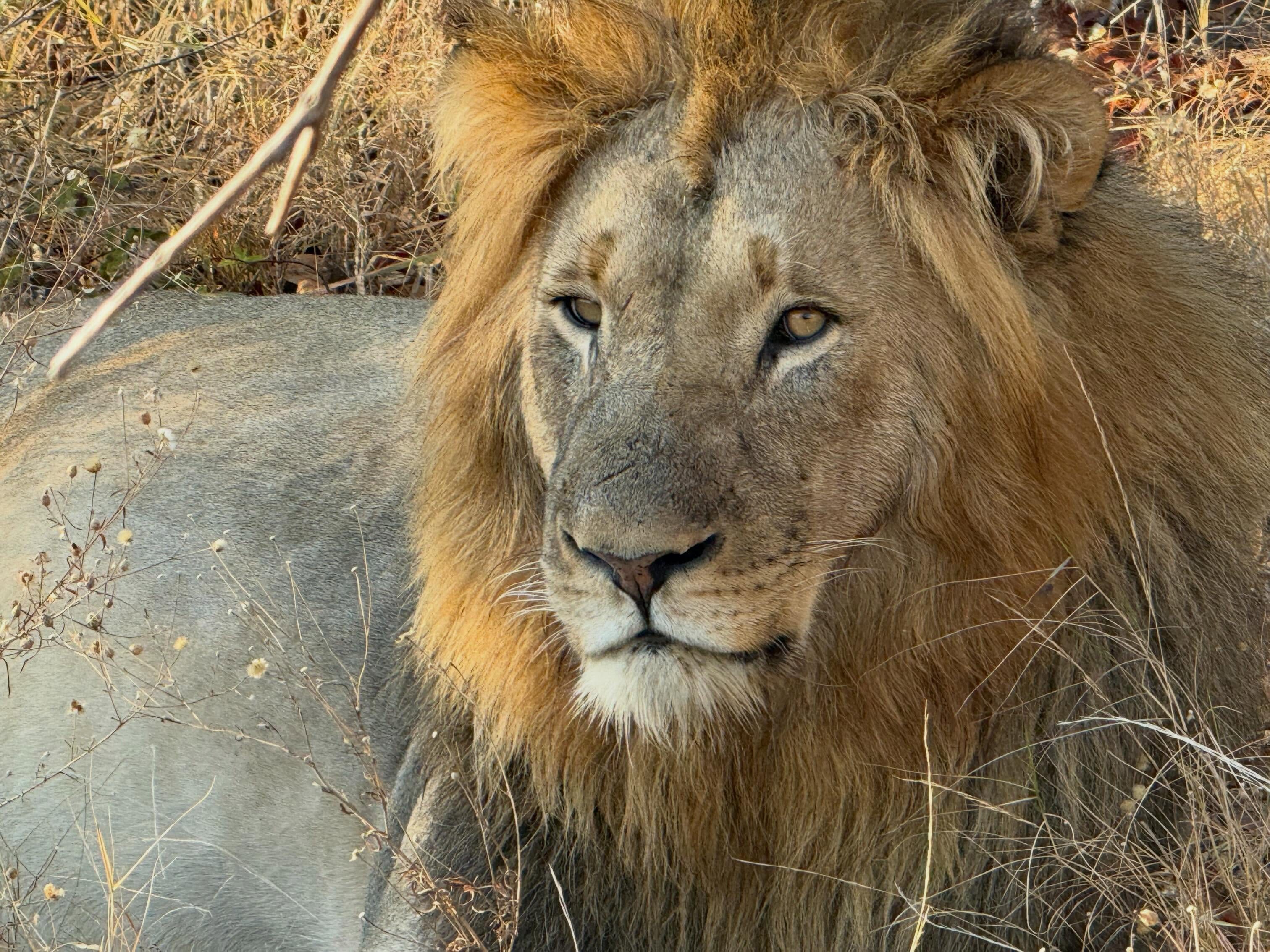
Again, I felt the wonder of the moment rising in tears and a clenched throat. Karen was wiping her eyes as she took pictures. To be so close to these fearsome creatures was way more powerful than I had expected, even after the elephants. We’d seen lions the previous day, but not three steps away from the truck…
Occasionally, the young lads would lift a new-maned head and lob a lazy side-eye at us, but they really had no interest, even though we were close enough to smell their coats. Freddie explained that lions see the truck and those in it as one big [and, thankfully, inedible] form. They would show no interest unless one of us were to suddenly jump up.
I have told a few people about this experience, and they have mostly reacted with either, “You’re crazy,” or some variation of, “Nopenopenope.” I get it, but the whole thing does prompt another philosophical reflection about fear.
I mentioned earlier that fear can be an exaggeration of caution. Of course, it’s is an instinct that is meant to keep us safe, so it can be necessary. (I can’t help thinking about another movie, the animated caveman movie The Croods, in which the father [Nicholas Cage] obsessively reminds his family to “never not be afraid.”)
The problem is, though, that when something is unknown to us, we tend to generate an excess of fear. The proverbial mountain of unfamiliarity, paradoxically, tends to look bigger the farther away from it we are. We think: lions are powerful and they kill and they rip things to shreds; therefore, it’s prudent never to be near a lion. It all makes perfect sense. Those majestic and powerful felines surely deserve all the respect we can give them.
I can say, though, that I never had a moment’s fear in their presence. I don’t think you (or my friends above) would have either. They hunt what they know: kudu or impalas or giraffes, etc. We’re not in their wheelhouse up in that jeep and we’re not on their normal menu, even if there is always a slim possibility of an issue.
Is there any danger? Let’s not be stupid: sure. A little. About 200 people per year are killed by lions in Africa, but these are usually residents. One or two deaths per year are tourists. Could it happen that some dweeb stands up in a Jeep yelling, “Here, kitty-kitty” and, consequently, becomes an oversized Fancy Feast (not to mention further proof of the validity of natural selection)? Of course. But that is usually what it comes down to: operator error. I am not a thrill-seeker (you wouldn’t catch me bungee jumping or skydiving), but I am willing to take a proportional risk to see something most people never see; to have an experience that will remain in my heart and on my mind for the rest of my life.
Too much of modern thinking (and even psychological analysis, as far as I can tell as a novice) assumes across-the-board sameness between people’s thinking. Your “risk” might be to become a trial lawyer even though you have a deep fear of public speaking; someone else’s might be going to college after years away from the books; a person who becomes a police officer accepts a very real level of risk every day. Only you can decide what is an acceptable risk. All I can say is that seeing these creatures in their natural environment was a life-affirming experience for me. If there was risk involved, it was worth it. And, really, all I want, in the end, is to gather stories to tell and memories to play back when I’m bored.
As I said, I never had a second of fear on safari. I’d been more worried about airplane mishaps and unsafe drinking water than of becoming a savannah chew toy. (We had tablets for the water…be not scared…be prepared… [Hey, I like that!])
At any rate, the safaris (all four of them) were fantastic. Even when we went long stretches without seeing many animals, just to be out in the bush was a joy. At each day’s end, we’d meet the other truck in a clearing to share stories and watch the sun set over drinks provided by our guides. Then, we’d drive back to the lodge in the complete darkness, Oriole shining a powerful, hand-held spotlight into the trees and brush—left, right, up, across, down—to catch the glow of a possible animal’s eyes. We only saw one little civet in the darkness over the course of those night runs, but the visuals left a modern art imprint of speed, light and shadow in my mind. They were some of my favorite moments of the trip.
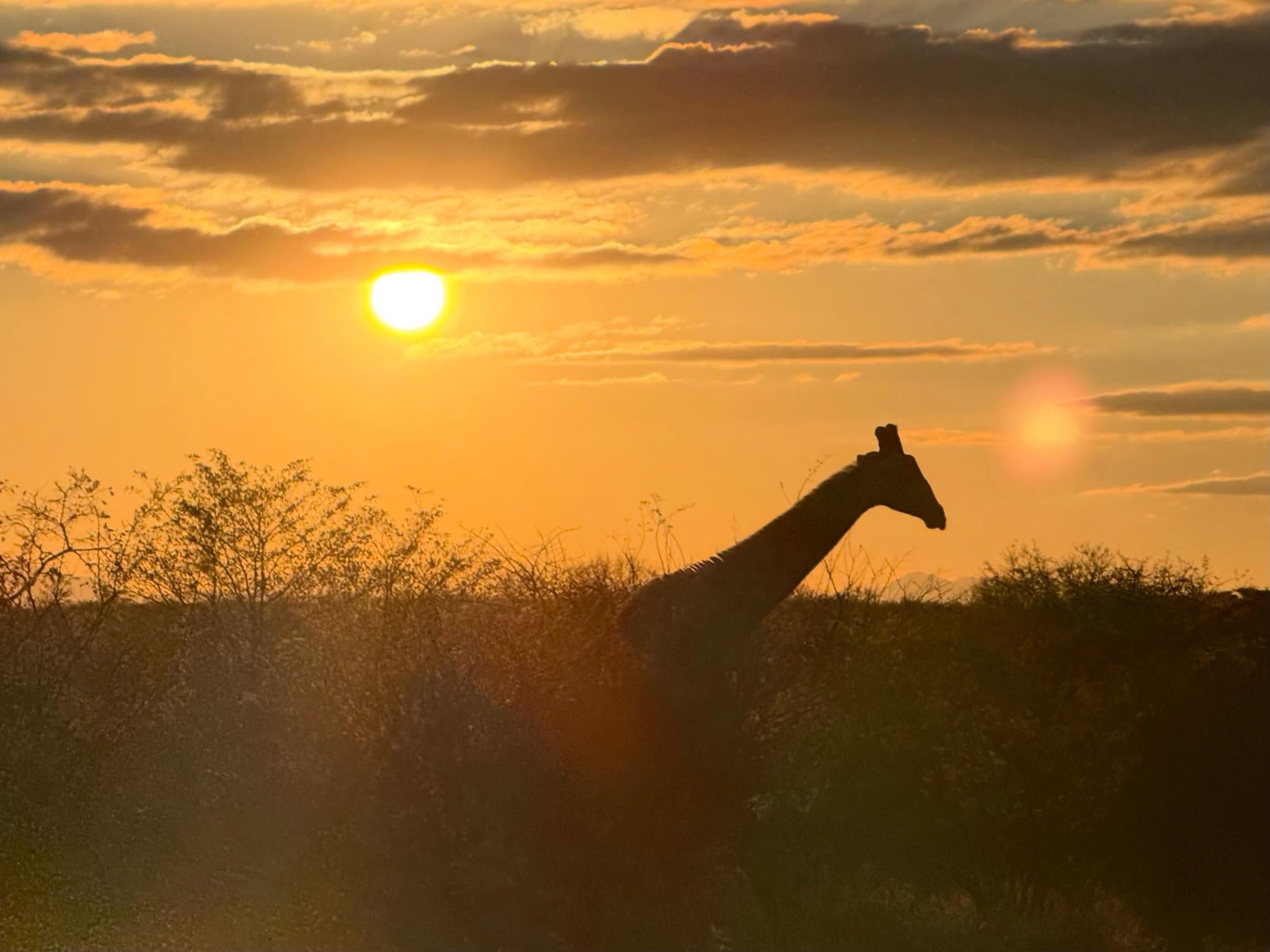
In short, Karongwe was pure bliss and adventure for several days, in the best of our lodgings.
The final stage, in part three, would be Zimbabwe and Zamvia, land of Dr. Livingstone, where we’d see natural wonders, dine in a Zimbabwean home, jam with African drummers and…well…eat worms…
