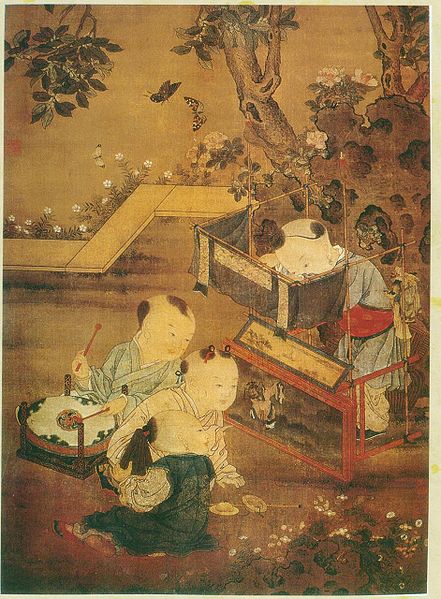
I was lucky to become an instant hero, nine years ago; and then, again, seven years ago. I became a hero the moment my boys were born.
You see, I was the best thing going, from the second they opened their eyes -- the strongest, smartest, funniest guy they had ever seen. Presto!
Then, after the first week or so, I became The Mysterious Adventurer who would step out into the dark of the morning -- into the mists of a world they had never seen -- and, then, who'd reappear at dinner time, smile and toss the lads into the air and snuggle with them and read them stories before putting them to bed. I'd sing a lullaby I'd written, just for them. I was the break in the daily routine; I was the goodnight kiss; I was the one who could help them defy gravity, effortlessly.
During my work day absence, their mom would deal with the crying fits and the day's majority of diapers and the naps and the mealtime struggles. She'd do all the hard stuff, then Daddy would whoosh through the door and prance about like a victorious knight come home to lead a merry parade of three around the living room.
Wednesday, October 5, 2011
Monday, October 3, 2011
Moments of Light for the Blind?
Posted by
Chris Matarazzo
at
6:30 AM
The day my wife, Karen, and I were married, everyone asked: "Do you feel different?" No, I didn't. She and I were married the day we fell in love, I always felt. My love for her, before and after the wedding day, until this day -- and, I'm sure, beyond it -- feels more profound than it did when we were all duded up and sweating under too much cloth in front of too many people who we wouldn't have invited if we had really had a choice. (By the way -- I'm not talking about the spiritual union; I'm talking about the trappings of the celebration and ceremony. The spiritual side has an importance beyond mere ceremony.)
My high school graduation? Didn't care in the least.
College gradation? Didn't go. Grad school? Got the diploma in the mail.
I was told by many wise people that I would regret not having attended these graduations. So far . . . um . . . nope.
Everyone, including me, always talks about living in the now. Maybe I do it too well -- that is, if having no real feeling of connection to ceremony is a fault. But it means little to me, especially ceremony that marks transitions. I simply tend not to care.
I can't make these occasions, with their canned speeches and their nearly scripted reactions and their homogenizing atmospheres, feel special.
My high school graduation? Didn't care in the least.
College gradation? Didn't go. Grad school? Got the diploma in the mail.
I was told by many wise people that I would regret not having attended these graduations. So far . . . um . . . nope.
Everyone, including me, always talks about living in the now. Maybe I do it too well -- that is, if having no real feeling of connection to ceremony is a fault. But it means little to me, especially ceremony that marks transitions. I simply tend not to care.
I can't make these occasions, with their canned speeches and their nearly scripted reactions and their homogenizing atmospheres, feel special.
Friday, September 30, 2011
Aristotle Jones: Personal Archaeology for Teens
Posted by
Chris Matarazzo
at
6:30 AM
Every year, around this time, I assign a paper to my high school seniors. It is called "The Learning Experience." In the paper, the kids write about a change in their perspective on something in their lives. It can be anything. One student might write about the day he discovered he liked onions. Another might write about the day he realized his mom was a good mom, even though she was strict. Another might choose to write about a calling to the priesthood, for all I know.
It is an assignment that satisfies the need to expose the students, from a writing standpoint, to some important Aristotelian modes of rhetoric, namely: process analysis, narration and description. But, more importantly, it forces these young people to learn something about themselves -- another branch of old Aristotle's areas of interest.
It always surprises me how lost they look when I ask them to do this. It scares me, a little, year-to year. But, when it is all over, my conclusion is always the same: a) most people regard themselves as a bag of sand that just walks around doing stuff and b) with only the slightest prompt, these same people can learn dig in the sand and find important artifacts -- learn to do enough personal archaeology to step onto the path that leads away from "the unexamined life" that Aristotle, himself, warned against: "The unexamined life is not worth living."
It is an assignment that satisfies the need to expose the students, from a writing standpoint, to some important Aristotelian modes of rhetoric, namely: process analysis, narration and description. But, more importantly, it forces these young people to learn something about themselves -- another branch of old Aristotle's areas of interest.
It always surprises me how lost they look when I ask them to do this. It scares me, a little, year-to year. But, when it is all over, my conclusion is always the same: a) most people regard themselves as a bag of sand that just walks around doing stuff and b) with only the slightest prompt, these same people can learn dig in the sand and find important artifacts -- learn to do enough personal archaeology to step onto the path that leads away from "the unexamined life" that Aristotle, himself, warned against: "The unexamined life is not worth living."
Wednesday, September 28, 2011
The Way-Forward Machine
Posted by
Chris Matarazzo
at
6:30 AM
By combining a lot of clock-springs, some cogs and some torn-up poems with a quirky melange of sprockets, love letters, campfire scents, tunes played on bells and crumpled appointment notes and by mounting these things on a metallic scaffold dotted with some shiny buttons and containing a screen that constantly prints and deletes an impressive series of deucedly latinate words, I have created a machine for entering the future. The problem is that this it is a subjective and preferential machine.
See, it only takes the young on journeys and, then, only to their dream careers. What it does is it drops teenagers smack into the middle of their projected desires. It allows them to experience said desire for one month. Thus, they can spend that month as a rock star; as a research scientist; as a novelist, as a doctor; as a priest; as a dancer; as a professional skate-boarder; as a housewife; as a wealthy writer of sonnets; as a tribal chief; a reporter or a linguist . . . anything they can conjure -- any career they wish.
For one month, they can see what it is going to be like.
See, it only takes the young on journeys and, then, only to their dream careers. What it does is it drops teenagers smack into the middle of their projected desires. It allows them to experience said desire for one month. Thus, they can spend that month as a rock star; as a research scientist; as a novelist, as a doctor; as a priest; as a dancer; as a professional skate-boarder; as a housewife; as a wealthy writer of sonnets; as a tribal chief; a reporter or a linguist . . . anything they can conjure -- any career they wish.
For one month, they can see what it is going to be like.
Monday, September 26, 2011
Fire Bundles
Posted by
Chris Matarazzo
at
6:30 AM
When are we grown-ups ever going to learn? We fret and fret over the things we put before our kids -- what we're doing right and what we're doing wrong -- and we toss and turn, worrying if we're crushing their creativity and initiative; whether the modern world is stealing their hearts away . . .
Of course, when I say "we" I mean "me" -- and maybe you, too?
But this morning, a misty Sunday with the absent sun returning for the first time in days to light up the droplets into diamonds on the grass, the smell of autumn earth as pleasant to me as the scent of a cake in the oven, I heard my smallest boy explaining something to his mother.
He was playing a "Toy Story" game on his fancy-schmancy portable gaming unit, and he was saying, "Mom -- I'm pretending this is "Silly Sheepies" (a show my sons put on with their stuffed animals during their weekend "sleep-overs" together in one of their beds) and they are trying to put Sheepie in the sheep-pound but Sean is trying to rescue them and . . ."
Of course, when I say "we" I mean "me" -- and maybe you, too?
But this morning, a misty Sunday with the absent sun returning for the first time in days to light up the droplets into diamonds on the grass, the smell of autumn earth as pleasant to me as the scent of a cake in the oven, I heard my smallest boy explaining something to his mother.
He was playing a "Toy Story" game on his fancy-schmancy portable gaming unit, and he was saying, "Mom -- I'm pretending this is "Silly Sheepies" (a show my sons put on with their stuffed animals during their weekend "sleep-overs" together in one of their beds) and they are trying to put Sheepie in the sheep-pound but Sean is trying to rescue them and . . ."
Subscribe to:
Posts (Atom)